Solutions and Titration
Senior 5 · Chemistry
Solutions and Titration
Lesson 4 of 5
25 min
Potassium manganate(VII) is not the only oxidising titrant. Potassium dichromate(VI) is a primary standard, which manganate(VII) is not, and it is still the basis of the chemical oxygen demand (COD) test that water laboratories use to measure organic pollution. Iodine is a much gentler oxidant, and iodide ions are a mild reducing agent; between them they let you measure vitamin C in juice, chlorine in bleach and copper in an ore. The price is that neither titration can show its own end point clearly: you need an indicator.

Definition
Dichromate titration: a redox titration with acidified potassium dichromate(VI), (orange), which is reduced to (green).
Iodimetry: direct titration of a reducing agent with a standard iodine solution, e.g. vitamin C.
Iodometry: indirect determination of an oxidising agent: the oxidant reacts with excess iodide to release iodine, which is then titrated with standard sodium thiosulfate.
Starch indicator: forms an intense blue-black complex with iodine (as ); the colour appears or disappears at the end point.
With iron(II), which gives one electron each, the ratio is 1 : 6:
| Feature | ||
|---|---|---|
| Primary standard? | no | yes |
| Electrons gained per ion | 5 | 6 |
| Indicator | none (self-indicating) | sodium diphenylamine sulfonate: green → violet-blue |
| Hydrochloric acid allowed? | no, oxidises | yes in dilute acid (a weaker oxidant) |
| Stability of solution | decomposes slowly in light | stable for years |
Phosphoric acid is usually added with the indicator: it forms a colourless complex with , which sharpens the end point.
Iodine is only slightly soluble in water, so "iodine solution" is iodine dissolved in potassium iodide, where it exists as the brown ion. The key titration reaction is with thiosulfate:
Thiosulfate is oxidised to tetrathionate; two thiosulfate ions give up one electron each. Iodometry uses this reaction to measure an oxidant indirectly:
| Oxidant | Reaction with excess iodide | mol per mol oxidant |
|---|---|---|
| iodate(V) | 6 | |
| copper(II) | 1 | |
| chlorate(I) (bleach) | 2 | |
| hydrogen peroxide | 2 |
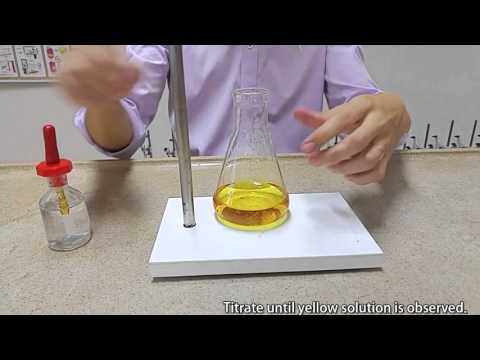
Figure 11.5: Colours in an iodometric titration. Starch is added only near the end point.
Why add starch late? With a lot of iodine present, the starch–iodine complex forms so strongly that iodine is released only slowly, and the end point is overshot or blurred. Adding it when the solution is pale straw-yellow gives a sharp change from blue-black to colourless.
Iodimetry works the other way: standard iodine is run from the burette into the reducing agent with starch already present, and the end point is the first permanent blue-black. Vitamin C (ascorbic acid, ) reacts 1 : 1: .
Worked example
Problem. 25.00 cm³ of an iron(II) solution needs 20.15 cm³ of 0.01667 mol dm⁻³ . Calculate .
Solution.
Worked example
Problem. (a) 0.1070 g of potassium iodate(V) (M = 214.00) is dissolved, excess KI and dilute sulfuric acid are added, and the iodine released needs 30.00 cm³ of sodium thiosulfate. Find the thiosulfate concentration. (b) 10.00 cm³ of household bleach is diluted to 250.0 cm³; 25.00 cm³ of this, with excess KI and acid, needs 16.10 cm³ of the same thiosulfate. Find the concentration of in the bleach and the mass of NaClO per dm³ (M = 74.44).
Solution.
(a) ; ; :
(b) ; in 25.00 cm³, so in the 10.00 cm³ of bleach:
Answer: (a) 0.1000 mol dm⁻³; (b) 0.805 mol dm⁻³, about 60 g of NaClO per dm³ (6.0 % mass by volume).
Warning
Chromium(VI) compounds are toxic and carcinogenic. Use the smallest amounts possible, wear gloves and goggles, never handle the solid powder outside a fume cupboard, and collect all chromium waste for safe disposal; never pour it down the sink. First aid (CDC/NIOSH Pocket Guide, chromic acid and chromates): eyes, irrigate immediately; skin, wash with soap and flush immediately; swallowed, get medical attention immediately.
Never mix bleach with acid outside a small, controlled titration: the two release chlorine gas. Iodine stains and irritates skin.
Tip
In iodometry, follow the iodine: oxidant → I₂ → thiosulfate. Write the ratio for each arrow, then multiply. For : 1 → 3 → 6. For : 2 → 1 → 2, i.e. 1 : 1.
tmjc chemistry: Iodometric Titration. Watch the colour run from brown to pale yellow as thiosulfate is added, then the blue-black after starch, and the sudden change to colourless at the end point.
Practice
Sources and credits