Solutions and Titration
Senior 5 · Chemistry
Solutions and Titration
Lesson 1 of 5
25 min
Every titration compares an unknown solution with one whose concentration is already known exactly. A water-quality laboratory checking hardness, a pharmaceutical company checking the strength of tablets, or a school testing vinegar all need that reference solution first. But you cannot simply weigh out sodium hydroxide and trust the label: its pellets absorb water and carbon dioxide from the air while they sit on the balance. This lesson is about choosing a substance you can trust, and about turning it into a solution of accurately known concentration.

Definition
Standard solution: a solution whose concentration is accurately known, e.g. 0.1000 mol dm⁻³ sodium carbonate.
Primary standard: a substance pure and stable enough that a standard solution can be made from it by weighing alone, e.g. anhydrous sodium carbonate, .
Standardisation: finding the exact concentration of a solution by titrating it against a primary standard. A solution standardised this way is a secondary standard, e.g. NaOH(aq) standardised with potassium hydrogen phthalate.
Concentration: in ; mass concentration in = .
Aliquot: an accurately measured portion of a solution, usually taken with a pipette.
| Requirement | Why it matters |
|---|---|
| Very high purity (at least 99.9 %) and a known formula | the mass weighed is the mass of the substance |
| Stable in air: not hygroscopic, not oxidised, does not absorb | the mass does not change on the balance or in storage |
| High molar mass | a larger mass is weighed, so the balance error is a smaller percentage |
| Soluble in water, and reacts rapidly and completely by one known equation | sharp, reproducible end points |
| Good primary standards (M / g mol⁻¹) | Not primary standards, and why |
|---|---|
| anhydrous sodium carbonate, (105.99), for acids | sodium hydroxide: absorbs water and |
| potassium hydrogen phthalate, (204.22), for alkalis | hydrochloric acid: concentrated acid loses HCl gas |
| ethanedioic acid dihydrate, (126.06) | potassium manganate(VII): contains , decomposes in light |
| sodium ethanedioate, (134.00), for | sodium thiosulfate: crystals lose water, solution decomposes slowly |
| potassium dichromate(VI), (294.18) | iodine: volatile |
| potassium iodate(V), (214.00), for thiosulfate |
Figure 11.1: Making up to the mark. Viewing from above or below the mark (parallax) gives a wrong volume.
A known volume of a standard solution, measured with a pipette (or burette), is transferred to a volumetric flask and made up to the mark. The amount of solute does not change, only the volume:
Worked example
Problem. Calculate the mass of anhydrous sodium carbonate needed to make 250.0 cm³ of 0.1000 mol dm⁻³ solution, and the percentage uncertainty if the balance reads to ±0.001 g and the 250 cm³ flask is accurate to ±0.15 cm³.
Solution.
Weighing by difference uses two readings, so the mass is uncertain by ±0.002 g:
Answer: 2.650 g; total uncertainty about 0.075 + 0.060 = 0.14 %. A substance with a larger molar mass, weighed in a larger amount, would reduce the first term.
Worked example
Problem. Concentrated sulfuric acid is 98.0 % by mass and has density 1.84 g cm⁻³. (a) Calculate its concentration. (b) What volume is needed to make 500 cm³ of 0.500 mol dm⁻³ acid?
Solution. (a) 1.000 dm³ has mass , of which is :
(b)
Answer: 18.4 mol dm⁻³; 13.6 cm³, added slowly to about 300 cm³ of water, then cooled and made up to 500 cm³. Because concentrated acid is not a primary standard, the diluted acid must then be standardised.
Warning
Always add acid to water, never water to acid. Diluting concentrated sulfuric acid releases a lot of heat; water poured onto the acid can boil instantly and spray acid out. Wear goggles and gloves.
First aid (CDC/NIOSH Pocket Guide, sulfuric acid): eye contact, irrigate with water immediately; skin contact, flush with water immediately and remove contaminated clothing; swallowed, get medical attention immediately.
Common mistakes: rinsing the volumetric flask with the solution (rinse it only with distilled water); shaking the flask sideways instead of inverting it; filling past the mark and pouring some out, which loses solute. If you overshoot, start again.
Tip
Each piece of glassware is rinsed with what it is about to hold or deliver: pipette and burette with the solution they will measure; volumetric flask and conical flask with distilled water only, because any extra solute left in them would change the amount.
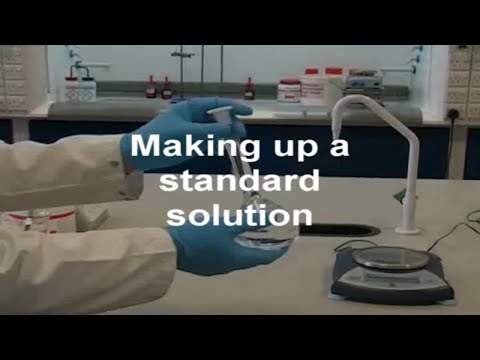
Royal Society of Chemistry: Preparing a standard solution. Watch for weighing by difference, the rinsings poured into the flask, and the final drops added with a dropping pipette at eye level.
Practice
Sources and credits