Basketball Rules of the Game
Senior 6 · Physical Education
Basketball Rules of the Game
Lesson 4 of 5
25 min
A 3-point shot scores half as much again as a 2-point shot, yet it is taken from at least 6.75 m and goes in less often. A coach who knows the rules of scoring and the percentages of her players can decide which shots her team should take. This lesson sets out how points are scored under Article 16 of the FIBA Official Basketball Rules 2026, how a game is won, and the five playing positions that turn rules into a team plan.
Definition
Field goal: a goal scored from play (2 or 3 points), as opposed to a free throw (1 point).
Goal: made when a live ball enters the basket from above and stays in it or passes through it.
3-point goal area: the whole court except the area inside and on the opponents' 3-point line.
Positions 1 to 5: point guard, shooting guard, small forward, power forward and centre.
| Situation | Points |
|---|---|
| Successful free throw | 1 |
| Goal released from the 2-point area (including a foot on the 3-point line) | 2 |
| Goal released from the 3-point area | 3 |
| Last free throw touches the ring, then a player legally taps it in | 2 |
| Accidental goal in a team's own basket | 2 to the opponents, entered for the opponents' captain on the court |
| Deliberate goal in a team's own basket, or the ball passing up through the basket from below | Violation: no points |
Worked example
Worked example 1: totalling a score. Team A scores 18 two-point goals, 7 three-point goals and 12 of its 16 free throws.
Points = 18 × 2 + 7 × 3 + 12 × 1 = 36 + 21 + 12 = 69. Missed free throws score nothing, so the 16 attempts do not enter the total. In the same game A6 is fouled while making a 3-point shot: the 3 points count and she gets 1 free throw, a possible 4-point play.
Worked example
Worked example 2: points per shot (illustrative figures). A team makes 50% of its 2-point attempts, 36% of its 3-point attempts and 75% of its free throws.
| No. | Position | Main job | Typical qualities |
|---|---|---|---|
| 1 | Point guard | Brings the ball up, calls the play, starts the offence; first defender on the ball | Ball-handling, passing, vision, leadership |
| 2 | Shooting guard | Scores from the perimeter, often from 3; second ball-handler | Shooting range, moving without the ball |
| 3 | Small forward | Scores from wing, drive and mid-range; guards the opponents' best wing | All-round skills, athleticism |
| 4 | Power forward | Rebounds, screens and scores near the basket or from the elbow | Strength, rebounding, mid-range shot |
| 5 | Centre | Scores and defends close to the basket; protects the rim; key rebounder | Height, reach, footwork in the post |
The numbers are roles, not fixed places. Modern teams often play "positionless" basketball, where any of the five may handle, shoot or post up. The rules shape every role: the 3-second rule keeps the centre moving in and out of the restricted area; the 8 and 24-second clocks make the point guard push the ball; the no-charge semi-circle tells the centre where to stand to draw a charge.
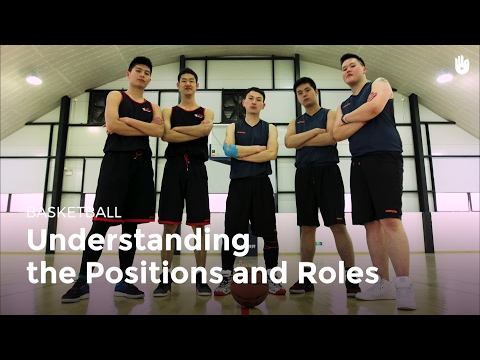
Video: "Basketball Positions and Roles", SIKANA English. Note what each position does in attack and in defence, then compare with the table above.
Tip
Coaching point. In a school team, rotate young players through all five positions in training before fixing roles: a tall pupil who only learns the centre's job may never learn to dribble or pass, and the modern game needs both.
Warning
Common mistakes. A foot on the 3-point line makes the shot worth 2, not 3. A missed three that a team-mate taps in from near the basket counts 2, because the tap is the scoring shot and it was released from the 2-point area. An accidental goal in the team's own basket is not a violation: it counts 2 for the opponents.
Practice
Remember
Sources and credits
This lesson adapts CC BY-SA material and is shared under CC BY-SA 4.0.