

Basic Rules of Playing Rugby
Senior 6 · Physical Education
Basic Rules of Playing Rugby
3 lessons
Lesson 2 of 3
Basic rules of rugby
30 min
Seven points without a kick
A try is worth 5 points and a successful conversion 2 more. But if a defender commits foul play that stops a probable try, the referee awards a penalty try: 7 points at once, no conversion needed, and the offender is shown a card. Rugby's laws reward attacking play and punish cynical defence. This lesson sets out the basic laws of the World Rugby Laws of the Game 2026: the pitch, team and time, scoring, restarts, the forward pass and knock-on, offside, the tackle, ruck and maul, the scrum and lineout, and foul play with its sanctions.
Definition
Try: grounding the ball in the opponents' in-goal (5 points).
Knock-on (knock forward): the ball goes forward off a player's hand or arm and touches the ground or another player before it is caught.
Offside: being in front of a team-mate who has the ball or last played it (in open play), or in front of the offside line at a ruck, maul, scrum or lineout.
Ruck: at least one player from each team, on their feet, in contact over the ball on the ground.
Maul: a ball-carrier and at least one player from each team, bound together and on their feet, with the ball off the ground.
The pitch, the team and the time
- Field of play 94–100 m long and 68–70 m wide; in-goal 6–22 m deep. Goal posts 5.6 m apart, crossbar top edge 3 m high, posts at least 3.4 m high. The surface must be safe.
- No more than 15 players per team on the pitch; up to 8 replacements, made only when the ball is dead and with the referee's permission. A squad must include enough trained front-row players; otherwise scrums become uncontested.
- A match lasts 2 × 40 minutes plus time lost, with half-time of up to 15 minutes. In school and other non-international matches the organiser may shorten it. A half ends when the ball next becomes dead after time is up.
Scoring
| Score | Points | How |
|---|---|---|
| Try | 5 | First to ground the ball in the opponents' in-goal (including on the try line) |
| Penalty try | 7 | Awarded between the posts when foul play prevents a probable try; no conversion |
| Conversion | 2 | Place-kick or drop-kick over the crossbar, from a point on a line through where the try was scored, within 60 seconds |
| Penalty goal | 3 | Kick at goal from a penalty |
| Dropped goal | 3 | Drop-kick over the crossbar in open play |

Starting and restarting
- Kick-off (each half) and the restart after a score are drop-kicks from the centre of the half-way line. After a score, the team that conceded restarts. The ball must reach the opponents' 10-metre line; the kicker's team-mates must be behind the ball and the opponents on or behind their 10-metre line.
- 22-metre drop-out: when a missed penalty goal or dropped goal is grounded or made dead in in-goal by the defenders.
- Try-line drop-out: when an attacker carries the ball into in-goal and is held up, or an attacking kick is grounded in in-goal by the defenders. It must cross the 5-metre line. Since 1 July 2026 more in-goal situations end in a try-line drop-out instead of a 22-metre drop-out.
- Lineout when the ball goes into touch; scrum after a knock-on, a forward pass or an unplayable ball.
Passing, knock-on and offside in open play
- A forward pass or an accidental knock-on: scrum to the opponents. Doing either on purpose: penalty. No knock-on if the ball is charged down from a kick or ripped from an opponent's hands.
- In open play a player in front of a team-mate who has the ball or last played it is offside and must not take part. An offside player is put onside when the ball-carrier or another onside team-mate runs past, or when an opponent kicks the ball or deliberately touches it without gaining possession.
- 10-metre law: players in front of a team-mate who kicks must retire behind an imaginary line 10 m from where the ball lands or is caught.
The tackle, ruck and maul
| Phase | Main duties (Laws 13 to 16) |
|---|---|
| Tackle | A tackle happens when the ball-carrier is held and brought to ground. The tackler must release the player and the ball at once, get up or move away, and be on his or her feet before playing the ball. The tackled player must immediately release, pass or place the ball (not forward) and move away. Arriving players must stay on their feet and come from their own side (through the "gate") |
| Ruck | Forms when players from each team are on their feet over the ball on the ground. No hands in the ruck. Heads and shoulders no lower than hips. Join from behind the hindmost foot of your team, binding on. Offside line: through the hindmost foot of each team. When the ball is won, the referee calls "use it": it must be played within 5 seconds |
| Maul | Must move towards a try line; if it stops for more than 5 seconds the referee calls "use it". Join only from behind, binding on the hindmost player; never collapse it |
Scrum and lineout
- Scrum: eight players from each team bind together (when both teams have 15). The referee calls "crouch", "bind" and "set"; heads and shoulders stay no lower than hips; hookers keep a "brake foot" for stability until "set" (full law since 1 July 2026). The scrum-half chooses which side to throw in and throws straight down the middle line. Backs must stay 5 m behind the hindmost feet.
- Lineout: at least two players from each team, between the 5-metre and 15-metre lines; the thrower stands outside the field and throws straight along the line of touch, and the ball must reach the 5-metre line. Lifting is allowed but no one may be lifted before the ball leaves the thrower's hands.
Foul play, cards and sanctions
- Foul play includes obstruction, repeated infringement, punching, kicking, tripping and dangerous tackles: early, late, without the arms, on a player in the air, lifting and dropping a player, or above the sanction line (the line of the shoulders in elite rugby; in community rugby the base of the sternum or the waist, as the competition decides).
- Penalty: the team may kick at goal, kick to touch (and throw in at the lineout), tap and run, or take a scrum. Opponents retreat 10 m. Free-kick (for technical offences): the team may tap and run or kick for position, but may not kick at goal, and cannot score a dropped goal until the ball is dead or an opponent has played it.
- Yellow card: the player is suspended for 10 minutes ("sin-bin"). A second yellow-card offence means a red card.
- Red card: sent off for the rest of the match. In community rugby the player may not be replaced. In elite rugby, since 1 July 2026 by full law, a player sent off for foul play that is not intentional may be replaced after 20 minutes of playing time; for intentional, highly dangerous acts the team stays short.
- Advantage: the referee lets play go on if the non-offending team gains from it, and returns for the sanction if it does not.
| Sevens variation | Rule |
|---|---|
| Players | 7 per team, up to 5 replacements |
| Time | 2 halves of 7 minutes, half-time up to 2 minutes (finals may be 2 × 10) |
| Conversion | Drop-kick only, within 30 seconds |
| Restart after a score | The scoring team kicks off |
| Yellow card | 2-minute suspension |
Worked example
Worked example 1: a full score line. Team A scores 3 tries (2 converted), a penalty try and 2 penalty goals. Team B scores 4 tries (1 converted) and a dropped goal.
Team A: 3 × 5 + 2 × 2 + 7 + 2 × 3 = 15 + 4 + 7 + 6 = 32. Team B: 4 × 5 + 1 × 2 + 3 = 20 + 2 + 3 = 25. Team A wins 32–25. (The penalty try counts 7 with no conversion.)
Worked example
Worked example 2: offside at a ruck. A ruck forms on Team B's 30-metre line. Team B's hindmost foot in the ruck is 1 m behind the ball; Team A's hindmost foot is 1.5 m behind it on the other side.
- Each team's offside line runs across the pitch through its own hindmost foot.
- Team A's flanker, who stood up from the tackle and is now standing beside the ruck on Team B's side without binding, is in front of Team A's offside line.
- When the Team B scrum-half picks up the ball and the flanker tackles him, he has taken part from an offside position: penalty to Team B. He should have retired behind his offside line or bound onto the ruck from behind.
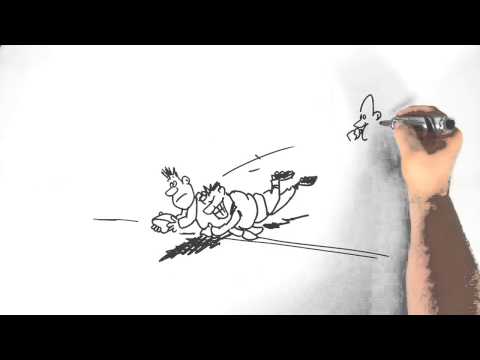
Video: "Rugby for beginners: a guide to the rules of rugby union", England Rugby. Check each rule shown against the 2026 laws in this lesson.
Warning
Common mistakes. A ball knocked forward and caught before it touches the ground or another player is not a knock-on. A drop-kick restart must reach the 10-metre line. A penalty try is 7 points with no conversion. The 20-minute replacement of a red-carded player applies only in elite rugby. In a scrum, a collapse or a lifted front-row player is dangerous: the referee stops play at once.
✦
Practice
- Give the maximum dimensions of the field of play and in-goal.
- List the five ways of scoring and their points.
- A kick-off travels 8 m and the receiving team does not touch it. What can the receivers choose?
- A player knocks the ball forward while trying to catch a high kick, and it hits the ground. Decision?
- What must a tackler do immediately after the tackle?
- What does the referee's call "use it" mean at a ruck?
- Team C scores 2 converted tries, 1 unconverted try and 1 penalty goal. Find its total.
- A defender deliberately knocks the ball down as an attacker is about to catch a pass with a clear run to the line. Evaluate the possible decisions.
Show answersHide answers
- Field of play 100 m × 70 m; in-goal up to 22 m deep.
- Try 5, penalty try 7, conversion 2, penalty goal 3, dropped goal 3.
- The kick did not reach the 10-metre line: they choose a retake or a scrum.
- Knock-on (accidental): scrum to the opponents.
- Release the ball-carrier and the ball at once, get up or move away, and be on their feet before playing the ball.
- The ball has been won and is available: it must be played away within 5 seconds, or a scrum is awarded.
- 2 × (5 + 2) + 5 + 3 = 14 + 5 + 3 = 22.
- An intentional knock-on is a penalty offence. Because it stopped a probable try, the referee should award a penalty try (7 points) and show the defender a yellow card (or a red card if it was also dangerous).
Remember
- 15 players; 2 × 40 min; field 94–100 m × 68–70 m.
- Try 5, conversion 2, penalty try 7, penalty or dropped goal 3.
- No forward pass or knock-on: scrum. Offside players must not take part.
- Tackler releases; tackled player releases; arrivals stay on their feet and come through the gate.
- Yellow = 10 min (sevens 2 min); red = off; elite only: non-intentional red replaced after 20 min.
Sources and credits
- Laws of the Game: Rugby Union 2026, World Rugby: Laws 1, 3, 5, 8 to 16, 18 to 20 and the sevens variations summarised, not copied.
- 2026-07 Law updates, World Rugby Passport: the changes made full law from 1 July 2026, summarised.
- Photo: Freshia Odour scores a point for Kenya during match between Kenya vs Uganda at RAWC, Kenya Rugby Union / Sirma Duncan, Wikimedia Commons, licensed under CC BY 4.0.
- Video: "Rugby for beginners: a guide to the rules of rugby union", England Rugby, embedded from YouTube.
- Pitch diagram, tables, worked examples and practice: written by Ganzaa.