

Basic Rules of Playing Rugby
Senior 6 · Physical Education
Basic Rules of Playing Rugby
3 lessons
Lesson 1 of 3
Recap of rugby techniques and tactics
25 min
Pass backwards to go forwards
In rugby the ball may never be thrown forward, yet the aim is to carry it over the opponents' try line. Everything else follows from that one law: players run in support behind the ball-carrier, tackles and rucks decide who keeps the ball, and kicks are the only way to send it ahead. This unit studies rugby under the World Rugby Laws of the Game 2026, including the changes that became full law on 1 July 2026. This first lesson recaps the positions, the core techniques with the safety points that the laws now demand, and the principles of tactics.
Definition
Gain line: an imaginary line across the pitch through the last breakdown or set piece; crossing it means the attack is going forward.
Phase: one passage of play between breakdowns (each ruck or maul starts a new phase).
Breakdown: the contest for the ball at and after a tackle.
Set piece: a scrum or a lineout, used to restart play.
Support: team-mates running behind and beside the ball-carrier, ready to take a pass or join a ruck.
The fifteen positions
In sevens, the version played at the Olympic Games, each team has 7 players: three forwards (two props and a hooker) and four backs, on the same full-size pitch.
Core techniques
| Skill | Key points |
|---|---|
| Passing | Sideways or backwards only. Hands to the target, sweep across the body, follow through to the receiver's chest. Spin pass for distance; short "pop" pass to a runner close by |
| Catching | Hands up early as a target, fingers spread, eyes on the ball, catch away from the body and run straight |
| Running and evasion | Run straight to keep space for the outside players; side-step, swerve, change of pace; a hand-off is allowed without excessive force |
| Tackling | Eyes open on the target; approach with short steps; head to the side of the ball-carrier's body, never in front; contact with the shoulder below the sanction line; wrap both arms and drive with the legs. In community rugby the line is the base of the sternum or the waist, as the competition decides; in elite rugby it is the line of the shoulders |
| Breakdown | Tackled player places the ball back towards team-mates and releases it; supporters arrive on their feet, through the "gate" from their own side, heads and shoulders no lower than hips, and bind to drive over the ball |
| Maul | Ball-carrier stays on feet; team-mates bind on and drive towards the opponents' line |
| Kicking | Touch-finder for territory; box kick and up-and-under to contest the ball; grubber along the ground behind the defence; drop kick for restarts and dropped goals |
| Scrum and lineout | Scrum: eight players bound, flat backs, on "crouch, bind, set". Lineout: a straight throw down the middle, lifters supporting the jumper |

Principles of tactics
- Go forward: gain ground by running, driving mauls or kicking, so that defenders must retreat.
- Support: there must always be a team-mate within passing distance of the ball-carrier.
- Continuity: keep the ball alive through passes and quick rucks; slow ball lets the defence reorganise.
- Pressure: in defence, advance quickly as a line (line speed) to give attackers less time; "drift" sideways to cover width or "blitz" up to rush the ball.
- Space: attack where defenders are few; create overlaps (more attackers than defenders) and use them before the defence covers.
Worked example
Worked example 1: the two-against-one. Ball-carrier A has a support runner B outside her; one defender D stands between them and the try line.
- A runs straight at D's inside shoulder, so that D must commit to tackling her.
- When D turns towards A (about two metres away), A passes sideways to B, who is a metre behind her so the pass does not go forward.
- D cannot now reach B. If A passes too early, D simply drifts to B; if too late, A is tackled with the ball. The skill is the timing of the draw and pass.
Worked example
Worked example 2: choosing an option at a penalty. Your team trails 15–17 with three minutes left and wins a penalty 30 m from the opponents' posts, in front of them.
- A successful penalty goal is worth 3 points: 18–17, and you lead.
- Kicking to touch near the opponents' line for a lineout and maul might bring a try (5 points, 7 with the conversion) but could also lose the ball.
- From a central 30 m penalty, a good kicker usually succeeds, and 3 points are enough to win. Kick at goal, then defend the restart. If the score were 15–22, 3 points would not be enough, and the lineout drive would be the better choice.
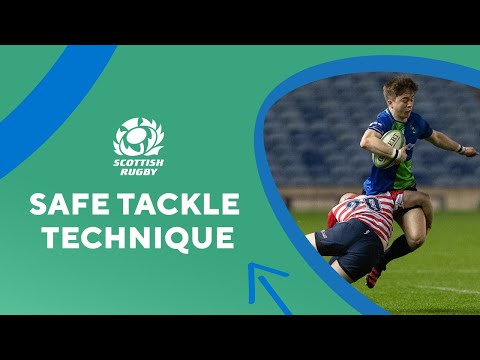
Video: "Safe Tackle Technique", Scottish Rugby Game Development. Practise each step slowly on your knees first, then walking, before any tackle at speed.
Warning
Safety first. Never tackle with the head in front of the ball-carrier: the head goes to the side. Tackles above the sanction line are illegal and are the main cause of head injuries. Teach contact in stages: kneeling, walking, jogging, then full speed, and match players by size and experience. Remove jewellery and wear a fitted mouthguard. Any player with a suspected concussion is removed and does not return to play until a health professional has assessed them.
✦
Practice
- Name the eight forward positions and their numbers.
- Which positions do the four backs and three forwards of a sevens team usually fill?
- Describe four coaching points of a safe side-on tackle.
- What is the tackle "sanction line" in community rugby and in elite rugby?
- Explain the purpose of running straight when attacking.
- In a 2-against-1, what happens if the pass is made too early? Too late?
- Give two ways a team can "go forward" without passing.
- Your team leads 20–18 with 30 seconds left and wins a scrum in its own half. Plan the tactics to finish the game.
Show answersHide answers
- 1 loose-head prop, 2 hooker, 3 tight-head prop, 4 and 5 locks, 6 and 7 flankers, 8 number 8.
- Forwards: two props and a hooker. Backs: scrum-half, fly-half, centre and wing (positions vary between teams).
- Any four: eyes open on the target; short steps to close down; head to the side, never in front; shoulder contact below the sanction line; wrap both arms; drive with the legs.
- Community: the base of the sternum or the waist, as the competition decides. Elite: the line of the shoulders.
- It keeps space for the players outside and stops the attack drifting towards the touchline, where the defence can trap it.
- Too early: the defender stays free to tackle the receiver. Too late: the ball-carrier is tackled before passing.
- Running with the ball and driving a maul; kicking ahead or to touch.
- Win the scrum cleanly, keep the ball in tight with the forwards through short pick-and-go rucks, avoid risky passes, and when the clock passes 80 minutes kick the ball into touch to end the game.
Remember
- 15 players: forwards 1–8, backs 9–15. Sevens: 3 forwards, 4 backs.
- Pass sideways or backwards; run straight; support the ball-carrier.
- Tackle below the sanction line, head to the side, wrap and drive.
- Principles: go forward, support, continuity, pressure, space.
Sources and credits
- Laws of the Game: Rugby Union 2026, World Rugby: Laws 3, 9, 14, 15 and 16 and the sevens variations summarised, not copied.
- Community Tackle Height law wordings approved, World Rugby Passport, June 2026: the tackle sanction lines, summarised.
- Rugby union positions, Wikipedia contributors, Wikipedia, licensed under CC BY-SA 4.0. Adapted by Ganzaa.
- Photo: Schoolkids doing a rugby tackle, R. Neil Marshman, Wikimedia Commons, licensed under CC BY-SA 3.0.
- Video: "Safe Tackle Technique", Scottish Rugby Game Development, embedded from YouTube.
- Positions diagram, tables, worked examples and practice: written by Ganzaa.
This lesson adapts CC BY-SA material and is shared under CC BY-SA 4.0.