Operations on the Set of Real Numbers
Senior 4 · Mathematics
Operations on the Set of Real Numbers
Lesson 3 of 5
25 min
The triangle below has its corners on grid points. Pythagoras gives its sides exactly: , and . An exam asks for the perimeter "in simplest surd form". To answer, you must know which radicals can be added, how to multiply them, and how to clear them out of a denominator. Those three skills are this lesson.
Definition
Like radicals: radicals with the same index and the same radicand, such as and . Only like radicals can be added or subtracted, by adding their coefficients: .
Conjugate: the conjugate of is , and the conjugate of is . Their product has no radical:
Worked example 1: adding and subtracting
(a) Find the perimeter of triangle in simplest form. (b) Simplify . (c) Simplify .
Solution Simplify each radical first; only then can you see which are alike.
Warning
There is no sum rule for roots. in general: , but . The product and quotient rules are the only ones that let you split a radical.
Expanding a product of two binomials follows FOIL, with for :
Definition
Rationalising the denominator: rewriting a fraction so that its denominator contains no radical, by multiplying the numerator and the denominator by the same suitable factor (the rationalising factor). The value of the fraction does not change, because you multiply by 1.
Example: . Halving 1.4142 by hand is far easier than dividing 1 by 1.4142, which is why exact answers are written this way.
| Denominator | Multiply top and bottom by | Because |
|---|---|---|
| , | () | |
| or | the conjugate | |
Worked example 2: one-term denominators
Rationalise (a) (b) .
Solution
Worked example 3: conjugates
Rationalise (a) (b) .
Solution
Worked example 4: a cube-root denominator
Rationalise .
Solution With and , the identity says the factor is :
Check: and . ✓
Tip
Before multiplying out, ask: "What times this denominator gives a whole number?" For it is ; for a sum or difference of square roots it is the conjugate; for cube roots, use the sum or difference of cubes. In Unit 7 you will use the same trick the other way round, rationalising a numerator such as to find a limit.
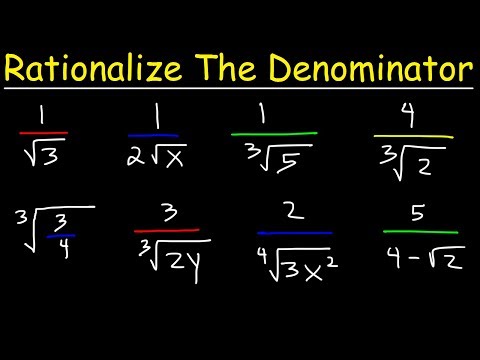
The Organic Chemistry Tutor: Rationalize The Denominator. Watch for how the factor is chosen for one-term denominators, for cube roots, and for binomials with the conjugate.
Practice
Give every answer in simplest form.
Key points
Sources and credits
Quick check
Simplify √12 + √27.