Introduction to Entrepreneurship
Senior 4 · Entrepreneurship
Introduction to Entrepreneurship
Lesson 1 of 4
25 min
Mukeshimana runs a small juice bar near the bus park in Musanze. In 2025 she noticed that farmers in the hills nearby were throwing away passion fruit that was too ripe to send to Kigali. She borrowed Frw 600,000 from her savings group, bought a blender and a freezer, and began selling frozen passion-fruit pulp to restaurants. If the restaurants stop buying, the loan is still hers to repay.
Nshimiyimana works as a quality officer for a large dairy company. He noticed that customers in Kigali returned glass yoghurt bottles at a shop near his home. He wrote a proposal: the company should collect, wash and reuse its own bottles. The managers approved it, gave him a team of three and a budget, and kept him on his salary. If the plan fails, the company loses the money; he keeps his job.
(Both cases are illustrative: the people and figures are invented.)
Think about it: both people spotted a problem and turned it into something of value. Which of them is taking the bigger personal risk, and who will keep the reward if the idea works?
"Entrepreneur" comes from the French verb entreprendre, to undertake. Economists have given the entrepreneur a different main job in different periods, and each view still explains part of what entrepreneurs do today.
| Thinker | Work and date | What the entrepreneur does |
|---|---|---|
| Richard Cantillon | Essai sur la nature du commerce en général, written about 1730, published 1755 | Buys at a known price and sells at a price that is not yet known, so bears uncertainty |
| Jean-Baptiste Say | A Treatise on Political Economy, 1803 | Brings together land, labour and capital and moves them into more productive uses |
| Joseph Schumpeter | The Theory of Economic Development, 1911 (English 1934); Capitalism, Socialism and Democracy, 1942 | Innovates: carries out "new combinations" (a new product, method, market, source of supply or way of organising an industry); the new destroys the old, which he called creative destruction |
| Israel Kirzner | Competition and Entrepreneurship, 1973 | Is alert to opportunities that other people have missed |
| Peter Drucker | Innovation and Entrepreneurship, 1985 | Looks for change, responds to it and uses it as an opportunity |
Mukeshimana fits all five views at once: she saw waste that others ignored (Kirzner), combined fruit, a freezer and her own labour (Say) into a product the town did not have (Schumpeter), and she carries the risk that prices fall (Cantillon).

Definition
Entrepreneurship: the process of spotting an opportunity, gathering the resources needed to act on it, and creating something of value (a new or better product, service or way of working) while accepting the risk of loss.
Example: turning over-ripe passion fruit into frozen pulp for restaurants.
Definition
Entrepreneur: a person who starts and runs a business or project of their own, decides how to combine resources, and personally carries the financial risk in return for the profit.
Example: Mukeshimana, who repays the loan whether or not the juice business succeeds.
Definition
Intrapreneur: an employee who behaves like an entrepreneur inside an existing organisation: they spot an opportunity, propose a new product, process or service and lead it, using the organisation's money and people. Intrapreneurship is that activity. The term was made popular by Gifford Pinchot III in his book Intrapreneuring (1985).
Example: Nshimiyimana leading the bottle-return project at the dairy company.
Definition
Enterprise: the business or project that an entrepreneur creates, such as a shop, a farm, a workshop or a cooperative. The word also names the quality of being willing to start new things.
The two share a way of thinking. They differ in who owns the venture, who carries the risk and who keeps the reward.
| Point of comparison | Entrepreneur | Intrapreneur | Ordinary employee |
|---|---|---|---|
| Ownership | Owns the enterprise | Does not own it | Does not own it |
| Capital | Raises it: savings, loans, partners | Uses the employer's budget | Uses the employer's tools |
| Risk | Personal: can lose savings and assets | Mainly the employer's; the intrapreneur risks reputation | Very little |
| Reward | Profit, which can be large or negative | Salary, plus bonus, promotion or recognition | Salary |
| Freedom to decide | Full | Within the organisation's rules and approvals | Follows instructions |
| Main job | Create and grow a new venture | Create something new inside the firm | Do the assigned work well |
Tip
Three questions sort any case. Who owns it? Who loses money if it fails? Who keeps the profit if it works? If the answer to all three is "the person", that person is an entrepreneur. If the answer is "the employer" but the person created and leads the new idea, they are an intrapreneur.
Entrepreneurs differ in how much they innovate. In 1949 the economist Clarence Danhof, studying farmers, sorted them into four types; the scheme is still used to describe businesses of every size.
| Type | Behaviour | Illustrative example |
|---|---|---|
| Innovative | Introduces something new: a product, method or market | The first person in a district to sell solar-powered milk coolers to dairy farmers |
| Imitative (adoptive) | Copies a proven idea, often adapting it to a new place | Opening a mobile-money and phone-charging kiosk in a trading centre that has none |
| Fabian | Very cautious; changes only when it becomes clear that not changing will cause losses | A shop owner who accepts mobile money only after most customers stop carrying cash |
| Drone | Refuses to change even when it means losing money | A miller who keeps an old diesel mill running while customers move to a cheaper electric mill |
Two more groupings are common. Opportunity entrepreneurs start a business because they see a chance to earn more or to do something new; necessity entrepreneurs start one because they have no better way to earn a living. The Global Entrepreneurship Monitor uses this distinction in its surveys of many countries. Social entrepreneurs use business methods mainly to solve a social or environmental problem, and measure success by that impact as well as by profit.

Worked example 1: Cantillon's uncertainty in numbers
A trader in Nyabugogo buys 200 kg of tomatoes at Frw 400 per kg, a price fixed at the moment she pays. She does not know what she will be able to sell them for. Find her profit or loss if she sells everything at (a) Frw 600 per kg; (b) Frw 300 per kg after a glut. (Illustrative figures.)
Cost (known now):
(a) Revenue and profit at Frw 600 per kg:
(b) Revenue and profit at Frw 300 per kg:
Interpretation: the same decision can earn Frw 40,000 or lose Frw 20,000. Nobody guarantees the selling price. Carrying that uncertainty is what Cantillon saw as the entrepreneur's job, and the profit is the reward for carrying it.
Worked example 2: classify each person
Warning
Two common mistakes. First, an entrepreneur is not only someone who invents: most entrepreneurs imitate or adapt ideas, and that still counts. Second, an intrapreneur is not just a hard-working employee. The test is whether the person started and leads something new for the organisation.
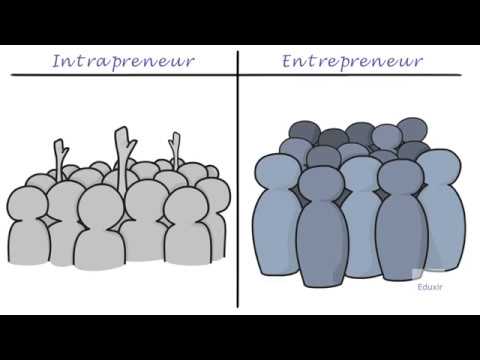
Eduxir, "Intrapreneur vs Entrepreneur". Watch for the points of comparison the video uses (ownership, risk, capital and reward) and check them against the table above.
Practice
Key points
Sources and credits
Written by Ganzaa: the Musanze and dairy cases, the Venn diagram, the tables, the worked examples and the practice items. The people, businesses and figures are illustrative (2026). The thinkers' ideas are summarised in Ganzaa's own words.
Quick check
Which thinker saw the entrepreneur mainly as an innovator who carries out new combinations and causes creative destruction?