Introduction to Entrepreneurship
Senior 4 · Entrepreneurship
Introduction to Entrepreneurship
Lesson 4 of 4
25 min
Twice a week a trading centre in Ruhango District holds a market of about 120 stalls. By evening a heap has grown behind the stalls: banana leaves, peels, cabbage leaves and plastic bags. The heap smells, attracts flies and blocks a drainage channel, so the street floods when it rains. Traders blame the sector, the sector blames the traders, and the heap stays. (Illustrative case: the place is typical, the details are invented.)
A group of S4 students is asked one question: "What could be done?" Gakwaya suggests a bigger bin. Uwera asks a different question: "Why is the waste there at all, and is any of it worth something?"
Think about it: both students want to help. Which question is more likely to lead to a business idea, and why?
Research on creativity finds that it is not a gift that only some people are born with. It is a set of habits that can be practised. The table lists the habits that matter most in business.
| Habit | What the person does | In the market case |
|---|---|---|
| Curiosity and observation | Notices details and asks why things are as they are | Uwera looks at what the heap is made of |
| Questioning assumptions | Asks whether "the way it is done" is the only way | "Is waste really worthless?" |
| Openness to ideas | Listens to other people and other fields | Asks a farmer what she does with crop leftovers |
| Connecting unrelated things | Joins ideas from different places | Market waste plus farmers who need fertiliser |
| Tolerance of uncertainty | Can work on a problem before the answer is clear | Keeps testing ideas even when the first fails |
| Persistence | Treats failure as information, not as an end | Tries three compost methods before one works |
Definition
Creative thinking: thinking that produces many different, new and useful ideas, often by looking at a problem from unusual angles. It works together with critical thinking, which judges ideas carefully and chooses the best. An entrepreneur needs both: first generate, then judge.
In The Art of Thought (1926), the English psychologist Graham Wallas described four stages that people go through when they solve a problem creatively. The model is still widely taught.
The practical lessons for an entrepreneur: illumination rarely comes without hard preparation, it often comes after a break, and every bright idea still has to be verified.
| Technique | How it works | Best for |
|---|---|---|
| Brainstorming | A group produces as many ideas as possible in a short time. Rules: no criticism during the session, aim for quantity, welcome wild ideas, build on others' ideas. The method was made popular by the advertising executive Alex Osborn in the 1950s. | Finding many options fast |
| Mind mapping | Write the problem in the centre of a page and draw branches for causes, users, resources and ideas, then sub-branches | Seeing how parts of a problem connect |
| The five whys | Ask "why?" about a problem, then about each answer, about five times, until the root cause appears | Finding the cause, not the symptom |
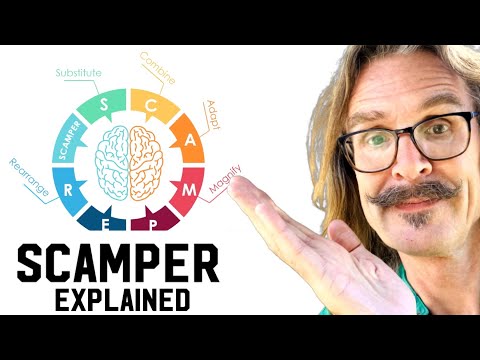
| SCAMPER | Ask seven questions about an existing product or process: Substitute, Combine, Adapt, Modify (or magnify), Put to another use, Eliminate, Reverse (or rearrange). Bob Eberle arranged Osborn's questions into this word in 1971. | Improving something that already exists |

Tip
Generate first, judge later. Most ideas are killed too early, often by their owner. Separate the session into two parts: first list ideas with no criticism at all, then, in a second step, judge them with clear criteria (Unit 2 shows how to score them).
Worked example 1: the five whys on the market heap
Root cause: the waste is seen as having no value. A bigger bin treats the symptom. A business that makes the waste valuable treats the cause: for example, collecting the organic part to make compost for farmers, and the plastic for a recycler.
Worked example 2: is there enough waste for a business?
Uwera estimates that each of the 120 stalls leaves 15 kg of organic waste per market day, with 2 market days a week. Assume that composting turns 40% of the mass into finished compost, and that farmers would pay Frw 100 per kg. Estimate the weekly compost and its value. (Illustrative figures and assumptions, to be checked in the field.)
Organic waste per week:
Compost and its value:
Interpretation: a heap that everyone saw as a nuisance could be worth about Frw 144,000 a week before costs. That figure is only as good as its three assumptions (15 kg per stall, a 40% yield, Frw 100 per kg), so the next step is verification: weigh the waste on two market days and ask farmers what they would pay.
| Barrier | How it shows | How to overcome it |
|---|---|---|
| Fear of failure or ridicule | "People will laugh at my idea." | Test ideas cheaply and small; treat a failed test as information |
| Habit and routine | "We have always done it this way." | Ask "why?" about each step; visit other businesses and places |
| "One right answer" thinking | Stopping at the first idea | Set a target: at least ten ideas before choosing |
| Judging too early | Criticising ideas as they are spoken | Separate generating from judging |
| Lack of information | Ideas based on guesses | Observe, ask users, read; prepare well |
| Lack of time or resources | No time to think; no money to test | Set aside time; build simple, low-cost prototypes |

Warning
Creativity is not the same as a good business idea. A creative idea still has to pass the tests of Unit 2: are there buyers, can it be done, and will it make a profit? A second mistake is to believe that creativity needs talent you do not have. The techniques above work for anyone who uses them.
Gijs van Wulfen, "The Scamper Technique Explained". Watch how each of the seven SCAMPER questions turns an existing product into a new idea, then try the questions on a product sold in your area.
Practice
Key points
Further reading
Sources and credits
Written by Ganzaa: the Ruhango market case, the creative-process diagram, the tables, the worked examples and the practice items. The case, people and figures are illustrative (2026).
This lesson adapts CC BY-SA material and is shared under CC BY-SA 4.0.
Quick check
Put Graham Wallas's stages of the creative process in order.
Tap the cards in the right order.