Reflection and Refraction of Light
Senior 4 · Physics
Reflection and Refraction of Light
Lesson 4 of 5
25 min
The "lens" on a good camera or in a school microscope is not one piece of glass but a tube holding several, sometimes more than ten. One perfect lens would be lighter and cheaper, so why use many? There are two reasons. Combining lenses lets a designer choose the overall focal length and magnification, and it lets one lens cancel the faults of another. Those faults, called aberrations, are the reason a single spherical lens or mirror never gives a perfectly sharp image. This lesson treats both ideas.
Put two thin lenses of focal lengths and in contact, and place an object at distance . Lens 1 alone would form an image at :
Before the light reaches that image, it meets lens 2. The rays are converging towards a point beyond lens 2, so for lens 2 this is a virtual object at distance (real is positive). Lens 2 then forms the final image at :
Adding the two equations, the terms cancel:
The pair behaves as one lens of focal length : powers in contact add. This is why an optician can test your eyes by dropping trial lenses into one frame and simply adding their powers.
Lenses separated by a distance . Treat them one at a time: the image formed by lens 1 is the object for lens 2 (real if it lies in front of lens 2, virtual if behind it), and the total magnification is . For parallel light the pair has a single equivalent power, which can be shown to be
which reduces to when .
Figure 4.1: Lenses in sequence. The image I₁ formed by lens 1 is the object for lens 2.
Definition
The equivalent (effective) focal length of a combination of lenses is the focal length of the single lens that would bend parallel light in the same way. For thin lenses in contact, . A virtual object for a lens is a point towards which light is converging when it reaches the lens; its distance is negative. Example: lenses of and in contact act as one lens of , .
Worked example 1: lenses in contact, and a diverging lens measured
(a) A converging lens of focal length 20.0 cm is placed in contact with a diverging lens of focal length 30.0 cm. Find the focal length and power of the combination.
(b) A diverging lens forms no real image, so its focal length cannot be found on a screen directly. Put it in contact with a stronger converging lens of focal length 10.0 cm; the combination forms real images, and a graph method gives . Then
Worked example 2: two separated lenses (Figure 4.1)
An object 2.0 cm tall stands 15.0 cm in front of lens 1 (). Lens 2 () is 50.0 cm beyond lens 1. Find the final image.
Lens 1: , so and .
Lens 2: is in front of lens 2, a real object, .
Total magnification : the final image is real, 60.0 cm beyond lens 2 and 12 cm tall. Each lens inverts, so the final image is the same way up as the object.
The mirror and lens formulas were derived for paraxial rays of a single wavelength. Real light is neither. The departures from a perfect point image are called aberrations. The two most important are spherical aberration and chromatic aberration.
You saw in lesson 1 that a ray striking a spherical mirror at angle to the normal crosses the axis at from C, closer to the mirror than F when is large. A spherical lens behaves in the same way: its outer zone is too strongly curved for the rays it receives, so marginal rays (near the edge) are focused nearer the lens than paraxial rays. The light never meets at one point; the smallest patch it forms is called the circle of least confusion.
Figure 4.2: Spherical aberration in a wide concave mirror, drawn with the law of reflection applied exactly to each ray.
Reducing it: (1) use a stop (aperture) to block the marginal rays, at the cost of a dimmer image; (2) for mirrors, use a parabolic surface, which sends every ray parallel to the axis through one focus (car headlamps, satellite dishes and solar cookers use this shape); (3) for lenses, share the bending between surfaces, for example by turning a plano-convex lens so its curved face meets the parallel light, or by grinding aspheric surfaces; (4) combine a converging and a diverging lens whose aberrations are opposite.
Spherical aberration can be very costly. In 1990 the Hubble Space Telescope sent back blurred images; NASA's investigation found that its primary mirror had been polished to the wrong curve, too flat near its outer edge, an error ten times the allowed tolerance. In December 1993 astronauts installed corrective optics that cancelled the error, like a pair of spectacles for the telescope.
The refractive index of glass is slightly larger for violet light than for red light (lesson 5). By the lens-maker's formula, , violet light therefore has the shorter focal length. White light from a point is focused into a spread of coloured images along the axis, and a photograph shows coloured fringes at sharp edges (Figure 4.3a). The distance is the longitudinal chromatic aberration.
A mirror has no chromatic aberration: the law of reflection does not depend on wavelength. This is one reason why large astronomical telescopes use mirrors rather than lenses.
The achromatic doublet. Cement a converging lens of crown glass to a weaker diverging lens of flint glass, which spreads colours more strongly (Figure 4.3b). For a thin lens, , so a small change between blue and red light changes the power by , where is the dispersive power of the glass. For the pair in contact to have the same power for both colours, the two changes must cancel:
Since and are both positive, one lens must be converging and the other diverging, and the lens with the larger (flint) must be the weaker.
Figure 4.3: Chromatic aberration (a) and its cure (b). The colour spread is exaggerated.
| Aberration | What you see | Main cure |
|---|---|---|
| spherical | a blurred image even on the axis | stops, parabolic mirrors, aspheric or combined lenses |
| chromatic | coloured fringes at edges | achromatic doublet; use a mirror |
| coma | off-axis points look like small comets | lens shape, stops |
| astigmatism | off-axis points focus as two short lines at different distances | combinations of lenses |
| distortion | straight lines near the edge of the picture curve (barrel or pincushion) | symmetrical lens design |
Definition
An optical aberration is any failure of a lens or mirror to bring all the rays from one object point to one image point. Spherical aberration is the focusing of marginal rays at a different point from paraxial rays because of the spherical shape of the surface. Chromatic aberration is the focusing of different colours at different points because the refractive index depends on wavelength. Example: a magnifying glass shows coloured edges round black print.
Worked example 3: how big is chromatic aberration?
A biconvex crown-glass lens has both radii 20.0 cm. Its refractive index is 1.514 for red light and 1.524 for violet. Find the two focal lengths.
The foci are 0.37 cm apart. That is small, but in a camera that must resolve detail of a few micrometres it is enormous.
Worked example 4: designing an achromatic doublet
Design an achromatic doublet of focal length +20.0 cm from crown glass () and flint glass ().
Achromatism: , so .
Focal length: .
Check: , so .


Warning
Common mistakes. (1) Adding focal lengths instead of powers: . (2) Forgetting that the image of lens 1 may be a virtual object for lens 2 (negative ) when it falls beyond lens 2. (3) Saying mirrors suffer chromatic aberration: they do not. (4) Thinking an achromat makes all colours meet perfectly: it brings two chosen colours to one focus and greatly reduces the spread of the rest.
Tip
For any multi-lens problem, make a table with one row per lens: , , , . Then the next row's is (separation − previous ), with a minus sign if that comes out negative (a virtual object).
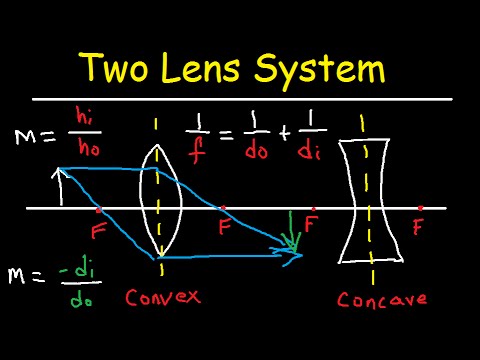
Two-lens systems with diverging and converging lenses (The Organic Chemistry Tutor). Watch how the image of the first lens becomes the object of the second, and how the total magnification is the product of the two.
Practice
Key points
Sources and credits
The derivations, the three diagrams, the worked examples and the practice exercises are written by Ganzaa.
Quick check