Direct Current Circuits
Senior 4 · Physics
Direct Current Circuits
Lesson 2 of 5
25 min
Switch on a car's headlights and then start the engine: the lights dim for a moment while the starter motor turns. The battery is the same, its chemistry unchanged, yet the voltage across the lamps falls. The reason is that every real source of electrical energy has some resistance inside it. This lesson separates what a battery can give (its electromotive force) from what reaches the circuit (its terminal potential difference), and shows how to measure both.
A cell, a battery, a generator or a solar cell converts energy from some other form (chemical, mechanical, light) into electrical energy. The electromotive force (e.m.f.) is the energy converted into electrical energy per unit charge that passes through the source:
The potential difference (p.d.) between two points of a circuit is the electrical energy converted into other forms (heat, light, motion) per unit charge passing between them. Despite its name, e.m.f. is not a force; both e.m.f. and p.d. are measured in volts, but e.m.f. is energy given to each coulomb, and p.d. is energy taken from it.
Definition
The electromotive force of a source is the energy converted into electrical energy per unit charge passing through it. The internal resistance is the resistance of the material of the source itself. The terminal potential difference is the p.d. across the source's terminals when it delivers current; . Example: a cell of e.m.f. 1.5 V gives 1.5 J to every coulomb that passes through it.
Model a real cell as an ideal source of e.m.f. in series with a small resistance (Figure 2.1). When it drives a current through an external resistance , energy conservation per coulomb gives
The p.d. across the terminals, which is also the p.d. across the external circuit, is
The term is sometimes called the "lost volts": energy per coulomb turned into heat inside the cell. When no current flows (), , so a high-resistance voltmeter connected alone across a cell reads very nearly its e.m.f. The larger the current drawn, the lower the terminal p.d.; that is why the headlights dim when the starter motor draws a huge current.
Figure 2.1: Measuring E and r. The voltmeter reads the terminal p.d. V; the ammeter reads the current I.
Worked example 1: a torch cell
A cell of e.m.f. 1.5 V and internal resistance is connected to a lamp. Find the current, the terminal p.d. and the lost volts.
Check: .
Worked example 2: starting a car
A car battery has and . The starter motor draws 150 A. Find the terminal p.d. while the engine is being started.
The headlights, connected across the same terminals, suddenly receive 9.6 V instead of about 12.6 V, so they dim. A battery's internal resistance must be very small to deliver such currents.
Apparatus: a dry cell, a rheostat (or a set of resistors), an ammeter (0–1 A), a high-resistance voltmeter, a switch, connecting wires.
| (A) | 0.10 | 0.20 | 0.30 | 0.40 | 0.50 | 0.60 |
|---|---|---|---|---|---|---|
| (V) | 1.48 | 1.38 | 1.31 | 1.24 | 1.14 | 1.07 |
Table 2.1: Illustrative results for one cell.
Figure 2.2: Terminal p.d. against current for Table 2.1.
Warning
Safety. Never connect a wire straight across the terminals of a cell or battery (a short circuit): the current is limited only by , so the wire and the battery can become very hot, and a car or lithium battery can burn or explode. Keep the rheostat from reaching zero resistance.
Worked example 3: reading the graph
From Figure 2.2 the line meets the axis at 1.55 V, so . Two points on the line: (0.10 A, 1.47 V) and (0.60 A, 1.07 V):
The short-circuit current would be , where the line would cut the axis.
The power delivered to the external resistance is
is largest when the denominator is smallest. Since gives , with equality when , the maximum power is delivered when the load resistance equals the internal resistance:
At that point half the energy is wasted inside the source, so the efficiency is only 50%. Matching to suits weak signals (aerials, loudspeakers); power stations instead keep much smaller than the load to work efficiently.
Figure 2.3: Cells in series and in parallel.
In series (Figure 2.3a), each coulomb passes through every cell, so the e.m.f.s add, and so do the internal resistances. A cell connected the wrong way round subtracts its e.m.f. but still adds its resistance. Identical cells in parallel (Figure 2.3b) share the current: the e.m.f. is that of one cell, and the internal resistance is . Parallel cells cannot give a higher voltage, but they can deliver a larger current with less internal loss, and last longer. Cells of different e.m.f. should never be connected in parallel: a current would circulate between them and waste energy.
Worked example 4: four cells, three ways
Four cells, each of e.m.f. 1.5 V and internal resistance , drive current through a resistor. Find the current when they are connected (a) all in series, (b) all in parallel, (c) as two parallel rows of two cells in series.
For a load much larger than , the series arrangement gives the most current; for a load much smaller than , the parallel one does.

Warning
Common mistakes. (1) Assuming the voltmeter across a cell always reads its e.m.f.: it reads while current flows. (2) Forgetting in . (3) Dividing the e.m.f. by for cells in parallel: it is the internal resistance that is divided. (4) Reading the gradient of the – graph as : it is negative.
Tip
Think of a cell as "an ideal battery with a small resistor inside it". Draw that resistor in every circuit diagram that mentions internal resistance, and the problem becomes an ordinary series circuit.
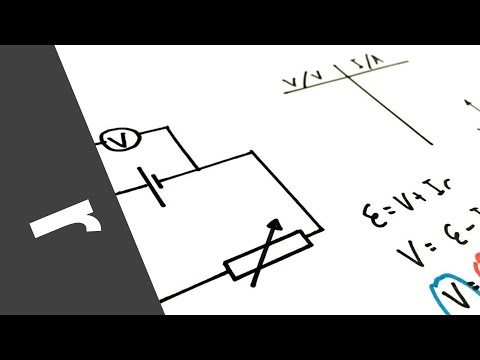
Measuring internal resistance, a practical (Physics Online). Watch how the terminal p.d. and current are measured for several load resistances and how the graph gives the e.m.f. and internal resistance.
Practice
Key points
Sources and credits
The derivations, the three diagrams, the experiment and its illustrative results, the worked examples and the practice exercises are written by Ganzaa.
Quick check
A cell of e.m.f. 2.0 V and internal resistance 1.0 Ω drives current through a 3.0 Ω resistor. What is the terminal p.d.?