Direct Current Circuits
Senior 4 · Physics
Direct Current Circuits
Lesson 4 of 5
25 min
A solar panel charges a battery while the battery also runs a lamp; two batteries of different e.m.f. are connected to the same resistor network. Such circuits cannot be simplified into series and parallel groups, because more than one source drives current through the same components. In 1845 the German physicist Gustav Kirchhoff stated two rules that solve any d.c. circuit. They are nothing more than the conservation of charge and the conservation of energy, written for circuits.
Charge cannot be created, destroyed or stored at a junction of wires. So the charge flowing in each second equals the charge flowing out each second:
Figure 4.1: Currents at a junction.
In Figure 4.1, , so out of the junction.
A coulomb that travels once round any closed loop of a circuit returns to its starting point with the same energy it started with. So the energy it gains from e.m.f.s must equal the energy it gives up in resistances:
Equivalently, the algebraic sum of the potential changes around any closed loop is zero.
Definition
Kirchhoff's first (junction) law: the sum of the currents entering any junction equals the sum of the currents leaving it (conservation of charge). Kirchhoff's second (loop) law: in any closed loop of a circuit, the sum of the e.m.f.s equals the sum of the products (conservation of energy). Example: in a single loop with a 9.0 V battery and resistors of and , , so .
| Going round the loop in your chosen direction… | Count it as |
|---|---|
| through a cell from its − terminal to its + terminal | (energy gained) |
| through a cell from + to − | |
| through a resistor in the same direction as the current you assumed | (energy given up) |
| through a resistor against the current you assumed |
Worked example 1: two cells in one loop
A 12 V battery charges a 6.0 V battery: the two are connected positive to positive through a resistor. Their internal resistances are and . Find the charging current.
Going round the loop in the direction the 12 V battery drives current, we go − to + through the 12 V battery () and + to − through the 6.0 V battery ():
The current enters the 6.0 V battery at its positive terminal, which is what charging means: energy is being stored in it.
Figure 4.2: Two sources, three branches: a job for Kirchhoff's laws.
Worked example 2: solving Figure 4.2
Find the current in each branch (ignore internal resistance).
Junction P: .
Loop 1 (left loop, clockwise: up through , along , down ): , so
Loop 2 (right loop, anticlockwise: up through , along , down ): , so
Multiply (1) by 3 and (2) by 5 and subtract: , so . Then from (1), , and .
is negative: the current in the right branch flows away from P, entering at its positive terminal, so the 12 V source is charging the 6.0 V one. Check with the outer loop (clockwise round the whole circuit): . ✓
Apparatus: two cells or low-voltage supplies of different e.m.f. (for example 3.0 V and 1.5 V), three resistors (about to ), three ammeters (or one moved between branches), a voltmeter, leads.
Small differences come from the cells' internal resistances and the meters' own resistances.
Warning
Safety. Use only low-voltage cells or supplies. Connecting cells of different e.m.f. directly in parallel, or short-circuiting a cell, can make wires and cells dangerously hot: always include resistors in every branch.

Warning
Common mistakes. (1) Mixing sign conventions within one loop. (2) Writing a loop equation for a path that is not closed. (3) Writing more loop equations than unknowns, or two equations that are not independent; use the third loop only as a check. (4) "Correcting" a negative answer by changing its sign without changing the direction of the current.
Tip
Use the junction rule first, in the diagram itself (label the third current ). Fewer unknowns means fewer equations and fewer chances to slip.
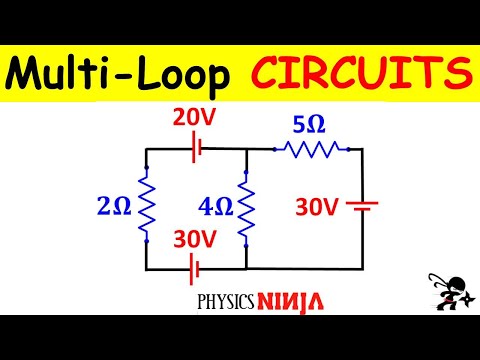
Solving circuit problems with Kirchhoff's rules (Physics Ninja). Watch how currents are labelled, loops chosen and the simultaneous equations solved for a circuit with more than one source.
Practice
Key points
Sources and credits
The diagrams, the method, the experiment, the worked examples and the practice exercises are written by Ganzaa.
Quick check