Major Ancient Civilizations
Senior 4 · History
Major Ancient Civilizations
Lesson 2 of 5
25 min
At the end of the first year of the Peloponnesian War between Athens and Sparta (431 to 404 BCE), the Athenian leader Pericles gave a speech at the annual public funeral of the war dead. The historian Thucydides, himself an Athenian, recorded it:
"Our constitution does not copy the laws of neighbouring states; we are rather a pattern to others than imitators ourselves. Its administration favours the many instead of the few; this is why it is called a democracy. If we look to the laws, they afford equal justice to all in their private differences"
Thucydides, History of the Peloponnesian War, Book 2, translated by Richard Crawley.
Read it as a historian, not as a believer. Who is speaking? A leader praising his own city at a funeral, in wartime. Why? To give meaning to the deaths and to keep citizens fighting. What is left out? The "many" Pericles praises were only the adult male citizens. How close is the record? Historians do not agree how closely Thucydides' version follows the words Pericles actually spoke. A source like this is excellent evidence of what Athenians believed about themselves, and weaker evidence of how equal Athens really was.
Definition
Democracy (Greek demos, people, and kratos, power): government in which the citizens decide public matters. Athens practised direct democracy: citizens voted on laws themselves instead of electing representatives.
Sortition: choosing officials by lot, like a lottery, so that any citizen might hold office. Ostracism: a vote by which Athenian citizens could expel a man from the city for ten years.
Oligarchy: rule by a few. Sparta was an oligarchy. Philosophy (Greek: love of wisdom): the use of reason to answer questions about knowledge, right and wrong, and how to live.
Athenian democracy grew in stages. Solon reformed the laws in 594 BCE; Cleisthenes' reforms of 508 to 507 BCE broke the power of the noble families by organising citizens into ten groups by where they lived rather than by wealth, and expanded the Council to 500 members, chosen by lot every year. Ephialtes made further reforms in 462 BCE. Most officials were chosen by lot, and a smaller number were elected by the Assembly.
Sparta shows that "Greek government" meant many different things. Sparta was an oligarchy with two hereditary kings of equal authority, a council of elders (the Gerousia: 28 men over 60, elected for life, plus the two kings) and officials called ephors, who decided cases and later took over foreign policy. All Spartan citizen men went through the harsh military training called the agoge. The work was done by helots, state-owned enslaved people who made up the vast majority of the population and revolted repeatedly.

| Element | Achievement | Key people and dates |
|---|---|---|
| Philosophy | Questioning by reason: Socrates' method of question and answer; Plato's Academy, a school in Athens; Aristotle's logic and study of nature, politics and ethics | Socrates (c. 470 to 399 BCE, sentenced to death in 399 BCE); Plato founded the Academy c. 387 BCE; Aristotle (384 to 322 BCE) tutored Alexander from 343 BCE |
| Mathematics and science | Geometry proved step by step from definitions; measurement of the Earth | Euclid's Elements (c. 300 BCE, Alexandria), often called the most successful textbook ever written; Eratosthenes (c. 276 to 194 BCE) |
| Medicine | Diagnosis by careful observation of the patient, rather than by blaming the gods | Hippocrates of Kos (c. 460 to 370 BCE), traditionally called the "Father of Medicine" |
| History and literature | Writing history from inquiry and evidence; epic poetry; tragedy and comedy in open-air theatres | Herodotus, called "The Father of History" by the Roman orator Cicero; Thucydides; Homer's Iliad and Odyssey |
| Architecture and art | Three column styles, or orders: Doric (plain capital), Ionic (scroll capital) and Corinthian (leaf capital); lifelike sculpture | The Parthenon, temple of Athena on the Acropolis, built 447 to 438 BCE, decoration finished 432 BCE |
| Religion and sport | Many gods (Zeus, Athena, Apollo); festivals with athletic contests | The Olympic Games, traditionally dated from 776 BCE |

Much of what is called "Greek" science was done in Africa. Alexandria in Egypt, founded in 331 BCE, held the Library of Alexandria, part of a research institution called the Mouseion that the Ptolemies, the Greek kings of Egypt, built in the early 3rd century BCE. Euclid spent his career there. Its chief librarian Eratosthenes was born in 276 BCE in Cyrene, the Greek city in Libya you met in lesson 1.
Eratosthenes made the first known calculation of the Earth's circumference. He learned that at noon on the summer solstice a vertical rod at Syene (Aswan, in southern Egypt) cast no shadow: the Sun was directly overhead. At the same moment, a rod at Alexandria did cast a shadow.
Worked example
According to the later writer Cleomedes, Eratosthenes measured the shadow angle at Alexandria as about 7.2°. Because the Sun's rays are parallel, this equals the angle at the centre of the Earth between the two cities (alternate angles). 360° ÷ 7.2° = 50, so the distance Syene to Alexandria is one fiftieth of the circumference. Professional pacers had measured that distance as about 5,000 stadia. So the circumference is 50 × 5,000 = 250,000 stadia. The method was sound; its two assumptions were slightly off, since Syene lies about 1° north of the Tropic of Cancer and about 3° east of Alexandria.
Warning
Do not write that "the Greeks invented democracy for everyone". Athenian democracy was direct and remarkable, but only free adult male citizens took part, probably no more than 30% of adults. Women, enslaved people and metics were excluded. An A-level answer states both the achievement and its limits.
Tip
PRIEST helps you list elements of any civilisation: Politics, Religion, Ideas (philosophy, science), Economy, Society, Technology and the arts. Use it to plan "describe the elements of Greek (or Roman) civilisation" answers, then give one named example with a date under each heading.
Important
Discuss. Athens chose most officials by lot, while Rwanda today elects its leaders. Some modern countries use lot to pick citizens' panels or juries. What are the strengths and weaknesses of choosing public officials by lot instead of by election? Would you trust a lottery to choose your school's student leaders? Give reasons.
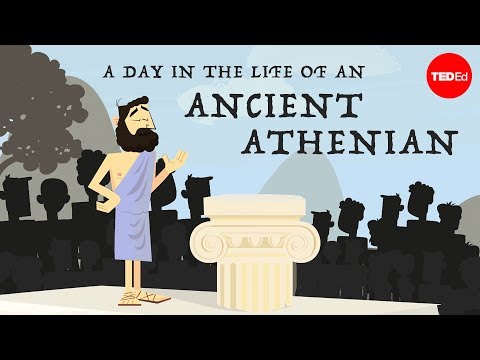
TED-Ed, "A day in the life of an ancient Athenian", by the historian Robert Garland. Follow one citizen through a day in 5th-century Athens. Watch for the places where he takes part in public life, and notice who is NOT taking part.
Practice
Key points
Sources and credits
Written by Ganzaa: the analysis, the democracy and Eratosthenes diagrams, the tables, the worked example and the exercises. This lesson adapts CC BY-SA material and is shared under CC BY-SA 4.0.
Quick check
Match each Greek to the field in which he is best known.
Tap one on the left, then its partner on the right.