Firm Behaviour
Senior 4 · Economics
Firm Behaviour
Lesson 2 of 5
30 min
Rwanda has 30 districts. If businesses were spread evenly, each would host about 3.3% of them. NISR's Establishment Census of 2023 found something very different: Gasabo (9.3%), Nyarugenge (8.4%) and Kicukiro (6.3%), the three districts of the City of Kigali, together hosted 24.0% of all establishments. Between 2020 and 2023 the number of establishments in urban areas grew by 44.6%, while in rural areas it fell by 3.4%.
Firms are not scattered at random. A tea factory sits among tea gardens, while banks, phone shops and restaurants crowd into city centres. This lesson explains where firms choose to locate, and why firms of the same industry so often cluster together.

Definition
Location of a firm: the choice of the place where a firm sets up its plant.
Localisation of industry (concentration): the gathering of many firms of the same or related industries in one area.
Delocalisation (dispersal): the spreading of firms of an industry over many areas.
Example: a coffee exporter choosing a site for its warehouse is making a location decision; the many furniture workshops in one neighbourhood of a town are an example of localisation.
A firm seeks the site where the total cost of producing and delivering its product is lowest, or where its revenue is highest. The main factors:
| Factor | How it pulls the firm | Example |
|---|---|---|
| Raw materials | Weight-losing, bulky or perishable materials pull the plant to the source | Tea factories among the tea gardens; cement plants near limestone |
| Market | Weight-gaining, fragile or perishable products, and most services, pull the firm to its customers | Bakeries, soft-drink bottlers, banks, salons |
| Transport and communication | Good roads, an airport or a border post cut the cost of moving inputs and output | Warehouses near main highways and border crossings |
| Power and water | Reliable, cheap electricity and water | Factories along the grid; washing stations by streams |
| Labour | Enough workers with the right skills, at acceptable wages | Call centres and software firms in cities |
| Land | Cost, size and suitability of the site | Large plants on cheaper land at the edge of towns |
| Government policy | Industrial parks, special economic zones, tax incentives, zoning rules | Firms moving into designated zones |
| External economies | Being near related firms, suppliers, banks and repair services | Garages that cluster in one quarter of a town |
| Security and stability | Safety of property and of workers | Investors avoid insecure areas |
| Personal and historical reasons | The founder's home area, or an early start that others followed | A family firm that stays in its home town |
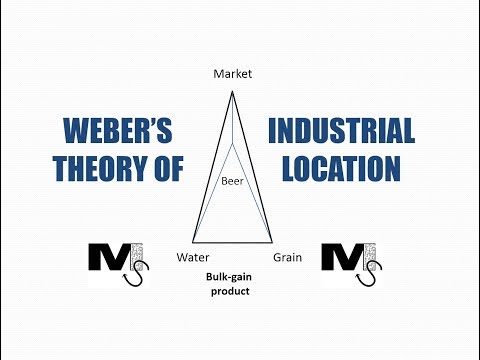
Weight-losing or weight-gaining? The German economist Alfred Weber (1909) compared the weight of the localised raw materials with the weight of the product. If the materials weigh more than the product (a weight-losing process), it is cheaper to process them where they are found and carry the lighter product. If the product weighs more than the materials, because a widely available input such as water is added (a weight-gaining process), it is cheaper to produce near the market.
Government policy in Rwanda. The Ministry of Trade and Industry (MINICOM) states that Rwanda has developed special economic zones and industrial parks across the country, which give investors access to affordable land, modern infrastructure and business-friendly policies, with incentives such as tax exemptions and duty remissions.

Worked example 1: where should a tea factory be built? (illustrative figures)
Suppose 4.5 tonnes of green leaf make 1 tonne of made tea, and road transport costs Frw 60,000 per tonne per 100 km. The tea gardens are 150 km from Kigali, where the tea is sold to exporters.
Option A: factory at the gardens. Carry 1 tonne of made tea 150 km: francs per tonne of tea.
Option B: factory in Kigali. Carry 4.5 tonnes of green leaf 150 km: francs per tonne of tea.
Decision: option A saves francs on every tonne. Tea making is weight-losing, so the factory goes to the raw material. The leaf also wilts within hours, which would rule out option B even if transport were cheap.
Reading the chart. The three red bars, the City of Kigali, stand far above the average district. Several of the next districts contain large secondary towns or busy border crossings, such as Musanze, Rubavu and Rusizi. Firms cluster because being near other firms, customers and services lowers their costs.
Causes of localisation. (1) Natural advantages: soil, climate or raw materials found in one area. (2) A large market nearby. (3) A pool of skilled labour that grows as the industry grows. (4) Good infrastructure: roads, power, water, telecommunications. (5) Ancillary (supporting) firms that supply parts and services. (6) The reputation of an area for a product. (7) Government policy, such as industrial parks. (8) Historical accident: an early firm attracts others.
| Merits of localisation | Demerits of localisation |
|---|---|
| External economies: shared roads, power and water; specialised suppliers and repair shops | Over-dependence: if the main industry declines, the whole area suffers unemployment |
| A ready supply of skilled labour; training institutions grow up nearby | Congestion, high rents and land prices |
| Specialised banking, insurance and marketing services | Pollution and pressure on housing, water and sanitation |
| Easier exchange of information and ideas; research centres | Regional imbalance: other areas fall behind, and rural–urban migration grows |
| The area's reputation helps every firm sell | Strategic risk: one disaster can hit a whole industry |
Government response. To spread development, governments can offer incentives to firms that locate in less developed areas, build industrial parks outside the capital, improve roads and power across the country, and restrict new building in congested centres.
Worked example 2: measuring concentration with the census
(a) Kigali's share: of establishments in 3 of 30 districts, which is 10% of the districts.
(b) Concentration ratio for Gasabo: , so Gasabo has about 2.8 times the establishments of an average district.
(c) Growth gap: urban establishments grew by 44.6% and rural ones fell by 3.4% (2020–2023). If an urban area and a rural area each had 10,000 establishments in 2020, by 2023 the urban area would have and the rural area .
(d) Interpretation: firms are concentrating where markets, infrastructure and services already exist: localisation is growing, with both its merits (external economies) and its demerits (regional imbalance).
Warning
Location and localisation are different questions. Location asks where ONE firm should go; localisation describes MANY firms of an industry gathered in one area. And a "weight-losing" industry is one whose raw materials weigh more than its product, not one whose product is light.
Tip
"Heavy in, light out: go to the source. Light in, heavy out: go to the market." Then check perishability, power, labour and policy.
Important
Discuss. Should the government encourage new factories to locate outside Kigali? Weigh the external economies firms enjoy in Kigali against the costs of congestion and regional imbalance.
Mister Simplify, "Weber's Theory of Industrial Location (Least Cost theory) - Simplest Explanation". Watch for the material index, the difference between weight-losing and weight-gaining industries, and how labour costs and agglomeration can pull a factory away from the least-transport-cost site.
Practice
Key points
Sources and credits
Written by Ganzaa: the text, the district chart (drawn to scale from the NISR figures), the tables, the worked examples and the practice items. The tea and cassava transport figures are illustrative.
This lesson adapts CC BY-SA material and is shared under CC BY-SA 4.0.
Quick check
Making a product uses 4 tonnes of raw material for every tonne of output. Where will a firm seeking the lowest transport cost usually locate?