First Aid
Senior 4 · English
First Aid
Lesson 3 of 5
25 min
Let's begin
First aid English has its own grammar. It gives orders (Press firmly), it gives advice (You should take a course), it states rules (You must wear gloves), it forbids (You mustn't use ice), and it says what is not necessary (You don't have to be a doctor). Each of these jobs has its own form, and mixing them up can change a safe instruction into a dangerous one. This lesson sorts them out.
Written by Ganzaa for an imagined school first aid team. Imperatives are in bold; modal verbs are underlined.
Our first aid team: rules and advice
Rules. Team members must complete a certified first aid course before they join. You have to sign the first aid book every time you help someone, because the school needs a record. You mustn't give anyone medicine: that is the nurse's job.
At an emergency. Check that the scene is safe. Shout for help and call 112 or 912. Don't move anyone who has fallen from a height. Never leave an unresponsive person alone.
Advice. You should keep your phone charged during school hours. You ought to practise the recovery position every term. If you see a burn, you'd better start cooling it at once, or it will get worse. You don't have to be a doctor to help: you just need to stay calm and follow the steps.
| Form | Example | Use |
|---|---|---|
| base verb | Press firmly on the wound. | a direct instruction |
| don't + base verb | Don't use ice. | a negative instruction |
| always / never + base verb | Never leave an unresponsive person alone. | a rule for every time |
| do + base verb | Do call 912 if you're not sure. | strong emphasis or encouragement |
| let's + base verb | Let's practise the recovery position. | a suggestion that includes the speaker |
In an emergency, imperatives are not rude: they are clear. In everyday requests, soften them with please or a question (Could you pass the gloves?).
| Form | Example | Notes |
|---|---|---|
| should / shouldn't + base verb | You should take a first aid course. | the most common way to advise |
| ought to + base verb | You ought to practise every term. | the same as should, a little more formal; the negative ought not to is rare |
| had better ('d better) + base verb | You'd better cool it now, or it will blister. | stronger: a warning that something bad will happen if you don't; about now, not the past |
| it's best to / why don't you …? | It's best to lean forward. | softer, friendly advice |
| Meaning | Form | Example |
|---|---|---|
| Strong obligation: the speaker or a written rule decides | must + base verb | Team members must complete a course. |
| Obligation from outside: a rule, law or situation | have to / has to; past: had to; future: will have to | We had to call an ambulance. |
| Necessity | need to | You need to stay calm. |
| Prohibition: it is wrong or not allowed | mustn't; be not allowed to | You mustn't give medicine. |
| No obligation: it is not necessary (but allowed) | don't have to; needn't; don't need to | You don't have to be a doctor. |
The most important contrast: You mustn't move him = don't move him! You don't have to move him = moving him is not necessary, but you may if you need to. In first aid, confusing the two can hurt someone.
Pronunciation: mustn't is /ˈmʌsnt/, with no first t; ought to is /ˈɔːt tə/; in fast speech should have sounds like /ˈʃʊdəv/, but it is never written "should of".
Worked example 1: choosing the modal from the situation
Worked example 2: what went wrong? Using should have
Situation (from Lesson 2): When a girl fainted at assembly, everyone stood around and nobody did anything.
Warning
Tip
"Mustn't" stops you; "don't have to" frees you. If the sentence would make a good warning sign (DO NOT …), you need mustn't. If it would make a relieved sigh (Oh good, it's not necessary), you need don't have to.
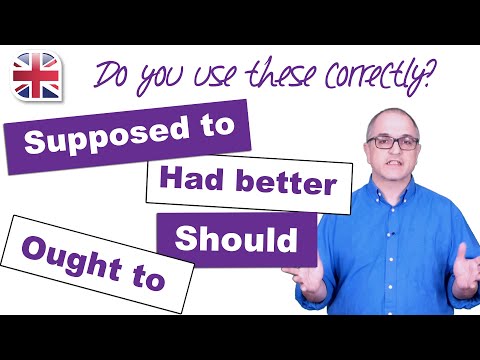
How to Use Should, Ought to, Supposed to and Had Better, Oxford Online English (about 14 minutes, 2017). Listen for how 'had better' differs from 'should', and for the past forms the teacher uses to criticise.
Practice
Key points
Sources and credits
Quick check
You ___ use ice on a burn: it deepens the injury.