Business
Senior 4 · English
Business
Lesson 1 of 5
25 min
Let's begin
Every business you know, from the kiosk at the school gate to the bank in town, began as one person noticing a problem and deciding to solve it for money. That person is an entrepreneur. Most new businesses do not grow in a straight line; they move through stages, and many fail at the same few points. This lesson's article follows an imagined young entrepreneur through those stages, and then looks at a real company that tested a bold idea in Rwanda before taking it to the world.
A feature article written by Ganzaa. Clarisse Uwera and her business are imagined, and the figures are illustrative. The facts about business registration and about Zipline come from the sources listed at the end of the lesson.
1 An entrepreneur is someone who sets up a business and takes the risk of losing money in the hope of making a profit. The word sounds grand, but most entrepreneurs start very small. What separates the ones who succeed from the ones who give up is rarely a brilliant idea. It is usually a habit of testing, measuring and learning at every step.
2 Spot a need. When Clarisse Uwera was nineteen, she noticed something about the boarding school near her home in Nyagatare. Its kitchen bought eggs from a trader in Kigali, and the eggs often arrived late, and some of them broken. The school needed eggs that were fresh, reliable and close by. That was a need, and a need is the beginning of every business.
3 Test small. Clarisse did not borrow a large sum. With 60,000 Frw of savings and a small loan from her aunt, she bought twenty laying hens and sold their eggs to neighbours and, after some persuading, to the school kitchen. She wrote every sale and every cost in an exercise book. After three months the book told her three things: people wanted her eggs, the hens ate more than she had expected, and her profit was very small. Testing small meant that her mistakes were small too.
4 Start properly. Clarisse then registered her business. In Rwanda, registration is done online, free of charge, and normally takes about six working hours. She opened an account at her sector's savings and credit cooperative (SACCO) and, for the first time, kept the business's money apart from her own. "That was the day it stopped being a hobby," she says.
5 Grow. Growth needs money, and money needs evidence. Because Clarisse could show the SACCO a year of records, it agreed to lend her enough to build a proper henhouse and buy 180 more hens. She hired two workers and paid a motorcycle taxi to deliver to three schools. Growth brought new problems: one wet season, a disease killed thirty hens in a week. Now she pays a vet to vaccinate every new bird.
6 Sustain and scale. Today Clarisse has year-long contracts with the schools, so she knows her income in advance. She puts part of each month's profit back into the business, and she has found a second product in what was once waste: the hens' manure, which local farmers buy as fertiliser. Her plan for next year is not more hens but a better market: hotels in the district.
7 Case study: a real idea that took off. Not every business starts with hens. Zipline, an American company, designs drones that deliver medical supplies. In October 2016, after an agreement with the Government of Rwanda, it began delivering blood by drone to rural health facilities from a distribution centre in Rwanda. A second Rwandan centre opened in 2018, and deliveries grew to include vaccines and medicines. The company later took the same service to Ghana, Nigeria, Kenya and other countries, and by January 2026 its drones had completed more than two million commercial deliveries. Like Clarisse, Zipline tested its idea in one place, measured the results with a partner, and only then grew.
Definition
Glossary

| Word or phrase | Meaning | Example |
|---|---|---|
| make a profit / make a loss | earn more / less than you spend | In her first month she made a small profit. |
| break even | earn exactly what you spend | Most businesses take months to break even. |
| take out a loan / pay back a loan | borrow money formally / return it | She took out a loan from the SACCO. |
| cash flow | the money coming into and going out of a business over time | Year-long contracts improved her cash flow. |
| a gap in the market | a need that no business meets yet | Fresh local eggs were a gap in the market. |
| supply / demand | how much is offered / how much people want | Demand for eggs rises when schools open. |
| customer / client | a person who buys goods / a person who buys a service, often regularly | The schools became her biggest clients. |
Worked example: describing figures in English
Clarisse's notebook for one test month (illustrative): 20 hens laid about 16 eggs a day; she sold them at 120 Frw each; she spent 40,000 Frw on feed, 5,000 Frw on medicine and 4,000 Frw on transport.
Tip
Read business texts for the stage. As you read about any business, ask: which stage is it at now, and what evidence moved it to the next one? The answer is usually a number: customers, sales, a loan, a contract.
Warning
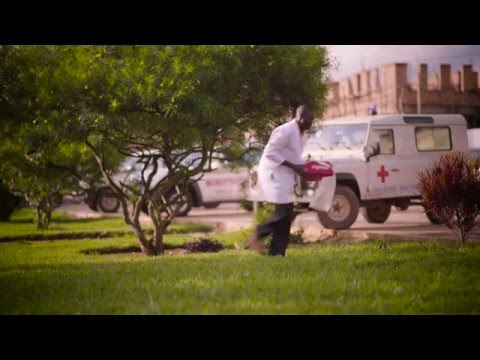
Zipline in Rwanda, Zipline (about 3½ minutes, 2016). Made before the service began, it explains the idea the company was about to test. Listen for the problem it wanted to solve and the partnership it describes.
Practice
Key points
Sources and credits
Quick check
Put the five stages of business development in order.
Tap the cards in the right order.