Effective Communication
Senior 4 · General and Religious Studies
Effective Communication
Lesson 3 of 5
30 min
Two students answered the question "Should boarding schools allow students to keep mobile phones?" Read both.
Version A: "Phones are good and also bad. Some students use them for bad things like games and some for good things. In my opinion I think that schools should think about it because phones are part of life today and many people have them so it is a big issue for everyone."
Version B: "Boarding schools should allow phones, but only at set times. A phone lets a student call home in an emergency and opens dictionaries and revision materials that small schools cannot afford in print. Yet a phone kept under the pillow costs sleep, and a group chat during lessons steals attention. Set times, for example an hour each evening with phones kept by the matron overnight, keep the benefits and remove most of the costs. The real question, then, is not whether to allow phones but when."
Version A has opinions but no clear point, no reasons a reader can test and no conclusion. Version B makes one claim, supports it, deals with the other side and ends by linking back to the question. The difference is not talent. It is a process, and this lesson teaches it.
Definition
Text: any piece of language, written or spoken, that communicates a complete message: a letter, an essay, a speech, a notice.
Purpose: what a text is meant to do (inform, explain, describe, narrate, persuade, instruct). Audience: who it is for.
Register: the level of formality of the language. Formal register suits an application letter; informal register suits a message to a friend.
Topic sentence: the sentence, usually first, that states the main point of a paragraph.
Revising: improving the content and organisation of a draft. Editing: improving sentences, word choice and grammar. Proofreading: a final check for spelling, punctuation and typing errors.
| Kind | Purpose | Typical features | Example |
|---|---|---|---|
| Narrative | Tell a story | Characters, events in time order, past tense | A short story about a journey home |
| Descriptive | Help the reader see, hear or feel | Sensory details, precise adjectives | A description of Nyungwe forest at dawn |
| Expository | Explain or inform | Facts, definitions, clear headings, neutral tone | An article on how a cooperative works |
| Argumentative | Prove a position with reasons and evidence | Claim, reasons, evidence, counter-argument, conclusion | Version B above |
| Persuasive | Move the reader to act or believe | Appeals to values and feelings as well as reason | A speech asking students to join a tree-planting day |
| Procedural | Tell the reader how to do something | Numbered steps, commands, materials list | Instructions for registering for an exam |
Worked example: from ideas to an outline
Prewriting (brainstorm on "phones in boarding schools"): call home in an emergency; dictionaries and revision apps; digital skills; distraction in class; cyberbullying; lost sleep; theft; students without phones feel left out; set times; matron keeps phones at night.
Planning (outline):
Ideas such as "theft" and "students without phones feel left out" were left out of this paragraph; they could become a second paragraph in a longer essay. Planning means choosing, not only listing.
Worked example: the anatomy of a paragraph (PEEL)
| Part | From Version B |
|---|---|
| Point (topic sentence) | "Boarding schools should allow phones, but only at set times." |
| Evidence | "A phone lets a student call home in an emergency ... Yet a phone kept under the pillow costs sleep ..." |
| Explain | "Set times ... keep the benefits and remove most of the costs." |
| Link | "The real question, then, is not whether to allow phones but when." |
Linking words carry the reader from one idea to the next: first, moreover, however, yet, for example, as a result, therefore, in conclusion.
Warning
Do not edit before you revise. Polishing the spelling of a paragraph that you will later delete wastes time. Fix the big things (point, evidence, order) first, the small things (commas, spelling) last. And do not copy another writer's sentences as your own: that is plagiarism. Use your own words, and name your source when you use someone's idea or data.
Tip
Read it aloud. When you revise, read your draft aloud, or ask a friend to read it to you. Your ear catches missing words, sentences that are too long, and places where the meaning jumps.
Important
Discuss. Many students now use AI tools that can produce a draft in seconds. Which stages of the writing process can such a tool help with, and which must remain the writer's own? What would be dishonest use?
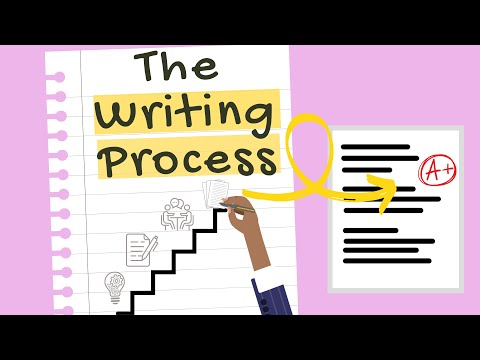
Tech meets Rhet: "The Writing Process: A Step by Step Guide to Academic Writing", about 5 minutes. Note what the video says happens at each stage, and where it says writers loop back.
Practice
Key points
Sources and credits
Written by Ganzaa: the two versions, Figure 4, the tables, the worked examples and the exercises. PEEL is a common classroom acronym for paragraph structure; the explanation here is Ganzaa's own.
Quick check
Put the stages of the writing process in order.
Tap the cards in the right order.