Effective Communication
Senior 4 · General and Religious Studies
Effective Communication
Lesson 2 of 5
25 min

Study the billboard. It has six words. Drivers pass it in a few seconds, so it must work fast. Is it effective communication?
In its favour: it is short; the two halves rhyme and contrast ("thrills" and "kills"), which makes them easy to remember; the colours separate the two ideas; the red ribbon is a symbol many people recognise. Against it: it tells people to "beware" but not what to do: where to get tested, how to protect themselves, where to find treatment. It relies on fear, which can make people avoid testing, and it can attach shame to people living with HIV. A message can be memorable and still fail its purpose. This lesson gives you the tools to judge.
Definition
Effective communication: communication in which the receiver understands the message as the sender meant it, and the message achieves its purpose (to inform, persuade, request or record).
Barrier to communication: anything that stops a message from being sent, received or understood as intended.
Jargon: specialist words that outsiders do not understand. Example: a doctor telling a farmer about "hypertension" instead of "high blood pressure".
Active listening: listening with full attention in order to understand, and showing it by paraphrasing, asking questions and summarising.
Assertive communication: stating your needs and views honestly and clearly while respecting the rights and feelings of others.
| Quality | Weak message | Stronger message |
|---|---|---|
| Clear: one main idea, plain words | "The thing for the parents is soon." | "The parents' meeting is on Saturday 14 March." |
| Concise: no unnecessary words | "We would like to take this opportunity to inform you that at this point in time ..." | "Please note that ..." |
| Concrete: specific facts and figures | "Fees must be paid early." | "Pay the second-term fees by 10 January." |
| Correct: accurate facts, spelling and grammar | "The meating is in the hall at 2 p.m." (the meeting is at 3 p.m.) | "The meeting is in the hall at 3 p.m." |
| Coherent: ideas in a logical order | Details first, purpose last | Purpose first, then details, then action |
| Complete: everything the receiver needs | "Bring your documents." | "Bring your report card and a copy of your national ID." |
| Courteous: respectful tone | "Late payers will be punished!" | "Families who need more time, please speak to the bursar before 10 January." |
| Barrier | Example | How to overcome it |
|---|---|---|
| Physical | Noise in a market; a poor phone signal; distance | Choose a quiet place; use a better channel; check the line |
| Language | Jargon; a language the receiver does not know well; ambiguous words | Use the receiver's language; plain words; explain terms |
| Psychological | Anger, fear, stress, lack of interest | Wait until people are calm; show empathy |
| Cultural | Gestures or eye contact that mean different things in different cultures | Learn the receiver's customs; ask when unsure |
| Perceptual | Assumptions and stereotypes about the sender or receiver | Listen to the message, not the label; check your assumptions |
| Technological | No electricity, no data, a broken device | Use a second channel that does not depend on it |
| Information overload | Thirty messages in a class WhatsApp group in one hour | Fewer, shorter messages; put the key point first |
| Hierarchy | A junior worker afraid to tell the manager about a problem | Create safe upward channels; reward honest reports |
Effective communication is two skills. The first is active listening: give full attention (put the phone away); do not interrupt or plan your reply while the other person speaks; paraphrase ("So you're saying that ..."); ask open questions ("What happened next?"); and summarise at the end. The second is assertiveness, shown in Figure 3.
A useful pattern for an assertive message has three parts: the fact ("When my notes come back late"), the effect ("I can't revise"), and a request or offer ("I'm happy to lend them until Friday evening"). It criticises the behaviour, not the person.
Warning
Sending is not communicating. A common mistake in answers and in life is to judge a message by whether it was sent ("I announced it on the radio") instead of whether it was understood and acted on. Always plan for feedback: ask a question back, count replies, or check who came.
Tip
Say it, check it. After giving important instructions, ask the receiver to tell you in their own words what they will do. If their version differs from yours, the fault is usually in the encoding, not in the listener.
Important
Discuss. Redesign the billboard in the photo for young people in Rwanda today. Keep it short enough to read in five seconds, but make it tell people what to do. Which of the seven Cs does your version improve, and which channel besides a billboard would you add?
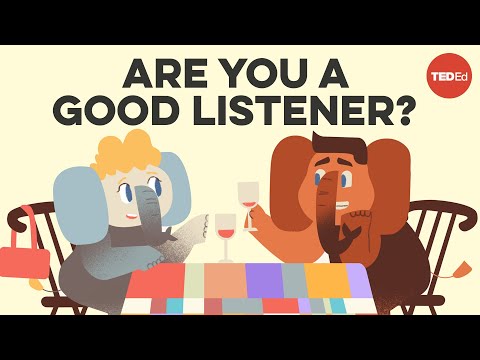
TED-Ed: "4 things all great listeners know". Listen for the habits that block listening and the techniques that improve it, and compare them with the active listening steps above.
Practice
Key points
Sources and credits
Written by Ganzaa: the analysis of the billboard, Figure 3, the tables of the seven Cs and of barriers, and the exercises. The "seven Cs" is a widely taught checklist of business communication; the version here is Ganzaa's own wording.
This lesson adapts CC BY-SA material and is shared under CC BY-SA 4.0.
Quick check
Match each problem to the barrier it shows.
Tap one on the left, then its partner on the right.