Chemical Basis of Life
Senior 4 · Biology
Chemical Basis of Life
Lesson 4 of 5
25 min
On a cool morning, ghee (clarified cow butter) in a jar is a soft solid, while groundnut oil in a bottle beside it pours freely. Both are almost pure triglycerides, and both store about twice as much energy per gram as sugar. Why should one be solid and the other liquid? The answer lies in a single kind of bond in their fatty acid chains, and the same bond decides how "healthy" a fat is considered to be.
Definition
Lipid: a member of a varied group of organic compounds that are insoluble in water but dissolve in organic solvents such as ethanol. They include fats and oils, phospholipids, waxes and steroids.
Fatty acid: a hydrocarbon chain with a carboxyl group, , at one end. Saturated: no carbon–carbon double bonds, so the chain holds the maximum number of hydrogen atoms. Unsaturated: one (monounsaturated) or more (polyunsaturated) C=C double bonds.
Triglyceride: one glycerol molecule joined to three fatty acids by ester bonds, formed by condensation.
Phospholipid: glycerol joined to two fatty acids and a phosphate-containing group.
Steroid: a lipid built on four carbon rings joined together, for example cholesterol.
Glycerol, , has three OH groups. Each reacts with the COOH group of a fatty acid in a condensation reaction, so a triglyceride forms with three ester bonds and three molecules of water are released (Figure 1). Hydrolysis by lipase enzymes, in digestion, reverses this.
Figure 1. A triglyceride forms from glycerol and three fatty acids by condensation; each ester bond releases one molecule of water. The kinked middle chain is unsaturated.
The properties of a triglyceride depend on its fatty acids:
A saturated fatty acid with carbon atoms has the formula . Each C=C double bond removes two hydrogen atoms.
Worked example 1: how many double bonds?
Linoleic acid, found in sunflower oil, has the formula . Is it saturated, monounsaturated or polyunsaturated?


In a phospholipid, one fatty acid of a triglyceride is replaced by a phosphate-containing group. The molecule now has a charged, hydrophilic head and two non-polar, hydrophobic tails (Figure 2). In water, phospholipids arrange themselves with their heads facing the water and their tails hidden inside: this is how the bilayer of every cell membrane forms, as you saw in Unit 4.
Steroids look nothing like fats, but they are lipids because they are insoluble in water. Cholesterol sits between the phospholipids of animal cell membranes and controls their fluidity; the body also uses it to make steroid hormones (testosterone, oestrogen, cortisol), vitamin D and bile salts.
Waxes are esters of a fatty acid with a long-chain alcohol. They are very water-repellent: the waxy cuticle of a leaf cuts water loss, and insects are coated with a thin layer of wax.
Figure 2. A phospholipid (simplified) and a cholesterol molecule. Only the phosphate head of the phospholipid and the OH group of cholesterol are attracted to water.
| Function | Explanation | Example |
|---|---|---|
| Energy store | Oxidation releases about , about twice as much as carbohydrate or protein (about ), because fatty acids have many C–H bonds and little oxygen; insoluble, so stored without osmotic effects | Adipose tissue under the skin; oil in groundnut and sunflower seeds |
| Source of metabolic water | Oxidising fat produces more water per gram than oxidising carbohydrate | Embryos in bird and reptile eggs; animals of dry regions |
| Thermal insulation | Fat conducts heat slowly | Fat layer (blubber) of whales and seals |
| Electrical insulation | The lipid-rich myelin sheath insulates nerve axons | Fast nerve impulses in mammals |
| Protection and buoyancy | Fat cushions organs; it is less dense than water | Fat around the kidneys; buoyancy of aquatic mammals |
| Waterproofing | Lipids are hydrophobic | Leaf cuticle; oil from a bird's preen gland spread on its feathers |
| Membranes | Phospholipid bilayer; cholesterol controls fluidity | Every cell membrane |
| Hormones and vitamins | Made from cholesterol, or are lipids themselves | Testosterone, oestrogen; vitamins A, D, E and K are fat-soluble |
Worked example 2: why store fat and not glycogen?
An adult has about 15 kg of stored fat (an illustrative figure). Using for fat and for glycogen, (a) how much energy does the fat store hold, and (b) what mass of glycogen would store the same energy?
Worked example 3: metabolic water
The fat tripalmitin is oxidised completely: Compare the mass of water produced per gram with that from glucose: . (: C = 12, H = 1, O = 16.)
Ethanol is highly flammable: keep it well away from any flame.
The World Health Organization's "Healthy diet" fact sheet (January 2026) advises adults to take no more than 30 % of their daily energy from fat, no more than 10 % from saturated fat (fatty meat, butter, ghee, palm and coconut oil, cream, cheese) and no more than 1 % from trans fat, and to replace them with unsaturated fats from plant oils, fish, avocado and nuts. Diets high in saturated and trans fats raise blood cholesterol, which contributes to fatty deposits in arteries (atherosclerosis), heart attacks and strokes.

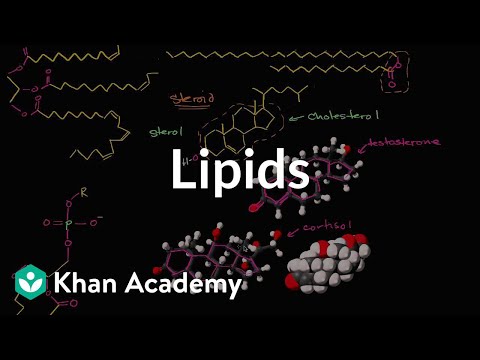
Khan Academy: "Lipid overview". Watch for how the fatty acid chains of a triglyceride are drawn, the difference between saturated and unsaturated chains, and the shapes of phospholipids and steroids.
Warning
Common mistakes
Tip
Memory hook. "Straight chains stack; kinks keep apart." Saturated chains are straight and stack into solid fats; the kinks of unsaturated chains keep molecules apart, giving liquid oils. For lipid functions, think "SWIMP": Store energy, Water (metabolic), Insulate, Membranes, Protect.
Practice: lipids
Key points
Sources and credits
Quick check
Why is groundnut oil liquid at room temperature while ghee is solid?