Trends in Chemical Properties of Group 14 Elements and Their Compounds
Senior 4 · Chemistry
Trends in Chemical Properties of Group 14 Elements and Their Compounds
Lesson 1 of 5
25 min
Rwanda is one of Africa's producers of tin ore: in 2019 its mines reported 3,727 tonnes of cassiterite, tin(IV) oxide, much of it from the Rutongo mines in Rulindo District. The tin from such ore coats the steel of food cans and joins the parts of every circuit board. Tin belongs to Group 14 together with carbon, silicon, germanium and lead, and this group shows the change from non-metal to metal more clearly than any other: at the top, carbon forms the hardest natural substance (diamond) and a soft, slippery solid (graphite); in the middle, silicon and germanium are the semiconductors of electronics; at the bottom, tin and lead are soft, low-melting metals. This lesson explains that change.

Definition
Group 14 (the carbon group): carbon (C), silicon (Si), germanium (Ge), tin (Sn), lead (Pb) and the artificial element flerovium (Fl). Each atom has the outer configuration . The common oxidation states are +4 and, increasingly down the group, +2. Example: is and is +4 in ; lead is +2 in .
Allotropes: different structural forms of the same element in the same physical state. Example: diamond, graphite and the fullerene are allotropes of carbon; white tin and grey tin are allotropes of tin.
Semiconductor: a solid whose electrical conductivity lies between that of a metal and an insulator, and increases as the temperature rises. Example: pure silicon and germanium.
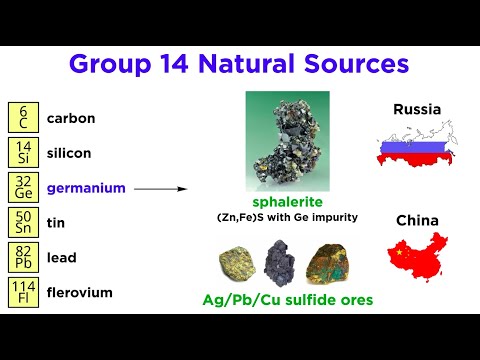
Table 9.1: Sources of the Group 14 elements
| Element | Main sources | Formula |
|---|---|---|
| Carbon | coal, graphite and diamond; carbonate rocks such as limestone; carbon dioxide in air; methane in natural gas | C; ; ; |
| Silicon | sand and quartz; silicate minerals and clays. Silicon is the second most abundant element in the crust (28.2% by mass), after oxygen | ; silicates |
| Germanium | a by-product of zinc refining and of coal ash | no common ore |
| Tin | cassiterite | |
| Lead | galena | PbS |
Tin and lead are extracted by reduction with carbon. Cassiterite is heated with coke: . Galena is first roasted in air to the oxide, which is then reduced: , then . Silicon for steel-making is made in an electric arc furnace, , and then purified much further for electronics.

Table 9.2: The Group 14 elements
| Property | C | Si | Ge | Sn | Pb |
|---|---|---|---|---|---|
| Atomic number | 6 | 14 | 32 | 50 | 82 |
| Outer configuration | |||||
| Covalent radius / pm | 75 | 116 | 121 | 140 | 144 |
| First ionisation energy / kJ mol⁻¹ | 1086.5 | 786.5 | 762 | 708.6 | 715.6 |
| Electronegativity (Pauling) | 2.55 | 1.90 | 2.01 | 1.96 | 2.33* |
| Melting point / °C | sublimes, about 3600 | 1414 | 938 | 232 | 327 |
| Density / g cm⁻³ | 2.27 (graphite); 3.51 (diamond) | 2.33 | 5.32 | 7.29 | 11.34 |
| Structure | giant covalent (diamond, graphite) | giant covalent (diamond type) | giant covalent (diamond type) | metallic (white tin) | metallic |
| Electrical behaviour | diamond insulator; graphite conducts | semiconductor | semiconductor | metal | metal |
*The Pauling value for lead in its +4 state; for lead(II) the value is 1.87.
Figure 9.1: Melting points of the Group 14 elements. *Carbon (graphite) does not melt at atmospheric pressure; it sublimes at about 3600 °C.
Figure 9.2: First ionisation energies of the Group 14 elements.
Ordinary white tin is a shiny, soft metal. Below 13.2 °C it can slowly change into grey tin, a brittle, powdery solid with the same diamond-type structure as germanium. The change is slow, and it starts at points on the surface that spread like a disease, so it was called "tin pest". It is why tin objects left for long periods in very cold buildings can crumble. Grey tin is less dense, so the metal expands and falls apart as it changes.

Worked example 1: how much tin is in tin ore?
(a) Calculate the percentage by mass of tin in pure cassiterite, . : Sn 118.71, O 16.00. (b) Rwanda reported 3,727 t of cassiterite concentrate in 2019. If the concentrate were 70% by mass (an illustrative figure), what mass of tin could it give?
Solution. (a) (b) Mass of ; mass of tin , about 2100 t to two significant figures (the 70% has only two).
Worked example 2: explaining a property from structure
Diamond and graphite are both pure carbon. Explain why (a) diamond is much harder than graphite, (b) graphite conducts electricity but diamond does not, and (c) both have very high sublimation temperatures.
Solution.
Warning
Common mistakes. (1) Saying graphite is soft because its covalent bonds are weak: the bonds within a layer are stronger than those in diamond; only the forces between layers are weak. (2) Calling silicon a metal because it is shiny: it is a brittle semiconductor, a metalloid. (3) Expecting first ionisation energy to fall all the way down the group: lead's is slightly higher than tin's. (4) Thinking "pencil lead" contains lead: it is graphite mixed with clay.
Safety. Lead and its compounds are toxic, and the World Health Organization states that no level of exposure to lead is known to be without harmful effects; young children are the most at risk. Handle lead samples with gloves or wash your hands at once afterwards, never eat or drink in the laboratory, and never heat lead or its compounds outside a fume cupboard.
Tip
Group 14 in one line: a non-metal (C), two metalloids (Si, Ge) and two metals (Sn, Pb). Melting points collapse where giant covalent structures give way to metallic bonding, and the d and f electrons that shield poorly make germanium and lead hold their electrons more tightly than you would expect.
Professor Dave Explains: Periodic Table Part 5, the Carbon Group (11 min). Watch for the allotropes of carbon, why silicon and germanium are semiconductors, and how tin and lead differ from the elements above them.
Practice
Key points
Sources and credits
Quick check
Graphite conducts electricity but diamond does not. Why?