Laws of Thermodynamics
Senior 4 · Physics
Laws of Thermodynamics
Lesson 3 of 5
25 min
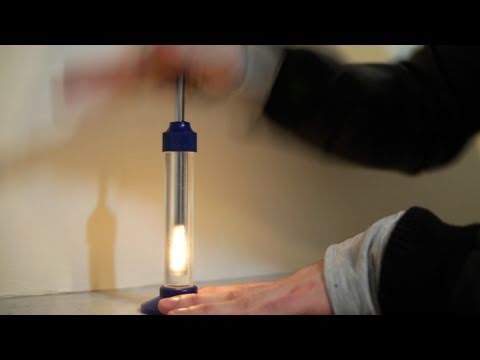
A fire piston is a narrow tube, closed at one end, with a tight-fitting piston. Put a wisp of cotton wool at the bottom and ram the piston down hard: the cotton bursts into flame, with no match and no spark. People in Southeast Asia made fire this way for centuries, and every diesel engine ignites its fuel the same way. The air is squeezed so fast that no heat can escape, so all the work done on it raises its internal energy, and its temperature shoots up by hundreds of degrees. A change in which no heat flows is called adiabatic. In this lesson you find the laws that adiabatic changes obey and use them to explain diesel engines, cool air from a tyre valve and the clouds that form over hills.
Definition
An adiabatic change is one in which no heat enters or leaves the system: . It happens when the system is perfectly insulated, or when the change is so fast that heat has no time to flow. By the first law, : a gas that expands adiabatically does work using its own internal energy and cools; a gas compressed adiabatically warms. Example: if a gas does 400 J of work while expanding adiabatically, its internal energy falls by 400 J.
For a small adiabatic change of moles of ideal gas, and the first law gives
using and . Integrating, is constant, so
Between two states, and ; in terms of pressure, . The work done by the gas is the fall in its internal energy:
Because , the curve constant, an adiabat, is steeper than the isotherm through the same point (Figure 3.1). In an isothermal expansion heat flows in to keep the gas warm; in an adiabatic one it does not, so the gas cools and its pressure falls further.
Figure 3.1: An isotherm and an adiabat through the same point A, for air (γ = 1.4). The adiabat is steeper.
Worked example 1: compressing air quickly
Air () at and 300 K is compressed adiabatically to one tenth of its volume. Find its new pressure and temperature.
The pressure rises 25 times, not 10 times as it would at constant temperature, and the air reaches 481 °C. That is hot enough to light cotton wool.
Worked example 2: the diesel engine
A diesel engine compresses air with a compression ratio of 18 (), starting at 300 K. Assuming an adiabatic compression, find the final temperature.
Diesel fuel sprayed into air this hot ignites by itself, so a diesel engine needs no spark plug. Petrol engines use much lower compression ratios, because a hot, compressed petrol–air mixture would ignite too early.
Worked example 3: work done in an adiabatic expansion
1.0 mol of a monatomic ideal gas expands adiabatically, and its temperature falls from 400 K to 300 K. Find the work done by the gas and its change in internal energy.
All the work comes from the gas's own internal energy, because no heat enters.
Figure 3.2: Air rising up a hillside cools as it expands; a cloud forms where its vapour condenses.
Worked example 4: how fast does rising air cool?
For dry air rising slowly, the cooling rate is , where is the specific heat capacity of air at constant pressure. Find the cooling per kilometre, and the cooling of air that rises 1.5 km.
Rising 1.5 km, dry air cools by about . (Once a cloud forms, condensation releases latent heat and the cooling slows.)


Warning
Common mistakes. (1) Thinking "adiabatic" means "constant temperature": it means no heat flow, and the temperature usually changes a lot. (2) Using constant with temperature-dependent quantities wrongly: use for temperatures and for pressures, with in kelvin. (3) Using for air: air is mainly diatomic, . (4) Forgetting that a real compression is only approximately adiabatic: some heat always leaks.
Tip
Fast or insulated means adiabatic. Then , so : squeeze it and it warms, let it expand and it cools. On a p–V graph the adiabat is steeper than the isotherm by the factor .
Fire Syringe (Veritasium). Watch the cotton wool ignite when the air is compressed very quickly, and listen for the explanation: the work done on the air raises its temperature because there is no time for heat to escape.
Practice
Key points
Sources and credits
Written by Ganzaa: the lesson text, derivations, diagrams, worked examples and practice exercises. This lesson adapts CC BY-SA material and is shared under CC BY-SA 4.0.
Quick check