Laws of Thermodynamics
Senior 4 · Physics
Laws of Thermodynamics
Lesson 4 of 5
25 min
In Unit 6 you saw that a steam power station turns only about a third of its fuel's energy into electricity, and sends about half of it to the cooling water. Engineers are not careless: no engine, however well built, could turn all the heat it takes in into work. A cup of hot tea cools to room temperature, but a cold cup never warms itself by taking heat from a cooler room, although that would not break the first law. Something beyond the conservation of energy decides which way heat flows and how much of it can become work. That is the second law of thermodynamics, the subject of this lesson, together with the engines, refrigerators and heat pumps it governs.
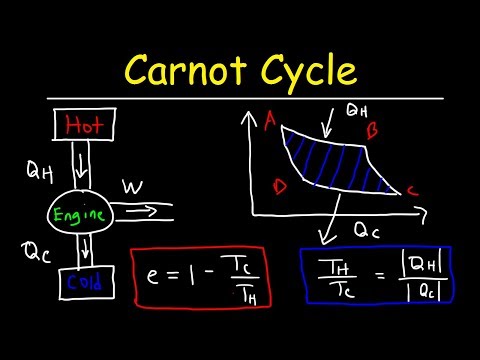
A heat engine is a device that works in a cycle, taking heat from a hot reservoir at temperature (burning fuel, hot steam), turning part of it into work , and giving out the rest, , to a cold reservoir at (the air, a river, cooling water), as in Figure 4.1. Over each complete cycle the working gas returns to its starting state, so and the first law gives
A refrigerator runs the cycle backwards: work from an electric motor drives heat out of the cold inside of the fridge and delivers to the warmer kitchen. Its usefulness is measured by its coefficient of performance, . A heat pump is the same machine used to warm a building; then the useful output is , and .
Figure 4.1: Energy flows in a heat engine and in a refrigerator or heat pump. Arrow widths suggest the sizes of the flows.
Definition
The second law of thermodynamics can be stated in two equivalent ways. Kelvin–Planck: no engine working in a cycle can take heat from one reservoir and turn all of it into work; some heat must always be given out to a colder reservoir. Clausius: heat cannot flow by itself from a colder body to a hotter one; moving heat "uphill" needs work. The efficiency of a heat engine is . Example: an engine that takes in 2000 J and rejects 1400 J per cycle does 600 J of work, so .
In 1824 the French engineer Sadi Carnot asked what limits the efficiency of an engine. He imagined an ideal, frictionless, perfectly slow engine whose gas goes round a cycle of two isothermal and two adiabatic changes (Figure 4.2), now called the Carnot cycle. Heat enters only at and leaves only at , and for this cycle , with temperatures in kelvin. Its efficiency is therefore
No engine working between the same two temperatures can be more efficient (if one could, it could be used to drive a Carnot engine backwards and move heat from cold to hot with no work, breaking the second law). Real engines, with friction, heat leaks and fast changes, always do worse. The lesson for engineers is clear: make as high and as low as the materials and surroundings allow. The best possible refrigerator has .
Figure 4.2: The Carnot cycle: two isothermal and two adiabatic changes. The net work per cycle is the enclosed area.
Worked example 1: the limit for a steam power station
A steam power station's turbines take steam at 540 °C and the condenser is at 30 °C. Find the Carnot efficiency, and compare it with the 32% of the station in Unit 6, Lesson 3.
Even a perfect engine could turn only 63% of the heat into work; real stations reach roughly half of this limit, because of heat leaking through the boiler, friction and the fact that heat is not all taken in at the top temperature. The heat dumped in the condenser is not waste from bad design: the second law demands it.
Car, lorry and motorcycle engines are internal combustion engines: the fuel burns inside the cylinder, and most work in a four-stroke cycle.
| Stroke | Petrol (spark-ignition) engine | Diesel (compression-ignition) engine |
|---|---|---|
| 1. intake | piston moves down, drawing in air mixed with petrol | piston moves down, drawing in air only |
| 2. compression | piston squeezes the mixture, typically to about to of its volume | piston squeezes the air much harder, to about to , heating it adiabatically |
| 3. power | a spark ignites the mixture; the hot gas pushes the piston down | fuel is sprayed into the hot air and ignites by itself; the hot gas pushes the piston down |
| 4. exhaust | piston moves up, pushing out the burnt gas | piston moves up, pushing out the burnt gas |
Table 4.1: The four strokes of petrol and diesel engines (typical compression ratios).
For an idealised petrol (Otto) cycle with compression ratio , the efficiency is . The higher the compression ratio, the higher the efficiency. Diesel engines use much higher compression ratios, which is the main reason they are more efficient than petrol engines, although real engines of both kinds reach only roughly half of their ideal efficiencies.
Worked example 2: compression ratio and efficiency
Find the ideal Otto-cycle efficiency for air () with compression ratios of 8 and 10.
Raising the ratio from 8 to 10 raises the ideal efficiency from 56% to 60%. A petrol engine cannot go much higher, because the mixture would ignite by itself during compression; a diesel compresses only air, so it can.
Worked example 3: a refrigerator
A refrigerator keeps its inside at 4 °C in a kitchen at 25 °C. (a) Find the greatest possible COP. (b) A real fridge with a COP of 3.0 uses 100 W of electrical power. At what rate does it remove heat from the food, and deliver heat to the kitchen?
(a) .
(b) removed; delivered to the kitchen. A fridge always heats the room more than it cools the food.
Definition
Entropy measures how spread out, or disordered, the energy of a system is. When heat enters a body at temperature , its entropy rises by . The second law can also be stated: in any natural process the total entropy of a system and its surroundings increases (or, in an ideal reversible process, stays the same). Example: when 300 J of heat flows from a body at 400 K to one at 300 K, the total entropy changes by : positive, so this is the direction heat flows naturally.

Warning
Common mistakes. (1) Using degrees Celsius in : temperatures must be in kelvin. (2) Thinking a better-built engine could reach 100%: the Carnot limit applies to every engine. (3) Thinking a refrigerator "makes cold": it moves heat out, and adds the work it uses, so the room warms. (4) Confusing COP with efficiency: a COP is usually greater than 1, because the work moves more heat than it supplies.
Tip
Hot in, work out, some heat always out. Draw the energy-flow diagram first (Figure 4.1), write , and only then calculate. For any limit, use kelvin: .
Carnot Cycle and Heat Engines, Maximum Efficiency and Energy Flow Diagrams (The Organic Chemistry Tutor). Watch how the energy-flow diagram gives W = QH − QC, and how the Carnot efficiency 1 − TC ÷ TH sets the limit, as in Worked example 1.
Practice
Key points
Sources and credits
Written by Ganzaa: the lesson text, derivations, diagrams, table, worked examples and practice exercises. This lesson adapts CC BY-SA material and is shared under CC BY-SA 4.0.
Quick check