Living Together in Community
Senior 4 · English (Languages)
Living Together in Community
Lesson 5 of 5
40 min
Let's begin
A summary is a test of understanding disguised as a writing task. To shorten a passage to a third of its length without losing its meaning, you must know which sentences carry the argument and which only support it. In this lesson you read an essay on how young people who move to cities rebuild the community they left behind, interpret the writer's argument and attitude, and then summarise it step by step. The lesson ends with the brief for the project that closes Units 1 and 2: "Guardians of culture".
An essay written by Ganzaa for this lesson.
1 When a young woman leaves her hill for the city, she carries more than a suitcase. She carries a lifetime of knowing whom to ask. At home, if her mother fell ill, an aunt arrived before anyone sent for her; if the roof leaked, the neighbours' sons came with a ladder. In the city, at first, she knows nobody, and nobody knows her. It is in this first year, many newcomers say, that they discover how much of their life was held up by other people.
2 It would be easy to conclude that the city destroys community. Rents are high, so people share small rooms with strangers; work is uncertain, so they move often; neighbours leave for their jobs before sunrise and return after dark. The extended family that once lived within shouting distance may now be a five-hour bus ride away.
3 Yet the conclusion is wrong, or at least too quick. What newcomers do, again and again, is rebuild the village in a new shape. They join savings groups at the market where they trade. They find people from their home district and meet on Sunday afternoons. They form football teams, choirs and prayer groups; they create telephone groups through which a hundred members can be told within minutes that someone's father has died, and through which money for the funeral arrives before evening.
4 These new communities differ from the old in one important way: people choose them. On the hill, you belonged to your neighbours whether you liked them or not. In the city, you belong to the groups you join and remain in. This gives the new communities a certain freedom, but also a weakness. A person who is too shy, too poor or too busy to join may fall through every net at once.
5 Old customs also travel to town and change their form. Community work still happens on the last Saturday of the month, but in a city estate it may mean clearing a drainage channel rather than a hillside path. Contributions to a wedding are still collected, but now through a phone instead of a basket. The form changes; the habit of helping does not.
6 The real question, then, is not whether the city will destroy community, but whether city dwellers will notice the people who belong to no group at all. The old village had no outsiders, because everyone had a place in it. The village in the city will only deserve its name when it, too, makes room for the stranger at the door.
Definition
Key terms
| Step | What you do | Applied to the essay |
|---|---|---|
| 1 Read for the whole | Read the passage twice; state its main idea in one sentence. | City newcomers rebuild community in chosen groups, but must include those who belong to none. |
| 2 Find each paragraph's point | Mark the topic sentence or write a five-word label for each paragraph. | 1 newcomers lose support; 2 city seems to destroy community; 3 but they rebuild it; 4 chosen groups: freedom and gaps; 5 customs change form; 6 include the outsider. |
| 3 Cut | Remove examples, lists, quotations, repetition and figures of speech. | Cut the ladder, the bus ride, the list of choirs and teams, the drainage channel. |
| 4 Paraphrase and combine | Put the points in your own words; join them with linking words. | "Although…", "Instead…", "However…" |
| 5 Check | Count the words; compare with the original; remove any opinion of your own. | Target: about 100 words, a quarter of the essay's 422. |
Worked example: summarising paragraph 3 (83 words) in one sentence
Notice that however keeps the logic of the original's Yet: a summary must keep the argument's turns, not only its facts.
Warning
Three summary mistakes. (1) Copying sentences: you lose marks for lifting whole lines; paraphrase. (2) Keeping the examples: "choirs, football teams and prayer groups" becomes "new groups". (3) Adding your opinion: a summary reports the writer's view, not yours. Words such as I think or I agree do not belong in it.
Tip
Generalise the list. When you meet a list of examples, find the category that covers them all: aunts, cousins and grandparents → relatives; a ladder, a meal, a loan → practical help. One general word replaces five specific ones.
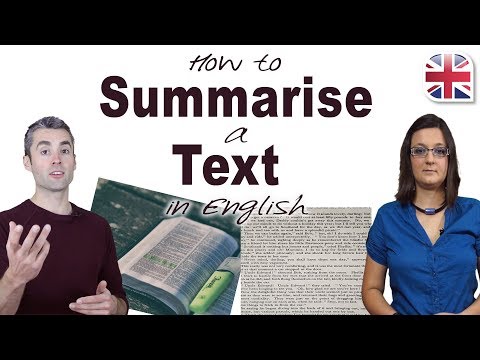
How to Summarise a Text in English, Oxford Online English (about 13 minutes, 2019). Watch how the teacher identifies the main idea of each paragraph before writing, as in step 2 of the table.
In about 100 words, summarise the argument of "The Village in the City". Use your own words and keep the writer's turns of argument.
Young people who move to the city lose the support network of relatives and neighbours they relied on at home, and city life, with its high rents, frequent moves and long working hours, seems to destroy community. However, newcomers rebuild it by forming new groups, from savings and sports clubs to telephone networks that raise help quickly, and old customs of mutual help continue in new forms. Because these groups are chosen rather than inherited, they offer freedom but may leave out those who join none. The writer concludes that city communities must find room for such outsiders. (98 words)
Units 1 and 2 have shown how a community keeps its stories and how it holds together. In this project your group becomes the community's memory.
| Criterion | Marks |
|---|---|
| Material collected respectfully and fully (story, two proverbs or riddles, a custom) | 5 |
| Accurate English retelling with correct narrative tenses | 5 |
| Introduction: genres correctly named and explained | 4 |
| Performance: clear voice, expression, audience involvement | 4 |
| Teamwork and acknowledgement of the elder | 2 |
| Total | 20 |

Practice
Key points
Further reading
Sources and credits
Quick check
Put the five steps of summarising in order.
Tap the cards in the right order.