Morals and Life Lessons
Senior 4 · English (Languages)
Morals and Life Lessons
Lesson 5 of 5
40 min
Let's begin
Aesop ends "Father and Sons" with three words: Union is strength. Maupassant ends "The Necklace" with a single line of dialogue, and never tells you what to think. Both stories teach, but in different ways: the fable states its moral; the modern short story lets the reader discover it. In this unit you have read moral stories from Rwanda, Russia and France. Now you write one. This lesson gives you a plan, a model and the techniques that turn a lesson into a story worth reading.
| Step | Question to ask yourself | Example |
|---|---|---|
| 1 Moral | What truth about life do I want the reader to feel? | Small courtesies to elders matter; ignoring them shames us. |
| 2 Character | Who has a want and a flaw that the moral will test? | Ishimwe wants rest before his exam; his flaw is selfishness disguised as tiredness. |
| 3 Test | What situation forces a choice? | An old woman with a heavy basket boards a full bus. |
| 4 Choice | What does the character decide, and why is it hard? | He pretends to sleep. |
| 5 Consequence | What follows from the choice? | Another woman, with a baby, stands instead; the old woman's gift shows she saw through him. |
| 6 Recognition | How does the character show what he has learned, without saying it? | He gives his seat to a pregnant woman before she reaches him. |
Written by Ganzaa; the characters are imagined.
1 Ishimwe had paid for the seat by the window, and he meant to keep it. The bus from Huye to Kigali was full before it left the bus park; by the edge of town, people were standing in the aisle, holding the rail above their heads.
2 At the second stop an old woman climbed in with a basket of mangoes on her hip. She looked down the bus, and her eyes stopped at Ishimwe. He turned to the window and closed his eyes. He had an exam on Monday, he told himself. He needed rest. Someone else would stand up.
3 Someone did. A market woman with a sleeping baby tied to her back rose from the seat across the aisle. "Sit, Mama," she said, and spent the rest of the way to Nyanza standing, swaying, one hand on the rail and the other steadying the child.
4 Ishimwe kept his eyes closed. He did not sleep. Each time the bus braked, he heard the market woman's feet shuffle to keep her balance, and each time it was harder to stay still.
5 At Nyanza the old woman got off. As she passed his seat, something heavy landed softly on his knee. He opened his eyes. It was a mango, the best in the basket, yellow and ripe. "For the young man who was so tired," she said, without a trace of a smile, and stepped down into the sun.
6 Ishimwe held the mango all the way to Kamonyi. He did not eat it.
7 At Kamonyi a young woman got on, heavily pregnant, with a bag of beans in her arms. Before she had reached the middle of the bus, Ishimwe was on his feet. "Please," he said. "Take the window. The view is better from here."
| Technique | Where | Effect |
|---|---|---|
| A first sentence that shows the want | "he meant to keep it" (1) | Sets up the test before it arrives. |
| Self-justification in the character's thoughts | "He had an exam on Monday, he told himself." (2) | We see him making excuses: indirect characterisation of his flaw. |
| A foil | the market woman with the baby (3) | Her sacrifice makes his selfishness visible. |
| Sound instead of sight | "he heard the market woman's feet shuffle" (4) | His eyes are closed, but his conscience is awake. |
| Irony | "For the young man who was so tired" (5) | The gift is kind and a rebuke at once: she knew he was not asleep. |
| A short paragraph for a turning point | "He did not eat it." (6) | Shows shame without naming it. |
| Recognition through action | "Ishimwe was on his feet" (7) | The moral is shown; it is never stated. |
Definition
Key terms
Worked example
From telling to showing
| Telling | Showing |
|---|---|
| Ishimwe felt guilty. | He held the mango all the way to Kamonyi. He did not eat it. |
| The old woman was tired. | She shifted the basket from one hip to the other and gripped the rail with both hands. |
| The market woman was kind. | "Sit, Mama," she said, and spent the rest of the way standing, one hand steadying the child. |
| He had learned his lesson. | Before she had reached the middle of the bus, Ishimwe was on his feet. |
The method: ask what a camera and a microphone would record (actions, words, sounds, objects) and write that.
| Ending | How it works | Use it when… |
|---|---|---|
| Stated moral (fable) | A final line names the lesson: Union is strength. | you write a fable with animal or unnamed characters, for young readers |
| Proverb ending | A character quotes a proverb that sums up the lesson, as Mutesi's son does in "The First Calf". | the proverb fits naturally in a character's mouth |
| Open ending, action | The last action shows the change: Ishimwe was on his feet. | you write a modern short story for older readers; examiners reward it |
Warning
Four ways to spoil a moral story. (1) Starting with the moral ("This is a story about respecting elders"). (2) A perfect hero: if the character never struggles, there is no test and no story. (3) A sermon at the end ("And so, dear reader, we must always…"). (4) A punishment out of all proportion, such as death for a small lie; it makes the story feel like a threat, not a truth.
Tip
Give the flaw a good excuse. Readers believe a character who has a reason: Ishimwe really does have an exam. The better the excuse, the harder the choice, and the stronger the moral.
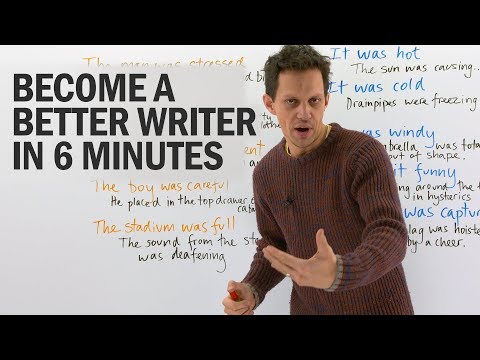
Improve your Writing: Show, Not Tell, engVid (about 6 minutes, 2017). Watch how plain sentences are turned into expressive ones, then rewrite two "telling" sentences from your own draft in the same way.
Write a story of 400–600 words that carries a moral lesson. Choose one of these, or your own:
Plan with the six steps first. Then write, and check your draft with a partner.
| Checklist | Yes / Not yet |
|---|---|
| The first paragraph shows the character's want. | |
| The flaw has a believable excuse. | |
| There is a clear test and a hard choice. | |
| The consequence follows logically and is in proportion. | |
| At least three feelings are shown, not told. | |
| The ending shows the change through action, or uses a fitting proverb; no sermon. | |
| Narrative tenses (Unit 1) and dialogue punctuation are correct. |
Practice
Key points
Further reading
Sources and credits
Quick check
Put the six steps for building a moral story in order.
Tap the cards in the right order.