Unity and Reconciliation
Senior 4 · English (Languages)
Unity and Reconciliation
Lesson 2 of 5
40 min
Let's begin
Most quarrels do not need a court. In Rwanda, a dispute between neighbours over a boundary, a debt or a goat is often heard first by Abunzi committees: people chosen from the community to help the two sides reach an agreement, whose work the Ministry of Justice coordinates. The same idea works in a school. A trained student, a peer mediator, sits with two classmates who have fallen out and helps them talk until they find their own solution. In this lesson you listen to one such session, learn the stages and the language a mediator uses, and then run a mediation yourselves.
Definition
Words you will hear
Important
Listening script: for a teacher or three classmates to read aloud
Only the readers open the script. It takes about four minutes. The school and the students are invented.
Bwiza: Good afternoon, both of you. Thank you for coming. My name is Bwiza, I'm in Senior 5, and I'm a peer mediator. I'm not a judge, and I won't decide who is right. My job is to help you talk so that you can find a solution yourselves. Before we start, can we agree on three ground rules? One person speaks at a time; no insults; and what we say here stays in this room. Is that all right with you, Mugisha?
Mugisha: Yes.
Bwiza: Ineza?
Ineza: Fine.
Bwiza: Good. Mugisha, you asked for this meeting, so would you like to start? Tell me what happened, from your side.
Mugisha: We were partners for the ICT project. I designed all twelve slides; I stayed up two nights doing it. Then on Friday Ineza posted the presentation on the class group with only her name on it. Everybody congratulated her. Nobody even knew I had worked on it.
Bwiza: So, if I've understood you correctly, you did most of the design work, and when the presentation was shared, your name wasn't on it, so you feel your work wasn't recognised. Is that right?
Mugisha: Exactly. That's exactly it.
Bwiza: Thank you. Ineza, now it's your turn. What happened, from your side?
Ineza: I didn't remove his name on purpose. I used the copy on my phone, and the title slide on that copy didn't have names yet. I was in a hurry because the teacher wanted it before six. But that isn't the real problem. On Saturday I heard that Mugisha had told half the class that I always steal other people's work. Always! Now people look at me as if I'm a thief.
Bwiza: So you're saying that leaving out his name was a mistake, not a choice, and that what hurt you most was hearing that he had called you a thief in front of others.
Ineza: Yes.
Bwiza: Let me check something with both of you. Mugisha, when you first came to me, you said you wanted Ineza to delete the post. What would deleting it give you?
Mugisha: I suppose … I just want people to know that I did the work. Deleting it wouldn't really do that.
Bwiza: And Ineza, what do you need?
Ineza: I need people to stop thinking I'm dishonest. And I want him to stop saying it.
Bwiza: It sounds as if you both want the same thing in a way: to be seen fairly by the class. Let's think of some ways to make that happen. Any idea is welcome for now; we'll choose later.
Mugisha: She could post the correct version, with both names.
Ineza: I could do that. And he could tell the people he spoke to that he was wrong to say "always".
Mugisha: That's fair. I was angry. I shouldn't have said it.
Bwiza: Anything else?
Ineza: Next time we should write both names on the first slide before we start.
Bwiza: Good. So, let me write down what you have agreed. Ineza will post the full version with both names on the class group by tomorrow evening. Mugisha will tell the classmates he spoke to that his comment was unfair. And in future projects you'll put both names on the title slide at the start. Are you both happy with this?
Mugisha and Ineza: Yes.
Bwiza: Then please both sign here. I'll check with you on Friday to see how it's going. Thank you both. It takes courage to sit in the same room and listen.
Which sentence best sums up the session? Give one reason.
Copy and complete the table: what happened at each stage of this mediation?
| Stage | What happened in this session |
|---|---|
| 1 Open | … |
| 2 Tell | … |
| 3 Understand | … |
| 4 Options | … |
| 5 Agree | … |
First listening: (b). Mugisha feels his work was not recognised and Ineza feels insulted, and they agree on steps that deal with both.
Second listening: 1 Bwiza introduces herself, says she is not a judge, and both agree to three ground rules. 2 Mugisha, then Ineza, tells their side; Bwiza paraphrases each. 3 Bwiza asks what deleting the post would give Mugisha; both say they want to be seen fairly. 4 Mugisha, then Ineza, suggest solutions; Bwiza says any idea is welcome for now. 5 Bwiza writes down the agreement, both sign, and she will check on Friday.
Third listening: 1 One person speaks at a time; no insults; what is said stays in the room. 2 She used the copy on her phone, whose title slide had no names yet, and she was in a hurry. 3 Position: Ineza should delete the post. Interest: people should know he did the work. 4 "So, if I've understood you correctly, you did most of the design work, and … you feel your work wasn't recognised. Is that right?" 5 "Always": it turned one mistake into a claim about her character. 6 Ineza posts the full version with both names by tomorrow evening; Mugisha tells the classmates his comment was unfair; both names go on the title slide at the start of future projects.
| Stage | The mediator says | The function |
|---|---|---|
| Open | I'm not a judge. My job is to help you find a solution yourselves. / Can we agree on some ground rules? | explaining the role; getting agreement |
| Tell | Would you like to start? Tell me what happened, from your side. | inviting with an open question |
| Tell | So, if I've understood you correctly, … Is that right? / So you're saying that … | paraphrasing and checking |
| Understand | What would that give you? / What do you need? | moving from position to interest |
| Options | Let's think of some ways to … Any idea is welcome for now. | brainstorming without judging |
| Agree | Let me write down what you have agreed. Are you both happy with this? | summarising and confirming |
A you-statement accuses ("You always steal my work!") and makes the other person defend themselves. An I-statement describes the speaker's own experience and need, so it opens the conversation instead of closing it. Its usual pattern is:
| Part | Form | Example |
|---|---|---|
| feeling | I feel / I felt + adjective | I felt ignored |
| event | when + clause (a fact, not a judgement) | when the presentation was posted without my name |
| reason | because + clause | because I worked on it for two nights. |
| request | Could you / Would you be willing to + base verb | Would you be willing to post the version with both names? |
Requests are softened with the modal verbs could and would, with be willing to, and with question forms. Compare "Post it again." (a command) with "Would you be willing to post it again?" (an invitation that respects the other person's choice).
Worked example: turning a you-statement into an I-statement
Start: "You told everyone I'm a thief. You're a liar."
Notice the past perfect "had told": the telling happened before the hearing. You studied this tense with the other narrative tenses earlier in the year.
Warning
Three mistakes that end a mediation. (1) Taking sides, even with a look or a tone: "Ineza, that wasn't very kind, was it?" (2) Solving it for them: "Just post it again and say sorry." An agreement the sides did not make is one they will not keep. (3) Asking "Why did you do that?", which sounds like an accusation. Ask "What happened?" or "What do you need?" instead.
Researchers describe conflict behaviour along two lines: how much you care about your own needs, and how much you care about the other person's. That gives five common responses. None is always wrong, but in a friendship the last one usually lasts longest.
| Response | What it looks like | When it may be right |
|---|---|---|
| avoiding | changing the subject; staying away | when tempers are too hot to talk today |
| accommodating | giving in to keep the peace | when the issue matters far more to the other person |
| competing | arguing until you win | when someone's safety is at risk |
| compromising | each side gives up half | when time is short and both needs are equal |
| collaborating | working together on a solution that meets both sides' interests | when the relationship matters and there is time to talk |
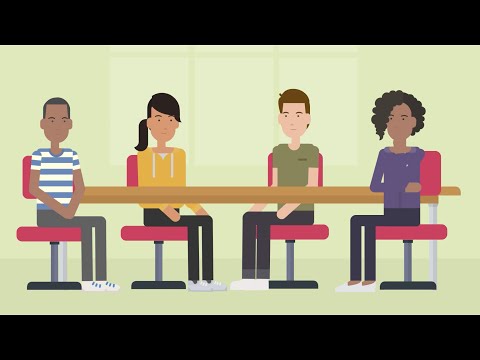
The Peer Mediation Process, from the Whitaker Peace and Development Initiative's school programme (about 3.5 minutes, 2022). It uses six steps where our diagram uses five. As you watch, find where its steps match ours, and note the three communication skills it names: reframing, reflecting and summarising.
Work in groups of four: two friends in a dispute, one mediator and one observer. Each group takes one card. The friends read only their own role; the mediator reads both. Run the five stages in about eight minutes, then swap roles.
| Card | Friend A | Friend B |
|---|---|---|
| 1 The football boots | You lent B your boots for a match. They came back torn. You need boots for Saturday. | The boots were already old and tore during a tackle. You feel blamed for an accident. |
| 2 The study group | B keeps arriving late and copying the group's answers. You want B out of the group. | You walk 50 minutes to school and do chores before you come. You need the group to pass. |
| 3 The secret | You told B something private, and now others know it. You feel betrayed. | You told only one person, who promised to keep it. You did not mean any harm. |
Observer's checklist. Tick each one you hear: ground rules agreed; open questions; at least two paraphrases; a question about interests ("What do you need?"); options from both sides; a written agreement read back. Give the mediator one strength and one thing to improve.
Practice
Key points
Sources and credits
Quick check
Put the stages of a mediation in order.
Tap the cards in the right order.