Netball Techniques
Senior 4 · Physical Education
Netball Techniques
Lesson 3 of 4
25 min
Because a netballer cannot run with the ball, every metre the ball travels is a pass. The best teams pass quickly and accurately, choose the right pass for each gap, and never give the defence time to read them. In Senior 1 you learned the chest, bounce and shoulder passes. This lesson refines them, adds the overhead and lob passes, uses projectile motion to show how high a lob must go, and sets out the rules on short passes and passing over a third from the World Netball Rules of Netball, 2024 edition.
Definition
Chest pass: a two-handed push from the chest, thumbs behind the ball, stepping towards the target; fast and accurate over short and medium distances.
Bounce pass: a pass bounced once on the ground on its way to the receiver; useful in the goal circle and under a defender's raised arms.
Shoulder pass: a one-handed overarm pass from beside the head, for speed and distance.
Overhead pass: a two-handed pass released above the head, to pass over a defender.
Lob pass: a high, looping pass over a defender into space, often to a shooter in the circle.
Short pass: a pass made with so little space that an opponent could not deflect or intercept it; not allowed (Rule 12:1).
Over a third: a pass that crosses a whole third without being caught or touched in it; not allowed (Rule 12:3).
| Pass | Teaching points | Use it for |
|---|---|---|
| Chest | Ball at the chest, fingers spread behind it, elbows in; step towards the target; push and turn the thumbs down; follow through. | Short, quick passes in open space. |
| Bounce | Same action as the chest pass, aimed at the ground about two-thirds of the way to the receiver. | Feeding the shooter in the circle; passing under raised arms. |
| Shoulder | Ball in the throwing hand beside the head, other hand guiding; step with the opposite foot; throw with the arm and wrist. | Fast, longer passes, such as across a third. |
| Overhead | Ball above the forehead, elbows slightly bent; snap the wrists forward. | Passing over a defender. |
| Lob | High release with soft hands, aimed to drop into the space in front of the receiver. | Over a defender to a tall shooter, or into space behind the defence. |
The rules on passing (Rules 11 and 12, summarised). The ball must be passed or shot within 3 seconds. It may be passed with one or both hands; it may not be kicked, struck with a fist or rolled to another player. There must be enough space for an opponent to be able to intercept the pass (no short pass). The ball must be caught or touched in each third. After passing, a player may not touch the ball again until it has touched another player or the goalpost.
Worked example
Worked example 1: how high must a lob go? A passer releases the ball 2.2 m above the floor to a receiver 6 m away who catches it at the same height. A defender 1 m away can jump and reach 2.7 m. For a projectile that lands at the same height after a distance , the height above the release point at a distance is
A flat chest pass over the same 6 m at takes 0.6 s. The lob clears the defender but gives the defence half as long again to move, so it is used only when the flat pass is blocked and the receiver has space. The reach and release heights are illustrative.

Worked example 2: is this pass legal?
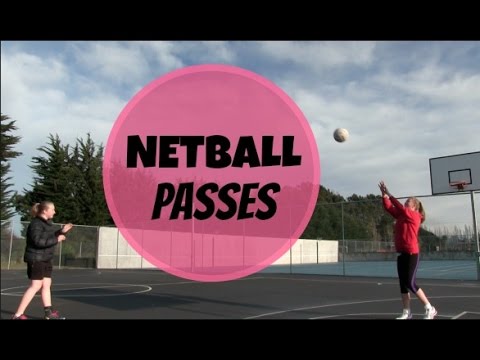
Video: "How to | NetBall Passes", Healthy Lifestyles. As you watch, name each pass and check the position of the hands and the step towards the target.
Tip
"Hands, step, snap, follow." Fingers spread behind the ball, step to the target, snap the wrists, and follow through to where you want the ball to go. Pass to the receiver's leading hand, in front of her.
Warning
Common mistakes. Telegraphing the pass by looking at the receiver for a long time. Lobbing when a flat pass was open. Bounce passes that bounce too close to the receiver's feet. Passing into a space the receiver has not yet run into. Holding the ball for longer than 3 seconds.
Safety. Warm up the shoulders and wrists before shoulder passes. Pass firmly but never at a team-mate's face from close range.
Practice
Remember
Sources and credits
This lesson adapts CC BY-SA material and is shared under CC BY-SA 4.0.
Quick check
A pass travels over the whole centre third and is first caught in the goal third. What is the ruling?