Reproduction in Plants
Senior 4 · Biology
Reproduction in Plants
Lesson 1 of 5
25 min
Until the 1950s, almost every banana exported to Europe and North America was of one variety, Gros Michel. Then Panama disease, a wilt caused by the soil fungus Fusarium oxysporum, swept through the plantations of Central America. By the 1960s exporters had given up on Gros Michel and replaced it with Cavendish varieties that resisted the fungus. Why could one fungus wipe out a whole variety across a continent? Because every Gros Michel plant was grown from a sucker of another: they were all genetically identical. A disease that could kill one could kill them all.
In S3 you met the main types of asexual reproduction and the parts of a flower. This lesson compares the two ways plants reproduce at A-level depth: how each produces (or prevents) genetic variation, which plant organs carry out asexual reproduction, and why farmers must weigh the benefits of identical plants against their risks.
Definition
Asexual reproduction: reproduction by one parent without the fusion of gametes; the offspring are produced by mitosis and are genetically identical to the parent and to each other.
Clone: a group of genetically identical organisms descended from one parent by asexual reproduction.
Vegetative reproduction (vegetative propagation): asexual reproduction in which a new plant grows from part of a root, stem or leaf, rather than from a seed.
Perennation: surviving an unfavourable season (drought or cold) as a dormant underground organ full of stored food, such as a tuber, bulb, corm or rhizome.
Sexual reproduction: reproduction involving meiosis to form haploid gametes and the fusion of a male and a female gamete (fertilisation) to form a diploid zygote; offspring differ genetically from their parents and from each other.
Apomixis: the formation of seeds without fertilisation, so the seedlings are clones of the mother plant.
| Feature | Asexual reproduction | Sexual reproduction |
|---|---|---|
| Number of parents | One | Usually two (one if the plant self-pollinates) |
| Gametes and fertilisation | None | Haploid gametes made by meiosis fuse at fertilisation |
| Cell division involved | Mitosis only | Meiosis to make gametes, then mitosis to grow |
| Genetic variation in offspring | None (except rare mutations): a clone | Large: crossing over and independent assortment in meiosis, and random fertilisation |
| Speed and number | Fast; many offspring from one plant | Slower; needs flowering, pollination and seed development |
| Energy and resources | Little; no flowers, nectar or pollen needed | A lot: flowers, pollen, nectar, fruits and seeds |
| Dispersal | Offspring grow next to the parent and compete with it | Seeds can be carried far, to new places |
| Adaptation | Good in a stable environment the parent already suits | Allows adaptation to changing environments and new diseases |
Worked example 1: how much variation can sex produce?
The common bean, Phaseolus vulgaris, has chromosomes, that is 11 homologous pairs. (a) Ignoring crossing over, how many genetically different gametes can one bean plant make by independent assortment? (b) How many different chromosome combinations could a zygote have from one cross between two plants? (c) How many genetically different offspring can a plant make by asexual reproduction?
Most vegetative reproduction uses a modified stem, root or leaf that has buds and a food store. A stem can be recognised even underground: it has nodes with scale leaves and buds, which roots never have.
| Structure | What it is | Examples |
|---|---|---|
| Stem tuber | Swollen tip of an underground stem (stolon) storing starch; its "eyes" are buds | Irish potato |
| Root tuber | Swollen adventitious root storing food; new shoots grow from its upper end | Sweet potato, dahlia |
| Bulb | Short, flat stem bearing fleshy leaf bases that store food, with a terminal bud | Onion, garlic |
| Corm | Short, swollen, upright underground stem with nodes and scale leaves | Taro (cocoyam), gladiolus |
| Rhizome | Horizontal underground stem with nodes, buds and scale leaves | Ginger, couch grass, canna |
| Stolon (runner) | Horizontal stem growing along the surface, rooting at the nodes | Strawberry, star grass |
| Sucker | Shoot growing from an underground stem or root, beside the parent | Banana, pineapple |
| Leaf plantlets | Tiny plants formed in notches along the leaf edge, which drop and root | Kalanchoe (mother of thousands) |
Many of these organs do two jobs: they reproduce the plant and they perennate, letting it survive a dry season underground and then grow quickly using the stored food when rain returns. Fungi, mosses and ferns also reproduce asexually by spores, and many plants regrow from broken fragments (fragmentation), which is why couch grass spreads when a field is hoed.


Worked example 2: how fast does a clone multiply?
A farmer starts with 5 seed potatoes. Each tuber planted produces 8 tubers at harvest, and every tuber is replanted the next season (illustrative figures). (a) Write an expression for the number of tubers after seasons. (b) How many seasons are needed to have at least 10 000 tubers?
| Advantages | Disadvantages |
|---|---|
| Only one parent is needed: no pollinator, no partner | No genetic variation, so a population cannot adapt to new conditions |
| Fast: many offspring in a short time | One disease or pest can destroy the whole clone (Gros Michel) |
| Offspring keep all the parent's good characteristics, so a valuable variety stays true | Diseases carried in the parent (viruses in tubers or cuttings) pass to every offspring |
| Young plants are fed by the parent's food store, so they establish quickly | Offspring crowd round the parent and compete with it for light, water and minerals |
| Can reproduce where seeds would fail, or in plants that make no viable seed (banana) | Slow spread to new areas, since there is no seed dispersal |
Many plants use both methods: grass spreads by rhizomes and stolons when conditions are good, and flowers to make seeds that carry variation to new places. Farmers do the same: they use asexual propagation to keep a good variety true (Lesson 2) and sexual reproduction, through plant breeding, to create new varieties.
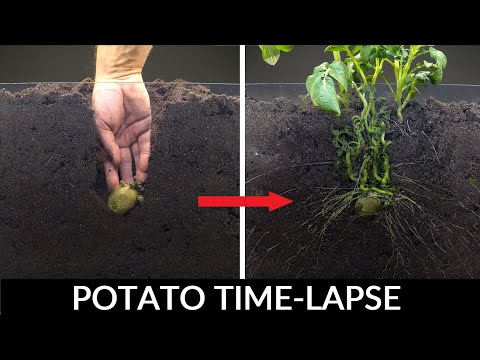
Boxlapse: "Potato Growing Underground Time Lapse – 92 Days", filmed through a glass-sided box. Watch the stolons grow out sideways from the stem and swell at their tips into new tubers, each a clone of the seed tuber.
Warning
Common mistakes
Tip
Memory hook. Is it a stem? Look for "N-B-S": Nodes, Buds and Scale leaves. Tubers of potato, bulbs, corms and rhizomes all have them; roots never do.
Practice: asexual and sexual reproduction
Key points
Sources and credits
Quick check
Match each plant to the organ it reproduces by.
Tap one on the left, then its partner on the right.