Reduction and Oxidation Reactions
Senior 4 · Chemistry
Reduction and Oxidation Reactions
Lesson 4 of 5
30 min
Try to balance this by trial and error: . You can make the atoms balance in several ways that leave the charges unequal, and only one way in which atoms and charge both balance. Redox equations in solution are hard to balance by inspection because water, hydrogen ions or hydroxide ions take part, and because the electrons lost and gained must match. This lesson gives two systematic methods: the half-equation (ion–electron) method and the oxidation-number method.
Definition
Balanced redox equation: an equation in which (1) every element has the same number of atoms on both sides, (2) the total charge is the same on both sides, and (3) the electrons lost in oxidation equal the electrons gained in reduction.
Acidic medium: a solution containing excess ions; and may be added to balance. Alkaline (basic) medium: a solution containing excess ions; and may be added.
Figure 16.4: The half-equation method. Step 5 is where electrons appear; step 6 makes them cancel.
Follow Figure 16.4 for manganate(VII) and ethanedioate (oxalate) ions in acid.
| Step | Reduction half | Oxidation half |
|---|---|---|
| 1. Split | ||
| 2. Atoms other than O, H | Mn already balanced | |
| 3. O with | O balanced (4 = 4) | |
| 4. H with | no H | |
| 5. Charge with | (charge +2 = +2) | (charge −2 = −2) |
| 6. Equal electrons | × 2: 10 gained | × 5: 10 lost |
Step 7 , adding: Check: Mn 2 = 2; C 10 = 10; O 8 + 20 = 28 and 8 + 20 = 28; H 16 = 16; charge and . Balanced.
Balance as if in acid, then add as many ions to both sides as there are ions; each pair becomes ; finally cancel water. This is worked in Worked example 1.
For copper and concentrated nitric acid, : Cu rises from 0 to +2 (increase 2); N falls from +5 to +4 (decrease 1). So 2 are needed for each Cu: . Nitrogen: 2 in + 2 in = 4 . Hydrogen: 4 H → 2 . Check O: 12 = 6 + 4 + 2.
Worked example 1: manganate(VII) and iodide in alkali
In alkaline solution, manganate(VII) oxidises iodide ions to iodate(V) ions and is reduced to manganese(IV) oxide. Balance the equation.
Solution. Reduction (Mn +7 → +4): . Oxidation (I −1 → +5): . Multiply the reduction by 2 (6 ) and add: Cancel: . The solution is alkaline, so add to each side: become : Cancel one water: Check: O 9 = 9; H 2 = 2; charge −3 = −3.
Worked example 2: dichromate(VI) and iron(II), with a titration
Balance the reaction of acidified dichromate(VI) with iron(II) ions, then calculate the volume of 0.0200 mol dm⁻³ that reacts with 25.0 cm³ of 0.120 mol dm⁻³ .
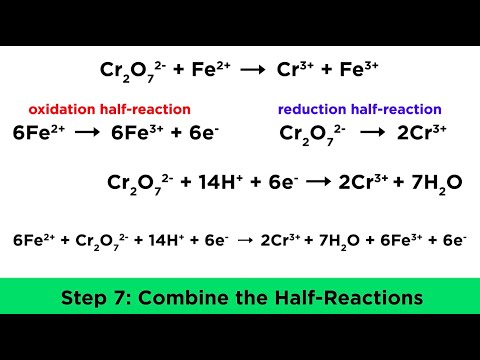
Solution. Reduction: . Oxidation: , × 6. Charge check: ; .
Warning
Common mistakes. (1) Balancing oxygen with or : in solution use (and or ). (2) Adding to an equation for an alkaline solution and leaving it there. (3) Adding electrons to the wrong side: count the charge on each side first, then add electrons to the more positive side. (4) Forgetting to check the charge at the end; an equation with balanced atoms but unequal charge is wrong.
Safety. The titration in Worked example 2 uses potassium dichromate(VI), which is toxic and a cause of cancer: use small volumes of dilute solution, a pipette filler (never your mouth), gloves and goggles, and put the waste in the labelled container.
Tip
"O, H, charge": after the main atoms, balance O with water, H with , then charge with electrons. In alkali, finish by adding to both sides to cancel every .
Professor Dave Explains: Balancing Redox Reactions in Acidic and Basic Conditions (8 min). Watch each step of the half-equation method, and the extra hydroxide step for basic solutions.
Practice
Key points
Sources and credits
Quick check
Put the steps of the half-equation method (acid solution) in order.
Tap the cards in the right order.