Reduction and Oxidation Reactions
Senior 4 · Chemistry
Reduction and Oxidation Reactions
Lesson 1 of 5
30 min
Hang a coil of bare copper wire in a colourless solution of silver nitrate. Within minutes the wire grows a fur of glittering silver crystals, and the solution slowly turns blue. Nothing has been added but a metal and a salt, yet two new substances have appeared: silver metal and copper(II) ions. Each copper atom has given two electrons, and two silver ions have taken them. Reactions in which electrons pass from one substance to another are called redox reactions. They rust iron, burn fuel, release energy from food in our cells, and, when the electrons are made to travel through a wire, run every battery. This lesson defines oxidation and reduction and shows how redox reactions and electricity are connected.

Definition
Oxidation: loss of electrons (also: gain of oxygen, or loss of hydrogen). Example: .
Reduction: gain of electrons (also: loss of oxygen, or gain of hydrogen). Example: .
Redox reaction: a reaction in which oxidation and reduction happen together; the electrons lost by one species are gained by another.
Half-equation: an equation showing either the oxidation or the reduction part of a redox reaction, with electrons written in.
Electrochemistry: the study of how redox reactions produce electricity (in galvanic, or voltaic, cells) and how electricity drives redox reactions (in electrolytic cells).
Chemists first described oxidation as combining with oxygen. The definition was widened twice, and the electron definition includes the other two.
| Definition | Oxidation is | Reduction is | Example |
|---|---|---|---|
| Oxygen | gain of oxygen | loss of oxygen | : CuO is reduced, is oxidised |
| Hydrogen | loss of hydrogen | gain of hydrogen | : is oxidised, is reduced |
| Electrons | loss of electrons | gain of electrons | : Na loses (oxidised), Cl gains (reduced) |
The sodium–chlorine reaction involves no oxygen or hydrogen at all, yet it is plainly the same kind of change: only the electron definition covers it.
For copper in silver nitrate, the nitrate ions take no part (they are spectator ions). Split the ionic equation into its two halves and balance the charge with electrons:
The electrons lost must equal the electrons gained, so the reduction is doubled before adding: Electrons never appear in the overall equation.
If zinc is dipped straight into copper(II) sulfate solution, electrons jump from zinc atoms to copper(II) ions on the metal surface and the energy is released as heat. In an electrochemical (galvanic) cell the two half-reactions are separated into two half-cells, so the electrons must travel through an external wire, where they can do useful work (Figure 16.1).
Figure 16.1: A zinc–copper (Daniell) cell. Oxidation happens at the anode, reduction at the cathode; the salt bridge lets ions move between the solutions so that each stays electrically neutral.
In electrolysis, which you met in Senior 3, the reverse happens: an external supply forces electrons into one electrode and out of the other, driving a redox reaction that would not happen by itself. For molten sodium chloride, the cathode reduces sodium ions and the anode oxidises chloride ions:

Worked example 1: zinc in copper(II) sulfate
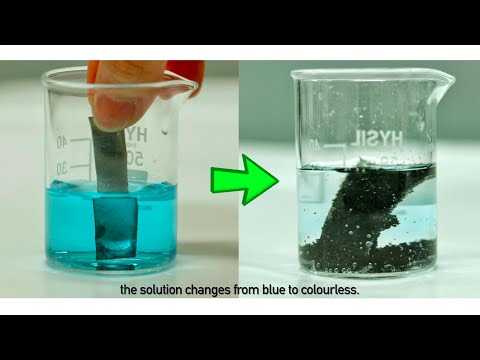
Zinc powder is stirred into blue copper(II) sulfate solution. The blue colour fades, a pink-brown solid forms and the mixture warms up. Write the ionic equation and the two half-equations, and identify what is oxidised and what is reduced.
Solution. Sulfate ions are spectators. Each half transfers 2 electrons, so they add directly: Zinc is oxidised (loses electrons); copper(II) ions are reduced (gain electrons). The blue ions are used up, the pink-brown solid is copper, and the energy is released as heat because the electrons transfer directly.
Worked example 2: counting the electrons
In the silver-tree experiment, 0.635 g of copper dissolves. Calculate (a) the mass of silver deposited and (b) the number of electrons transferred. (Cu = 63.55, Ag = 107.87, )
Solution. (a) From : ; mass .
(b) Each Cu atom loses 2 electrons: , so the number of electrons .
Warning
Common mistakes. (1) Thinking oxidation can happen alone: every oxidation is matched by a reduction. (2) Writing electrons on the wrong side: in an oxidation half-equation they are products; in a reduction they are reactants. (3) Adding half-equations without first making the electrons equal. (4) Saying "the anode is always positive": in a galvanic cell it is negative; in electrolysis it is positive. What never changes is that oxidation happens at the anode.
Safety. Silver nitrate solution is corrosive, stains skin black and is toxic to aquatic life: wear gloves and goggles and collect silver residues for recovery, not down the sink. Copper(II) sulfate is harmful if swallowed and irritates eyes. Wash your hands after the practical.
Tip
OIL RIG: Oxidation Is Loss, Reduction Is Gain (of electrons). AN OX, RED CAT: oxidation at the ANode, reduction at the CAThode, in every cell.
Raquel Yoong: Displacement Reaction of Metals, Zinc in Copper(II) Sulfate (6 min). Watch the copper appear on the zinc and the explanation of the electron transfer at the level of particles.
Practice
Key points
Sources and credits
Quick check
In Cu + 2Ag⁺ → Cu²⁺ + 2Ag, which species is oxidised?