Energy Changes and Energy Profile Diagrams for Chemical Reactions
Senior 4 · Chemistry
Energy Changes and Energy Profile Diagrams for Chemical Reactions
Lesson 2 of 4
30 min
In the 1840s James Prescott Joule let falling weights turn a paddle wheel inside a closed can of water. The churning water got slightly warmer, although no flame was used. Doing work on the water had the same effect as heating it: both raised its temperature. Joule's experiments showed that heat and work are two ways of transferring energy, and that a fixed amount of work always produces the same rise in temperature. This lesson names the energy stored inside a system, its internal energy, and states the law that connects it to heat and work.

Definition
Internal energy, U: the total energy of all the particles in a system: the kinetic energy of their motion (moving, rotating, vibrating) and the potential energy stored in chemical bonds and in the forces between particles. Only changes, ΔU, can be measured.
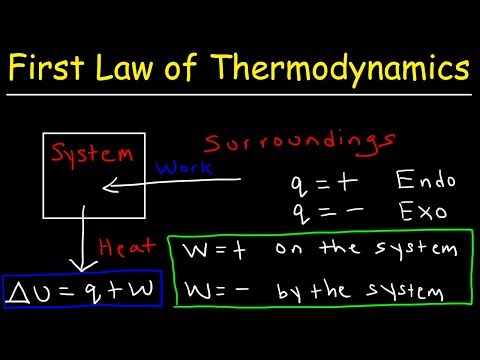
First law of thermodynamics: energy cannot be created or destroyed; the change in internal energy of a system equals the heat supplied to it plus the work done on it: .
Enthalpy, H: . For a change at constant pressure, the enthalpy change equals the heat transferred: .
Figure 17.2: Heat flowing into a gas raises its internal energy; work done by the gas as it expands takes energy out. The first law adds the two.
Chemists (following IUPAC) count everything from the point of view of the system:
| Quantity | Positive (+) when | Negative (−) when |
|---|---|---|
| q (heat) | heat flows into the system | heat flows out of the system |
| w (work) | work is done on the system (it is compressed) | the system does work on the surroundings (it expands) |
| ΔU | the system gains energy | the system loses energy |
For an isolated system q = 0 and w = 0, so : the energy of the universe is constant. A machine that produces work forever without an energy supply is therefore impossible.
When a reaction produces gas against a constant outside pressure p, the gas pushes back the atmosphere and the system does work: with p in Pa, ΔV in m³ and w in J. If the volume cannot change (a sealed steel "bomb" calorimeter), w = 0 and the heat measured at constant volume.
Most reactions are carried out in open vessels at the constant pressure of the atmosphere. Then the heat transferred is not ΔU but the enthalpy change: For a reaction involving gases, , where is the change in the number of moles of gas: When no gas is formed or used up, ΔH and ΔU are almost equal.
Worked example 1: heat in, work out
A gas in a cylinder absorbs 500 J of heat and, as it expands, does 200 J of work pushing back a piston. Calculate ΔU.
Solution. Heat enters the system: . The system does work on the surroundings: . The internal energy of the gas rises by 300 J; the other 200 J left as work.
Worked example 2: work done by a reaction that makes gas
0.100 mol of magnesium reacts with excess dilute hydrochloric acid in an open flask at 25 °C (298.15 K) and 101 325 Pa: . Calculate the work done by the system. ()
Solution. 0.100 mol of is formed. Its volume: (equal to ). The hydrogen pushes back the atmosphere, so 248 J of the reaction's energy leaves as work rather than as heat.
Worked example 3: ΔH and ΔU for burning methane
Use standard enthalpies of formation ( −74.8, −393.5, −285.8 kJ mol⁻¹) to find ΔH for at 298.15 K, then find ΔU.
Solution. Moles of gas: 1 () after, 3 () before, so . At constant pressure the gas volume shrinks, the atmosphere does about 5 kJ of work on the system, and that energy also leaves as heat, so slightly more heat (890.3 kJ) is released than at constant volume (885.3 kJ).
Warning
Common mistakes. (1) Mixing sign conventions: some physics books write , with W the work done by the system. In chemistry, with w the work done on the system, . (2) Forgetting the minus sign in : an expanding gas does work, so w is negative. (3) Using dm³ with Pa: convert to m³ (1 dm³ = 10⁻³ m³), or use kPa with dm³. (4) Counting liquids and solids in : only gases count.
Safety. Never heat a sealed container: as the internal energy of the gas inside rises, so does its pressure, and the container can explode. Reactions that make gas are done in open or vented apparatus.
Tip
ΔU = q + w, "gains are positive". Heat in and work on the system both add to U. At constant volume ΔU = q; at constant pressure ΔH = q. They differ by , about 2.5 kJ per mole of gas at 25 °C.
The Organic Chemistry Tutor: First Law of Thermodynamics, Basic Introduction (11 min). Watch for the signs of q and w, and the worked problems on internal energy, heat and work.
Practice
Key points
Sources and credits
Quick check