
Numbers up to 20
Primary 1 · Mathematics
Numbers up to 20
Lesson 5 of 7
13 min
Let's begin
Habimana keeps his bottle caps in an old tin.
He already has 8 caps inside. His friend gives him 5 more.
He tips them all out and starts counting from one again. That is slow.
Today you will learn a faster way to add.
The + sign says: put these groups together.
Start with one bundle of ten sticks. Add 4 loose sticks.
10 + 4 = 14
This is read: ten plus four equals fourteen. Say it out loud!
The bundle stays whole. Only the loose ones change.
Try more of them:
See the pattern? The ones digit is the number you added.
Worked example
13 + 2.
13 is 1 ten and 3 ones.
Step 1 Keep the bundle. It does not change.
Step 2 Add the ones: 3 + 2 = 5 ones.
Step 3 Put them back together: 1 ten and 5 ones is 15.
Here the ones stayed under ten, so the bundle was safe.
Do the same with 16 + 3.
Ones: 6 + 3 = 9. The answer is 19.
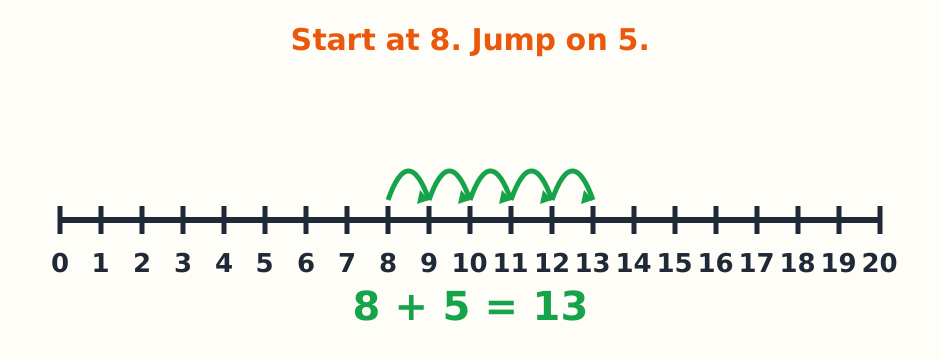
Now back to Habimana: 8 + 5.
8 wants 2 more to become a full ten.
Split 5 into 2 and 3.
Step 1 8 + 2 = 10.
Step 2 10 + 3 = 13.
8 + 5 = 13
You used all of the 5: 2 and 3.
Careful! Some children make ten and then add the whole 5 again. They answer 15. That uses the 5 twice.
One more. 9 + 4.
9 wants 1 more. Split 4 into 1 and 3.
9 + 1 = 10. 10 + 3 = 13.
You used all of the 4: 1 and 3.
Tip
Fill the ten, then carry on
Ask how many the first number needs to reach 10.
Split the second number into that piece and the rest.
Then check out loud: did you use every one of them?
Watch: adding up to 20.
Do each one, then tap Show answer to check.
10 + 7 = ?
Answer: 17. The bundle stays, and 7 ones sit beside it.
12 + 4 = ?
Answer: 16. Ones: 2 + 4 = 6. The ten does not change.
9 + 3 = ?
Answer: 12. Split 3 into 1 and 2. 9 + 1 = 10, then 10 + 2 = 12.
7 + 5 = ?
Answer: 12. Split 5 into 3 and 2. 7 + 3 = 10, then 10 + 2 = 12.
Uwase has 11 beans. Her mama gives her 6 more. How many beans now?
Answer: 17. Ones: 1 + 6 = 7, so she has 1 ten and 7 ones.
What you learned today
Quick check

