
Numbers up to 20
Primary 1 · Mathematics
Numbers up to 20
Lesson 1 of 7
12 min
Let's begin
Mugisha carries sticks home for the cooking fire.
He drops them on the ground and counts them. He reaches ten. Then he stops.
There are still sticks left on the ground. What comes after ten?
Today you will count all the way to 20.
Take 20 small sticks. Lay them in one long row.
Touch each stick. Say one number for each one.
Say them out loud with me:
1, 2, 3, 4, 5, 6, 7, 8, 9, 10
11, 12, 13, 14, 15
16, 17, 18, 19, 20
You know the first ten already. The new part starts at 11.
The last number you say is how many there are.
You have 20 sticks.
Now mix the sticks up. Count them again.
Nothing was added. Nothing was taken away. There are still 20.
Count out 10 sticks. Tie them with a blade of grass.
That is one bundle of ten.
Count out 10 more sticks. Tie those too.
Now you hold two bundles.
Two bundles of ten make 20.
Untie both bundles and count again. You still have 20.
Careful! Some children run past the end.
If you hear yourself say twenty-one, you have slipped off your jump.
Hop back to 20 and try again.
20 is where this row stops.
Now count the other way. Start on 20.
Move one stick away. Then say how many are left.
20, 19, 18, 17, 16, 15
14, 13, 12, 11, 10
Keep going: 9, 8, 7, 6, 5, 4, 3, 2, 1, 0.
The ground is empty now. You are back on 0.
Counting back is slow at first. Say it every day and it gets easy.
Tip
One touch, one number
Whisper each number as your finger touches a stick.
Did you finish with sticks left over? Then your mouth ran ahead of your hand.
Start again, and go slowly.
Sing the numbers 1 to 20.
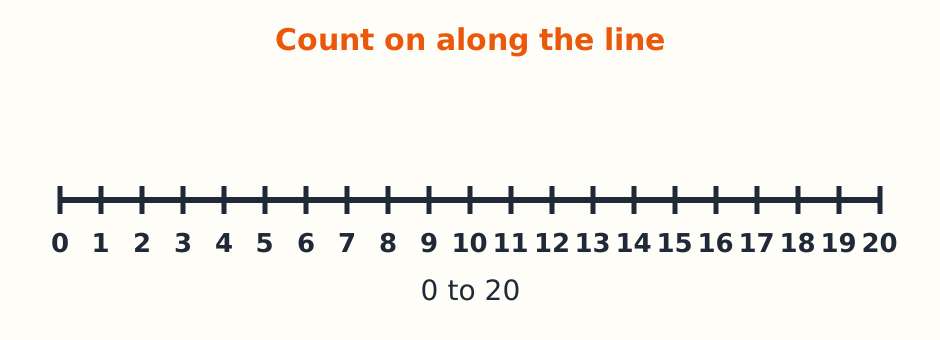
Do each one, then tap Show answer to check.
What number comes after 14?
Answer: 15. Count on from 14 by one step.
What number comes before 18?
Answer: 17. Step back one from 18.
Count on from 16 up to 20. Say the numbers.
Answer: 17, 18, 19, 20. Do not say 16 again.
Keza holds 1 bundle of ten sticks and 3 loose sticks. How many sticks?
Answer: 13. Start on 10, then count 11, 12, 13.
Find 20 bottle caps at home. Make two piles of ten.
Answer: two full piles, with none left over. 20 is two tens.
What you learned today
Quick check

