Simple Harmonic Motion
Senior 5 · Physics
Simple Harmonic Motion
Lesson 2 of 4
25 min
Hang a mass on a spring above a motion sensor, pull it down and let go. The data logger plots its displacement, and from that its velocity and acceleration, against time. Three curves appear, all sinusoidal, all with the same period, but none of them in step with each other. The mass is fastest where its displacement is zero, and its acceleration is greatest where it stops. In this lesson you derive these curves from , find a formula for the speed at any displacement, and follow the energy as it flows back and forth between kinetic and potential.
Take a body released from rest at at , so . Differentiating once and then again:
Read the graphs column by column:
Often you know where the body is, not when. Eliminate using : from and ,
The sign is when the body moves in the positive direction. The formula holds whatever the phase constant, because cancels when you eliminate the time.
Worked example 1: speed and acceleration at a point
A mass on a spring oscillates with amplitude 5.0 cm and frequency 2.0 Hz. Find (a) its greatest speed, (b) its greatest acceleration, (c) its speed and acceleration when it is 3.0 cm from equilibrium.
Solution
and .
(a) .
(b) .
(c) . : its size is , directed towards equilibrium.
Worked example 2: SHM is not uniform
Show that a body in SHM takes to go from equilibrium to , but to go from on to .
Solution
Start the clock at equilibrium, moving outwards: . Then when , so and . The body reaches at , that is . So the outer half takes : twice as long as the inner half, because the body slows down as it moves out.
The kinetic energy at displacement follows from the speed formula:
The potential energy is the work done against the restoring force (with ) in moving the body from equilibrium to . The force grows steadily from 0, so
Adding the two, the terms cancel:
The total energy is constant, and it is proportional to the square of the amplitude. Doubling the amplitude stores four times the energy.
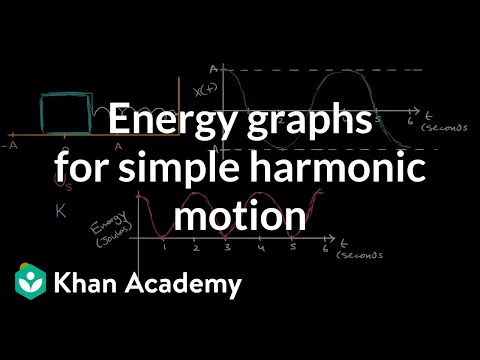
Against time, and . Since , each energy oscillates at twice the frequency of the motion: the potential energy peaks at both extremes, and the kinetic energy peaks each time the body passes through equilibrium, in either direction.
The same exchange happens in every oscillator; only the form of the potential energy changes. In a pendulum it is gravitational potential energy, highest at the ends of the swing. In a horizontal spring it is elastic energy. In a vertical spring both change, but if you measure the displacement from the equilibrium position (where the spring already supports the weight), the gravitational and elastic terms combine into exactly , so all the results above still hold. In a real system some energy is also converted to heat and sound by friction and air resistance in every cycle, so the amplitude slowly falls: that is the subject of Unit 2.
Definition
The total energy of a simple harmonic oscillator is the sum of its kinetic and potential energies, . In the absence of friction it is conserved: it stays constant while energy flows between the kinetic and potential stores twice per cycle. Example: a 0.20 kg mass on an spring with amplitude 0.10 m has .
Worked example 3: sharing the energy
For the 0.20 kg mass on the spring with amplitude 0.10 m, find (a) the greatest speed from energy, (b) the kinetic and potential energies at , (c) the displacement at which the two energies are equal.
Solution
(a) At equilibrium all 0.40 J is kinetic: . Check: , and .
(b) , so . Halfway out, three quarters of the energy is still kinetic.
(c) gives , so .
Aim: to compare the gravitational potential energy lost by a pendulum bob with the kinetic energy it gains at the bottom of its swing.
Apparatus: a heavy bob of known mass and diameter on a string about 1 m long, a clamp stand with a G-clamp, a light gate and timer (or data logger), a metre rule, vernier calipers.
Method:
Illustrative results: a 50 g bob of diameter 2.00 cm released from blocks the beam for 20.4 ms. Then , and . The kinetic energy is about 2% less than the potential energy lost: some energy was transferred to the air, and the measurement of is the largest uncertainty.
Warning
Safety. Clamp the stand to the bench, or weight its base, so that a swinging bob cannot topple it. Keep faces out of the plane of the swing, and use a bob no heavier than a few hundred grams.
Warning
Common mistakes. (1) Putting at the extremes: the body is momentarily at rest there; the speed is greatest at equilibrium. (2) Writing for the total energy: that is only the potential energy; the total uses the amplitude, . (3) Saying the energy oscillates with the same frequency as the body: and each go through two cycles per oscillation. (4) Forgetting the square root's sign: gives the speed; the direction comes from the motion.
Tip
Each time you differentiate, multiply by one more and move a quarter cycle ahead: has amplitude , has amplitude , has amplitude .
Energy graphs for simple harmonic motion (Khan Academy). Watch how the kinetic and potential energy curves are built from the displacement, and why the total stays flat.
Practice
Key points
Sources and credits
The experiment, the four diagrams, the worked examples and the practice exercises are written by Ganzaa.