
Number Patterns
Primary 1 · Mathematics
Number Patterns
Lesson 4 of 4
13 min
Let's begin
Habimana lays his number cards in a line on the desk.
The wind blows. One card turns over. Now he cannot see it.
The other cards are still there. Today you will find the hidden card.
This is always your first move. Always.
Look at two numbers that sit next to each other. See what the pattern did between them.
Worked example
6, 9, 12, ___.
Step 1 Find the step. 6 and 3 more make 9. The step is add 3.
Step 2 Use the step. 12 and 3 more make 15.
Careful! Do not just add 1. The step here is 3, so you add 3.
Sometimes the hidden card is not at the end.
Worked example
12, ___, 16, 18.
Step 1 Find the step. You can see 16 and 18. From 16 to 18 you add 2.
Step 2 Fill the gap. 12 and 2 more make 14.
Step 3 Check it. 14 and 2 more make 16. It fits!
Always check a middle gap on both sides.
Worked example
40, ___, 20, 10.
Step 1 Which way? The numbers are getting smaller.
Step 2 Find the step. From 20 to 10 you take away 10.
Step 3 Fill the gap. 40 take away 10 is 30.
Step 4 Check the other side. 30 take away 10 is 20. It fits.
Sometimes the gap sits inside a sum.
5 + ___ = 9
Do not add the two numbers you can see.
Say it as whole and parts. The whole is 9. One part is 5.
You need the other part. Take the part off the whole.
9 take away 5 is 4.
Check: 5 + 4 = 9. It fits.
Careful! Some children answer 14. They added 5 and 9. The gap is inside the sum, not after it.
Tip
Step first. Then the gap
Never fill a gap before you know the step.
For a gap in the middle, check both sides. Your number must fit the left and the right.
Find the step, then fill the gap.
The other kind of gap: 5 + ___ = 9.
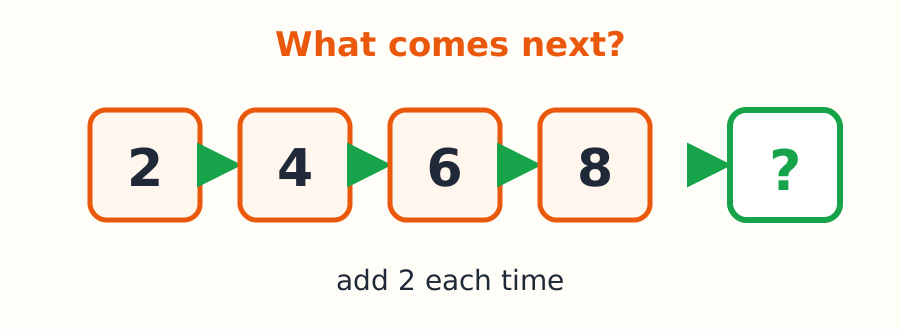
Find the step first every time. Then tap Show answer to check.
4, 8, 12, ___
Answer: 16. The step is add 4. 12 and 4 more make 16.
20, ___, 40, 50
Answer: 30. The step is add 10. 20 and 10 more make 30.
18, 16, ___, 12
Answer: 14. Smaller. The step is take away 2.
7 + ___ = 10
Answer: 3. The whole is 10. One part is 7. 10 take away 7 is 3.
Mutesi counts her goats: 2, 4, 6, ___, 10. Which number is missing?
Answer: 8. The step is add 2. 6 and 2 more make 8.
What you learned today
Read Kubara amashu first. It is in Kinyarwanda and free to read, from African Storybook. The children in it count cabbages the way you counted shoes and hands: abirabiri in 2s, atatatatu in 3s, anane in 4s. Count along out loud with them.
Then sit with a grown person and open Pranav the Pattern Detective, free to read from the Global Digital Library. It is in English and the words are a little hard for P1, so let the grown person read them while you point at every pattern you can find on the page. This is Uncle Som, also English and also free from the Global Digital Library, counts down from six to one and then back up again.
Then go and hunt for patterns at home: the lines on a kitenge cloth, an agaseke basket, the tiles on a roof.
Quick check


