Food Nutrients and Diet
Senior 1 · Biology
Food Nutrients and Diet
Lesson 3 of 5
25 min
A juice seller in Nyabugogo says her passion-fruit juice has "no added sugar". Is there sugar in it at all? A laboratory in Kigali could measure it exactly, but a school laboratory can answer a simpler question in ten minutes: which nutrients are present? Each class of nutrient reacts with a particular chemical, called a reagent, to give a colour change you can see.
Definition
Food test: a simple chemical test that shows whether a particular nutrient is present in a food, by a colour change.
Reagent: a chemical added to cause a reaction. Example: iodine solution for starch.
Control: a tube set up in exactly the same way but with water instead of food, to show the colour of a negative result.
Reducing sugar: a sugar, such as glucose, fructose, maltose or lactose, that gives a positive result with Benedict's solution. Sucrose (table sugar) is not a reducing sugar.
Preparing the food: crush or grind a small piece of solid food with a little distilled water in a mortar and pestle. Use a fresh portion of the food for each test, and set up a control tube with water for each.
Figure 1: The five food tests and their colour changes.
| Nutrient | Reagent | Heat? | Negative result | Positive result |
|---|---|---|---|---|
| Starch | iodine solution | no | stays yellow-brown | blue-black |
| Reducing sugar (glucose) | Benedict's solution | yes, water bath | stays blue | green, yellow, orange or brick-red precipitate |
| Protein | Biuret reagent | no | stays blue | purple (lilac) |
| Vitamin C | DCPIP | no | stays blue | blue colour disappears |
| Lipid | ethanol, then water | no | stays clear | cloudy white emulsion |

Warning
Safety, and three common mistakes. Wear eye protection. Heat Benedict's tubes in a water bath, never directly in a flame, and point them away from people. Sodium hydroxide is corrosive. Ethanol catches fire easily: no flames anywhere near the emulsion test. The common mistakes are: forgetting to heat the Benedict's test (it then stays blue even with sugar); testing table sugar and concluding "no sugar" (sucrose is not a reducing sugar); and reusing one portion of food for several tests, so reagents mix.
Worked example 1: reading a results table
Four foods were tested. Identify the main nutrients in each.
| Food | Iodine | Benedict's | Biuret | Emulsion | DCPIP |
|---|---|---|---|---|---|
| W: raw egg white | yellow-brown | blue | purple | clear | stays blue |
| X: cassava flour | blue-black | blue | blue | clear | stays blue |
| Y: cooking oil | yellow-brown | blue | blue | cloudy white | stays blue |
| Z: orange juice | yellow-brown | orange | blue | clear | colourless |
Worked example 2: planning a fair test
Gatete wants to find out whether a bottle of sports drink contains glucose and vitamin C. Plan his tests.
Conclusion rule: if the drink tube changes colour and the control does not, the nutrient is present.

The Rwanda Standards Board and food companies test products for much more than school tests can show, measuring exact amounts rather than just "present" or "absent". But the ideas are the same: react a nutrient with a reagent and read a colour. Health workers once used a colour test like Benedict's on urine to screen for diabetes, because sugar in the urine is a sign of the disease.
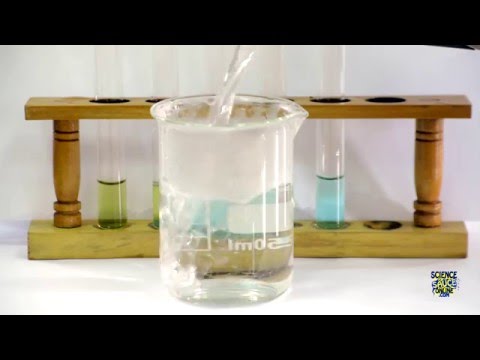
Food Tests: Iodine, Biuret, Benedict's, Ethanol, DCPIP, Science Sauce. Pause at each test and note the colour before and after, then check it against Figure 1.
Tip
Memory hook: "In Bed, Big Eggs Drop": Iodine (starch), Benedict's (sugar, the only one you heat), Biuret (protein), Ethanol (lipid), DCPIP (vitamin C).
Practice: food tests
Key points
Sources and credits
Figure 1, the methods, the tables, the worked examples and the practice questions are written by Ganzaa.
This lesson adapts CC BY-SA material and is shared under CC BY-SA 4.0.