Food Nutrients and Diet
Senior 1 · Biology
Food Nutrients and Diet
Lesson 2 of 5
25 min
A child can eat enough cassava and rice to feel full every day and still grow up with weak bones, poor eyesight in the evening, or tired, pale skin. Energy is not enough. The body also needs tiny amounts of substances it cannot make for itself, or cannot make enough of, and without them some of its processes stop working. These are the vitamins and mineral salts. Two more nutrients, roughage and water, give no energy at all, yet nobody can stay healthy without them.
Definition
Vitamin: an organic substance needed in very small amounts in the diet to keep body processes working normally. Vitamins give no energy. Vitamins A and D are fat-soluble; the B vitamins and vitamin C are water-soluble.
Mineral salt (mineral): an inorganic element taken in as ions dissolved in food and water, such as calcium or iron.
Roughage (dietary fibre): the parts of plant food, mainly cellulose, that the human body cannot digest.
Deficiency disease: an illness caused by too little of one nutrient in the diet. Example: scurvy, caused by too little vitamin C.
In 1747 a ship's doctor showed that oranges and lemons cured sailors of scurvy (lesson 5). Early in the twentieth century, doctors found that each of several diseases could be cured by adding just one food, or one substance, to the diet. From these observations came the idea that each vitamin and mineral has its own job.
Figure 1: Where some vitamins, minerals, roughage and water do their main jobs.
| Nutrient | Good sources in Rwanda | Function | Deficiency causes |
|---|---|---|---|
| Vitamin A | orange-fleshed sweet potatoes, carrots, pumpkin, dark green leaves (isombe, dodo), mangoes, liver, milk, eggs | seeing in dim light; healthy skin and linings; fighting infection | night blindness; dry, damaged eyes; more infections |
| Vitamin B1 (thiamine) | whole grains, beans, groundnuts, meat | releasing energy from carbohydrates | beriberi (weak muscles, heart problems) |
| Vitamin C | oranges, lemons, passion fruit, guavas, tomatoes, fresh green leaves | healthy skin, gums and blood vessels; wound healing; helps iron to be absorbed | scurvy (bleeding gums, slow healing) |
| Vitamin D | made in the skin in sunlight; eggs, oily fish, liver, fortified milk | absorbing calcium for bones and teeth | rickets in children; soft bones in adults |
| Calcium | milk, yoghurt, small fish eaten whole (isambaza), beans, dark green leaves | bones and teeth; blood clotting; muscle contraction | weak bones and teeth; rickets (with too little vitamin D) |
| Iron | beans, dark green leaves, meat, liver, eggs | making haemoglobin in red blood cells | anaemia (tiredness, pale skin, breathlessness) |
| Iodine | iodised salt, fish | making the thyroid hormone, which controls the rate of metabolism | goitre (swelling of the thyroid in the neck) |
| Roughage | vegetables, fruit with skins, whole grains, beans, cassava leaves | adds bulk so the intestine muscles can push food along | constipation |
| Water | drinking water, milk, fruit, soups, porridge | dissolves and transports substances; cools the body by sweating; removes wastes in urine | dehydration (headache, dark urine, confusion) |
Protein deficiency, too, causes disease: children who get too little protein and energy grow slowly and can develop kwashiorkor or marasmus.

Warning
Vitamins give no energy, and more is not always better. A common mistake is to say that vitamins "give energy". Vitamin B1 helps release energy from carbohydrates, but vitamins themselves provide none. Also, fat-soluble vitamins A and D are stored in the body, so taking large doses of supplements can build up to harmful levels. A varied diet is the safe source.
Worked example 1: diagnosing from a diet
Habimana, aged 14, eats mostly ugali, rice and cassava. He rarely eats fruit, green vegetables, beans or milk. Which deficiencies is he at risk of, and what cheap foods would help?
| Missing food group | Nutrients lost | Risk | Cheap fix |
|---|---|---|---|
| fruit and fresh vegetables | vitamin C, vitamin A | scurvy, night blindness | oranges, tomatoes, dodo, orange sweet potatoes |
| beans and dark leaves | protein, iron, fibre | anaemia, constipation, slow growth | beans with isombe |
| milk | calcium, protein | weak bones and teeth | a cup of milk or ikivuguto |
Answer: his diet gives energy but few micronutrients. Adding beans, leaves, fruit and milk covers every gap.
Worked example 2: how much should Uwase drink?
Typical figures for an adult on a mild day: water is lost in urine (1.5 litres), sweat (0.5 litres), breath (0.4 litres) and faeces (0.1 litres). Food provides 0.8 litres and respiration in the cells makes 0.3 litres. How much must Uwase drink to stay in balance?
Answer: about 1.4 litres a day, and more on a hot day or after sport, when sweat losses rise.

Because a lack of iodine was once common in Rwanda, all salt sold in the country must now be iodised, and goitre has become rare. Orange-fleshed sweet potatoes and iron-rich ("biofortified") bean varieties bred by plant scientists are grown by many Rwandan farmers to add vitamin A and iron to ordinary meals. Vitamin C is easily destroyed by long cooking, so fresh fruit eaten raw is its best source.
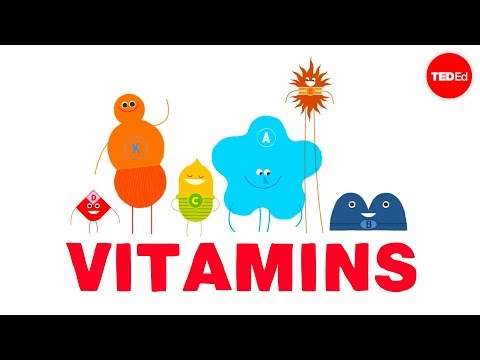
How do vitamins work? by Ginnie Trinh Nguyen, TED-Ed. Listen for the difference between fat-soluble and water-soluble vitamins, and why water-soluble ones must be eaten almost every day.
Tip
Memory hook: the fat-soluble vitamins are "ADEK" (A, D, E, K): they travel with fat and are stored. The water-soluble ones (B and C) are washed out in urine, so you need them almost every day.
Practice: vitamins, minerals, roughage and water
Key points
Sources and credits
Figure 1, the tables, the worked examples and the practice questions are written by Ganzaa. The water-balance figures in worked example 2 are typical textbook values for an adult in a mild climate.
This lesson adapts CC BY-SA material and is shared under CC BY-SA 4.0.