Tropic Responses
Senior 1 · Biology
Tropic Responses
Lesson 4 of 5
25 min
Two responses in this lesson happen in places you might not think to look. Deep inside a bean flower, a pollen grain grows a tube thinner than a hair down through the style, and it finds its way to an ovule it cannot see. On a garden fence in Rubavu, a young passion fruit (marakuja) vine throws out green threads that wrap themselves round the wire within hours of touching it. The first is guided by chemicals, the second by touch.
In Unit 3 you learned the parts of a flower, including the carpel (stigma, style, ovary and ovules), and you met tendrils as modified stems (passion fruit) or modified leaves (garden pea). Here you will see how both parts respond to stimuli.
Definition
Chemotropism: a growth movement in response to a chemical. The pollen tube shows positive chemotropism: it grows towards chemicals released by the ovule.
Pollen tube: a tube that grows out of a pollen grain after it lands on a stigma, and carries the male sex cells down the style to an ovule.
Thigmotropism: a growth movement in response to touch (contact with a solid object). Tendrils and twining stems show positive thigmotropism: they grow round the object they touch.
After pollination, a pollen grain on the sticky stigma takes in water and sugar and grows a pollen tube. The tube grows down through the style into the ovary, and then turns towards an ovule. Special cells in each ovule release chemicals, and the tip of the tube grows towards where these chemicals are most concentrated. When the tube reaches the ovule it releases the male sex cells, so that fertilisation can take place and the ovule can become a seed.
Figure 1: Positive chemotropism. The pollen tube grows from the stigma down the style and turns towards the ovule, following the chemicals the ovule releases.
Without chemotropism, a pollen tube would wander in the ovary and fail to reach an ovule: no fertilisation, no seed. In a bean pod, every seed that forms is the result of one pollen tube that found its ovule.
You need a flower with plenty of ripe pollen, a 10% sugar solution (10 g of sugar dissolved in water to make 100 cm³), two microscope slides, a scalpel and a microscope (Unit 4).
A class obtained these counts. These are illustrative figures, made up for this lesson.
| Slide | Tubes growing towards the left | Tubes growing another way | Total tubes counted |
|---|---|---|---|
| A (stigma and style at the left) | 42 | 18 | 60 |
| B (control, no tissue) | 29 | 31 | 60 |
Warning
Safety. Cut the stigma and style on a tile, cutting away from your fingers. Handle cover slips by their edges; they break easily into sharp pieces. Students with hay fever or a pollen allergy should not shake or sniff pollen and should wash their hands afterwards.
Worked example 1: interpreting the pollen tube results
Answer: the results support positive chemotropism of pollen tubes. To make the conclusion more reliable, repeat with more slides and count more tubes.
A young tendril grows out from the stem and its tip slowly sweeps round in circles, which gives it a good chance of touching something. When one side of the tendril touches a support, the cells on the touching side grow less and the cells on the far side grow more. The far side becomes longer, so the tendril curls round the support, and each new turn brings more of it into contact. After gripping, the part of the tendril between the stem and the support coils up like a spring, pulling the stem closer and letting it sway in the wind without snapping.
Figure 2: How a tendril coils. The far side of the tendril grows more than the side touching the support, so the tendril curls round it.

Climbing beans twine. Climbing beans (Phaseolus vulgaris), grown on stakes all over Rwanda's highlands, do not have true tendrils. Instead, the growing tip of the stem itself circles slowly and winds round the stake, which farmers often describe as the bean's tendril. The stem responds to touch in the same way: the side against the stake grows less, so the stem wraps round it. Peas and passion fruit use tendrils; beans use a twining stem.

Worked example 2: explaining a coil from a diagram
Look at stage 2 of Figure 2. The tendril touched the stick on its upper side and is curling upwards round it. Explain why it curls this way and not the other.
Answer: it curls towards the side that was touched, because the far side grows faster. This is positive thigmotropism. If the tendril had touched the stick on its lower side, it would have curled downwards round it.
Warning
Common mistakes. (1) "The tendril ties itself on by strength." Coiling is caused by uneven growth, which is why a tendril that has finished growing cannot grip a new support. (2) "The Mimosa leaf closing is thigmotropism." It is a nastic response: its direction does not depend on where it was touched. (3) "Chemotropism is only about pollen." Chemotropism is any directional growth response to a chemical; the pollen tube is simply the best-known example.
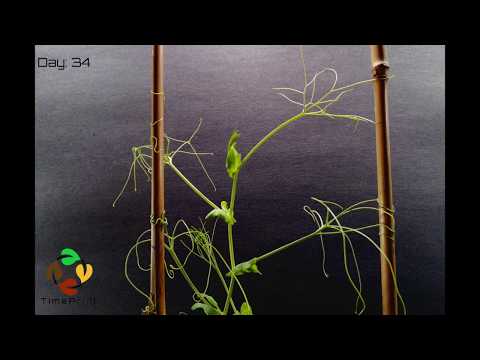
How Plants Climb, time-lapse (Time Print). Weeks of growth are squeezed into minutes. Watch the tendril tips sweep round in circles, then coil round the sticks within a short time of touching them.
Tip
Memory hook: "the far side grows." In every tropism, the organ bends because one side grows more than the other. Phototropism: the shaded side grows more. Thigmotropism: the side away from the touch grows more. Chemotropism: the tube tip grows towards the chemical, like following a smell to the kitchen.
Practice: chemotropism and thigmotropism
Key points
Sources and credits
Written by Ganzaa: Figures 1 and 2, the investigation and its results table (illustrative figures), the worked examples and the practice questions.