Tropic Responses
Senior 1 · Biology
Tropic Responses
Lesson 3 of 5
25 min
When a farmer in Bugesera plants maize at the start of the rainy season, she drops the grains into the holes without looking which way up they land. Some lie on their side and some upside down. Yet a week later every seedling has its root growing down into the soil and its shoot growing up into the air. Later in the season, when the rains stop, the roots keep growing towards the damp soil deep down. Two stimuli guide them: gravity and water.
Definition
Geotropism (or gravitropism): a growth movement in response to gravity. Main roots show positive geotropism (they grow down); shoots show negative geotropism (they grow up).
Hydrotropism: a growth movement in response to water. Roots show positive hydrotropism: they grow towards wetter soil.
Clinostat: an apparatus with a slowly turning axle, driven by a clock motor, on which seedlings are fixed. As it turns, each side of the seedling faces downwards in turn, so gravity acts equally on all sides.
Aim: to show that roots respond to gravity.
Figure 1: The clinostat experiment. Only the root that felt gravity from one side (A) bent. The shoots, not shown, do the opposite: on A they curve upwards.
Clinostat B is the control. It shows that the root in A did not bend just because it was pinned sideways or damp: it bent because gravity always pulled on the same (lower) side. The clinostat does not switch gravity off; it spreads its effect evenly round the root.
Warning
Safety. Push pins through the seed, not the root, and keep your fingers behind the cork while you do it. A clinostat has an electric or clockwork motor: keep water and wet cotton wool away from it, and wipe up any spills before switching it on.
When a seedling lies on its side, heavy starch grains in special cells settle to the lower side, and auxin moves to the lower side of both the shoot and the root. The surprise is that the same hormone has opposite effects in the two organs:
Figure 2: A seedling laid on its side. Auxin collects on the lower side of both organs, but speeds up growth in the shoot and slows it in the root.
Warning
Common mistakes. (1) "The root tip droops because it is heavy." A drooping tip would hang limp; a root actually grows downwards and pushes its way into firm soil, and on a turning clinostat it does not bend at all. (2) "Auxin always speeds up growth." In roots, a high concentration slows growth. (3) Forgetting that the clinostat must be kept dark: light from one side would add a second stimulus.
Worked example 1: reasoning about the clinostat
A student repeats Experiment 1 but leaves both clinostats on a sunny bench with no cover. The roots on A bend down as before. On B, the shoots all bend towards the window. Explain both results, and say what the student should change.
Answer: the roots on A show positive geotropism and the shoots on B show positive phototropism. The student must cover both clinostats with dark boxes so that gravity is the only stimulus being tested.
Aim: to show that roots respond to water.
Figure 3: The hydrotropism experiment. Roots still grow downwards, but curve towards the damp side when water is on one side only.
The results of one class are shown below. These are illustrative figures, made up for this lesson; your own results will differ.
| Seedling (experiment box) | Root length at start (mm) | Root length after 3 days (mm) | Curved towards the damp side? |
|---|---|---|---|
| 1 | 12 | 36 | yes |
| 2 | 10 | 31 | yes |
| 3 | 14 | 38 | yes |
| 4 | 11 | 29 | no |
| 5 | 13 | 40 | yes |
Worked example 2: growth rate and percentage from a results table
Use the table to find (a) the growth rate of root 1, (b) the mean growth rate of all five roots, (c) the percentage of roots that curved towards the water.
Interpretation: most roots curved towards the water, while in the control box they grew straight down, so roots are positively hydrotropic. With only five seedlings, one root that did not curve changes the answer by 20%; using more seedlings would make the result more reliable.
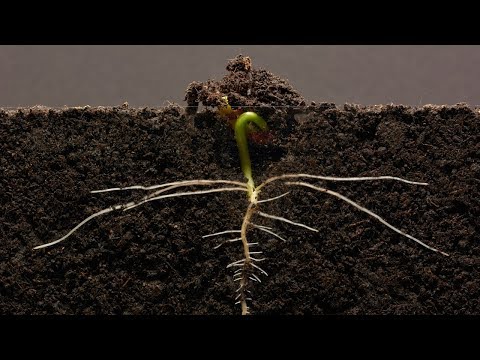
Bean Time-Lapse, 25 days, soil cross-section (GPhase). Watch the first root turn and grow straight down while the hooked shoot pushes upwards and straightens: positive and negative geotropism in the same seedling.
Tip
Memory hook: "Auxin sinks; shoots rise, roots dive." In a seedling on its side, auxin always goes to the lower side. It makes shoot cells grow more (shoot rises) and root cells grow less (root dives). In an exam, a clinostat answer must mention that turning makes gravity act on all sides equally.
Practice: geotropism and hydrotropism
Key points
Sources and credits
Written by Ganzaa: the experiments as set out here, Figures 1 to 3, the results table (illustrative figures), the worked examples, the farming applications and the practice questions.