Social Factors That Affect Good Health
Senior 1 · Biology
Social Factors That Affect Good Health
Lesson 1 of 5
25 min
Keza is 13 and lives in Nyamagabe. This term she has had no fever, no cough and no injury. Yet she sleeps badly, sits alone at break, and has stopped going to choir since her best friend moved to Kigali. Down the hill, her cousin's family shares one latrine with three other households, and a case of diarrhoea in one house soon appears in the next.
A doctor could examine Keza and find nothing wrong with her body. Would you still call her healthy? And is her cousin's health only her own business, or the whole village's? This lesson answers both questions.
The World Health Organization (WHO) wrote its definition of health in its Constitution in 1946, and it is still the definition used in health science today:
"Health is a state of complete physical, mental and social well-being and not merely the absence of disease or infirmity."
So there are three sides to one person's health, and a fourth side that belongs to the whole community. A problem on one side often spreads to the others: a long illness can make a person lonely and sad, and constant worry can cause headaches and poor sleep.
Definition
Health: a state of complete physical, mental and social well-being, not merely the absence of disease or infirmity (WHO). Infirmity means weakness or disability.
Definition
Physical health: the good working of the body, its organs and systems. Example: eating a balanced diet, sleeping enough and being active keep the heart, lungs and muscles strong.
Mental health: well-being of the mind, in which a person can cope with the normal stresses of life, think clearly, learn, and manage their feelings. Example: talking to a trusted adult when worried about exams.
Social health: the ability to build and keep good relationships with family, friends and the community, and to take part in community life. Example: helping at umuganda and having friends you can rely on.
Definition
Public health: the organised effort of a whole society to prevent disease, prolong life and promote health in the community, for example through vaccination, clean water, sanitation, food safety and health education. It looks after populations, not only individual patients.
| Type | Signs that it is good | A threat to it | One way to protect it |
|---|---|---|---|
| Physical | energy, normal growth, recovers quickly from minor illness | malnutrition, injury, infection | balanced diet, exercise, sleep, vaccination |
| Mental | copes with stress, concentrates, can name and manage feelings | long-lasting stress, bullying, substance abuse | rest, talking to someone you trust, asking for help early |
| Social | has friends, gets on with family, respects others | isolation, violence, stigma | joining clubs, sport, choir, community work |
| Public | few outbreaks, clean water, high vaccination cover | poor sanitation, unsafe food, epidemics | latrines, safe water, inspection, health education |
Worked example 1: which type of health?
Decide which type of health is mainly affected in each case, and give your reason.
Method: ask what is harmed (body, mind, relationships) and how many people share the cause. One shared cause affecting many people points to public health.
Rwanda organises health care as a ladder (Figure 1). Care starts in the village and moves up only when it is needed. This keeps simple care cheap and close to home, and keeps hospital beds for the people who really need them.
Figure 1: Most care starts at the bottom of the ladder, close to home. Patients who need more are referred upwards. Numbers: Ministry of Health, 2021, as quoted by RBC in 2022.
Definition
Referral: sending a patient from one level of care to a higher level that has the skills or equipment the patient needs.
Health insurance: a system in which many people pay regular contributions into a shared fund, which then pays most of the cost of care for whoever falls ill. Mutuelle de santé is Rwanda's community-based health insurance.

Worked example 2: climbing the ladder
At 9 p.m. in a village in Gakenke District, three-year-old Habimana has a high fever. His mother is a Mutuelle member. Use Figure 1 to decide what the family should do.
Answer: go to the CHW first, and move up the ladder by referral. Going first to a referral hospital for a simple illness wastes time and money and crowds out patients who need specialists.
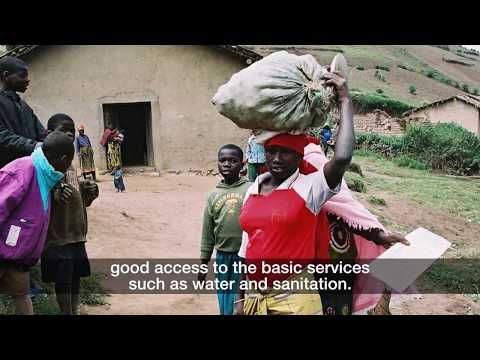
WHO: Universal health coverage in Rwanda (World Health Organization, 2 min). The WHO Representative explains how community-based health insurance lets people who work in the informal sector afford care. The video dates from 2017, so its figures are older than those in this lesson.
In groups of four, discuss and then report back:
Warning
Common mistakes. (1) Saying a person is healthy just because they have no disease: mental and social well-being count too. (2) Thinking a mental health problem is a weakness or a punishment; it is a health condition, and like a physical illness it can be treated. (3) Confusing public health (a whole community) with physical health (one person's body).
Tip
Memory hook: Body, Mind, People, Place. Physical health is the body, mental health the mind, social health your people, and public health the place where everyone lives together.
Practice: types of health and health services
Key points
Sources and credits
Written by Ganzaa: the lesson text, Figure 1, the table, the worked examples, the discussion and the practice questions.