Social Factors That Affect Good Health
Senior 1 · Biology
Social Factors That Affect Good Health
Lesson 2 of 5
25 min
In Keza's cousin's neighbourhood, four households share one latrine that has no door and no handwashing point. Their drinking water comes from an open spring below the houses. In March a child in the first house had watery diarrhoea. Within ten days, children in the other three houses were sick too.
Nobody sneezed on anybody. So how did the germs travel from house to house? The answer lies not in medicine but in four social factors: housing, food, water and hygiene. These are the conditions people live in, and families, communities and the Government can change them.
Copy the table and tick yes or no for your own home or for your school. Do not touch waste or open latrine covers; just look.
| Factor | Question | Yes | No |
|---|---|---|---|
| Housing | Can air flow through every room (windows that open)? | ||
| Housing | Is cooking done outside, or on a stove that sends smoke out of the room? | ||
| Food | Is cooked food kept covered? | ||
| Food | Are packets checked for the expiry date before use? | ||
| Water | Is drinking water boiled or treated, and stored in a covered container? | ||
| Hygiene | Is there soap and water next to the latrine? |
Every no is a possible route for disease. The rest of this lesson explains why.
Definition
Social factors of health (also called social determinants of health): the conditions in which people are born, grow, live, work and age, such as housing, income, education, water, sanitation and food, which strongly affect their health.
Definition
Ventilation: the movement of fresh air into a room and stale air out of it, through windows, doors or vents.
Overcrowding: too many people living in too little space. The United Nations counts a home as overcrowded when more than three people share one habitable room (a room for living or sleeping, not a kitchen or bathroom).
Worked example 1: is this home overcrowded?
Gatete's family of 7 lives in a house with a sitting room and one bedroom; the kitchen is a separate hut. Use the United Nations rule to decide whether the house is overcrowded, and how many habitable rooms it would need.
Answer: overcrowded; one more habitable room would bring it within the rule. Until then, good ventilation (windows open by day) lowers the risk of airborne infections.
Food can carry bacteria, viruses, parasites and harmful chemicals. Food is made safe by two groups of people working together.
Definition
Food inspection: the checking of food, and of the places where it is produced, stored and sold, by trained officers, to make sure it is safe and meets legal standards.
Expiry date: the date printed on a packet after which the food or medicine should not be used.
Many diarrhoeal diseases, including cholera, typhoid and dysentery, spread by the faecal-oral route: germs leave a sick person in faeces and enter a new person through the mouth. Figure 1 shows the four main routes, which all begin with F.
Figure 1: The F-diagram. Each red bar is a barrier. Safe toilets (1) stop germs at the source; barriers 2 to 6 are the second line of defence.
Definition
Hygiene: practices that keep people and their surroundings clean in order to prevent disease, such as handwashing, safe toilets and clean food preparation.
Faecal-oral route: the way germs from the faeces of an infected person reach the mouth of another person, usually through water, food, flies or hands.
Worked example 2: tracing the outbreak
Use Figure 1 to explain how diarrhoea spread from the first house to the others in the opening story, and choose the barrier that would have done most to stop it.
Answer: faeces reached the other children through unwashed hands, the spring water and flies. The best first step is to make the latrine safe and put soap and water beside it; the families should also boil their drinking water until the spring is protected.


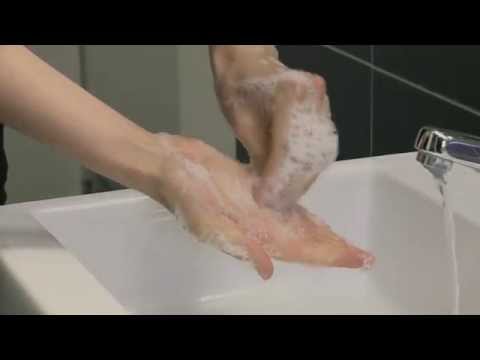
WHO: How to handwash? With soap and water (World Health Organization). Count the steps: palms, backs of the hands, between the fingers, thumbs and fingertips are all washed, for about as long as it takes to sing a short song.
Look back at your survey. Which no in your table is the most dangerous, and why? Which one could your class fix this month at no cost, and who would you need to ask?
Warning
Common mistakes. (1) "Clear water is clean water." Germs are far too small to see; clear water can still carry cholera. (2) Rinsing hands without soap: soap is what lifts the grease and germs off the skin. (3) Thinking food is safe because it smells fine: many harmful bacteria do not change the smell or taste.
Tip
Memory hook: the four Fs (fluids, fields, flies, fingers) lead to the fifth F, food. Block them with T-W-H-C: Toilets, safe Water, Handwashing and Covered food.
Practice: housing, food, water and hygiene
Key points
Sources and credits
Written by Ganzaa: the lesson text, the survey, Figure 1 (drawn after the widely used F-diagram of faecal-oral transmission), the worked examples and the practice questions.