Laboratory Safety and Apparatus
Senior 1 · Chemistry
Laboratory Safety and Apparatus
Lesson 5 of 5
25 min
Light a Bunsen burner with its air hole closed and you get a tall, lazy, yellow flame. Turn the collar to open the air hole and the flame shrinks, turns blue and starts to roar. Hold a clean beaker over each flame for a few seconds: the yellow flame leaves a black layer on the glass, the blue one leaves none. Why does letting in air change the flame so much?
Figure 5.1: The parts of a Bunsen burner.
Warning
Never turn on the gas before the lit match is ready: gas collects and bursts into flame at your face. Never leave a lit burner alone. When you pause, close the air hole so the flame turns yellow: a blue flame is hard to see in daylight, and people have leaned into one without noticing.
Figure 5.2: The two kinds of Bunsen flame.

Laboratory gas is a fuel such as methane, propane or butane. To burn completely it needs plenty of oxygen. With the air hole open, air mixes with the gas inside the barrel, so the gas burns completely to carbon dioxide and water. For propane:
With the air hole closed, the gas meets air only at the edge of the flame, so there is not enough oxygen. Some carbon is left unburnt as tiny particles of soot, which glow yellow in the heat and blacken anything held in the flame, for example:
Definition
Complete and incomplete combustion: complete combustion is burning with enough oxygen, so a fuel's carbon all becomes carbon dioxide; incomplete combustion is burning with too little oxygen, so some carbon is left as soot (or forms poisonous carbon monoxide).
Definition
Luminous flame: the yellow, bright, flickering flame given when the air hole is closed. It is cooler and sooty, and is used as a visible 'safety flame' when the burner is not heating anything.
Definition
Non-luminous flame: the blue, hardly visible, roaring flame given when the air hole is open. It is much hotter, gives no soot, and is used for heating. Its hottest part is just above the tip of the inner blue cone.
Table 5.1: Comparing the two flames
| Property | Luminous flame | Non-luminous flame |
|---|---|---|
| Air hole | closed | open |
| Colour | yellow | blue |
| Appearance and sound | large, wavy, quiet | small, steady, roaring |
| Burning | incomplete, too little oxygen | complete, enough oxygen |
| Soot | yes, blackens apparatus | no |
| Temperature | cooler | much hotter |
| Used for | a visible flame while waiting | heating |
Worked example
Problem. Mugisha heats water in a beaker over a yellow flame. The water warms slowly and the bottom of the beaker turns black. Explain both observations and say what he should change.
Solution.
Answer: he should open the air hole to get a blue, non-luminous flame, which is hotter and leaves no soot.
Figure 5.3 shows more apparatus you will meet. Many Rwandan schools without a gas supply use spirit lamps, which burn methylated spirit (mostly ethanol), or small portable gas stoves; the same safety rules apply.
Figure 5.3: Apparatus for heating (top two rows) and for separating (bottom row).
Table 5.2: Apparatus for heating and separating
| Apparatus | Use |
|---|---|
| Tripod and gauze | supports a beaker or basin over a flame; the gauze spreads the heat evenly |
| Crucible and lid on a pipe-clay triangle | heating a small amount of solid very strongly |
| Evaporating basin | evaporating water from a solution to leave the solid |
| Spirit lamp | a small flame where there is no gas supply |
| Tongs | holding hot crucibles and other hot objects |
| Water bath | warming gently to no more than 100 °C; the only safe way to warm a flammable liquid |
| Filter funnel, separating funnel, condenser | separating mixtures (Unit 4) |
Worked example
Problem. Choose the apparatus for each task. (a) Heat 2 g of magnesium ribbon strongly in air. (b) Warm 5 cm³ of ethanol. (c) Evaporate the water from salt solution.
Solution.
Warning
Spirit lamps: fill them only when cold and unlit, and away from flames. Never refill a lamp that is burning. Put the flame out by placing the cap over the wick, not by blowing.
Tip
Air hole open: flame is blue and hot. Air hole closed: flame is yellow and sooty. More air, more heat.
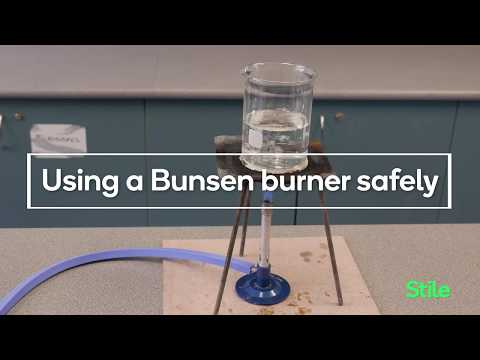
Stile Education: How to use a Bunsen burner safely (3 min). Compare their lighting steps with the six steps above.
Practice
Further reading
Sources and credits
This lesson adapts CC BY-SA material and is shared under CC BY-SA 4.0.