Laboratory Safety and Apparatus
Senior 1 · Chemistry
Laboratory Safety and Apparatus
Lesson 3 of 5
20 min
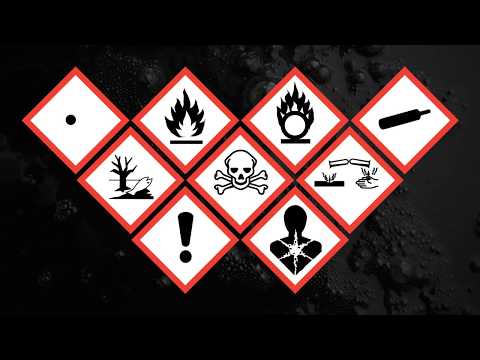
A bottle of drain cleaner in a Kigali shop, a cylinder of cooking gas, a can of pesticide at a farm-supply store and a bottle of acid in your laboratory all carry small red diamonds with black pictures. The same diamonds are used in almost every country, so anyone can understand the warning, whatever language they read. In this lesson you will learn to read them, and the words printed beside them.
Definition
Hazard pictogram: a picture in a red-bordered diamond that shows the kind of danger a substance has. The set used worldwide is part of the Globally Harmonized System (GHS).
Figure 3.1: The nine hazard pictograms (drawn by Ganzaa in the GHS style).
Table 3.1: What each pictogram means
| Pictogram | What it means | Laboratory example | Example at home or work |
|---|---|---|---|
| 1. Explosive | may explode if heated, struck or sparked | rarely found in school laboratories | fireworks, blasting explosives in quarries |
| 2. Flammable | catches fire easily | ethanol, methylated spirit | petrol, kerosene, cooking gas, matches |
| 3. Oxidising | gives off oxygen and makes other things burn fiercely | potassium manganate(VII), strong hydrogen peroxide | pool chlorine (calcium hypochlorite) |
| 4. Gas under pressure | a gas in a cylinder that may burst if heated | gas cylinders for Bunsen burners | cooking-gas (LPG) cylinders |
| 5. Corrosive | destroys skin, eyes and metals | concentrated acids, sodium hydroxide | drain cleaner, car-battery acid, bleach |
| 6. Acute toxicity | small amounts can kill if swallowed, breathed in or absorbed through the skin | methanol | rat poison, some pesticides |
| 7. Harmful or irritant | irritates skin, eyes or lungs; harmful if swallowed | copper(II) sulfate | many household cleaners |
| 8. Serious health hazard | long-term damage to organs or lungs, or may cause cancer | some organic solvents | petrol, kerosene (deadly if it enters the lungs) |
| 9. Hazard to the environment | poisonous to fish and other water life | copper(II) sulfate | pesticides, used engine oil |
Definition
Signal word: one of two words printed on a hazard label: DANGER for the more severe hazards, or WARNING for less severe ones.
Definition
Corrosive: able to destroy living tissue and metals on contact. Example: sodium hydroxide, , in drain cleaner.
Definition
Oxidising substance: a substance that releases oxygen or helps other materials burn more fiercely, even without air. It must be stored away from flammable substances.
A full hazard label has six parts (Figure 3.2): the name of the chemical, one or more pictograms, a signal word, hazard statements that say what can go wrong, precautionary statements that say how to stay safe, and the supplier's name and the amount.
Figure 3.2: The parts of a hazard label on a bottle of ethanol.

Worked example
Problem. Use the label in Figure 3.2. (a) What two hazards does ethanol have? (b) How should it be used safely in a school laboratory?
Solution.
Worked example
Problem. A laboratory technician is tidying a shelf. Which of these should not be stored side by side, and why? Ethanol (flammable), potassium manganate(VII) (oxidising), bleach (corrosive), hydrochloric acid (corrosive).
Solution.
Answer: keep oxidisers away from flammables, and acids away from bleach.
Warning
At home too: never mix bleach with an acidic toilet cleaner. The chlorine gas released attacks the lungs, and people have been badly hurt cleaning a small bathroom this way.
Warning
Common mistake: pouring kerosene, petrol or pesticide into an empty water or soda bottle. A child may drink it. Poisonous and flammable liquids must stay in their own labelled container, out of reach of children.
Tip
Read a label in the order picture → signal word → what can go wrong → what to do. If a container has no label, do not use it: tell your teacher.
iHasco: The COSHH symbols and their meanings (2 min). Pause on each symbol and find it in Figure 3.1.
Practice
Sources and credits
This lesson adapts CC BY-SA material and is shared under CC BY-SA 4.0.