Elementary Probability
Senior 1 · Mathematics
Elementary Probability
Lesson 3 of 5
22 min
Toss a coin and it is as likely to land heads as tails, because its two faces are the same shape. Now toss the metal top of a soda bottle. Does it land with its open side up, or open side down? Its two sides are different shapes, so there is no reason to expect an even chance, and no way to work the answer out by thinking. The only way to find the probability is to experiment: toss it many times and count.
Definition
Relative frequency of an event: the fraction of the trials in which the event happened,
Experimental probability: the relative frequency, used as an estimate of the probability of the event.
Example: a bottle top lands open side up 41 times in 100 tosses, so the experimental probability is .
An S1 class tossed a bottle top 500 times and kept a running count of how often it landed open side up:
| Trials so far | Open side up so far | Relative frequency |
|---|---|---|
| 10 | 6 | |
| 20 | 9 | |
| 50 | 22 | |
| 100 | 41 | |
| 200 | 83 | |
| 500 | 204 |
Important
More trials give a better estimate. With a few trials, the relative frequency jumps about a lot, because a short run of luck makes a big difference. As the number of trials grows, it settles down close to a fixed value, and that value is the best estimate of the probability. So an experimental probability should always be reported together with the number of trials it came from.
Definition
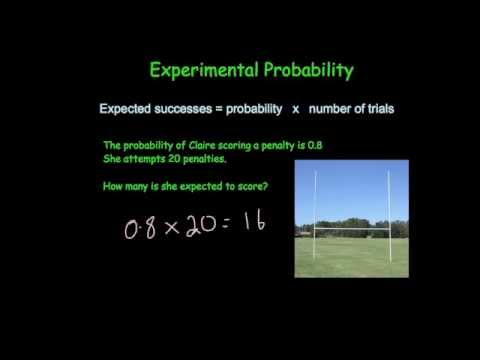
Expected frequency: the number of times an event is expected to happen in a given number of trials,
It is a prediction, not a promise: the actual count will usually be close to it, but not exactly equal.
Worked example 1: late buses
Of the last 80 buses to leave Nyabugogo for Musanze, 12 left late. (a) Estimate the probability that the next bus leaves late. (b) How many of the next 200 buses would you expect to leave late?
Solution
Worked example 2: Umuganda
In an umudugudu, 172 of the 200 households took part in last month's Umuganda. (a) Estimate the probability that a household chosen at random took part. (b) A neighbouring umudugudu with similar habits has 350 households. About how many would you expect to take part?
Solution
Worked example 3: is the die fair?
Ishimwe rolls a die 30 times and gets 8 sixes. Keza rolls the same die 600 times and gets 104 sixes. For a fair die, the probability of a six is . (a) Find each relative frequency. (b) Whose estimate is more reliable? (c) Does the die seem fair?
Solution
Warning
An experiment gives an estimate, not the exact answer
Tip
Experimental probability answers "how often did it happen?"; the expected frequency turns it round to "how often will it happen?". Divide by the trials to get the probability; multiply by the trials to get the expected frequency.
Corbettmaths: Relative Frequency (8 min). Watch how relative frequency is calculated from experiments, and why more trials give a more reliable estimate.
Practice
Give probabilities as decimals. Question 6 is harder.
Sources and credits
The bottle-top experiment and its graph, the Rwandan examples, the practice items and the quiz questions were written by Ganzaa.