Elementary Probability
Senior 1 · Mathematics
Elementary Probability
Lesson 4 of 5
25 min
In Lesson 3 you had to toss a bottle top hundreds of times to estimate a probability. Yet nobody tosses a coin a thousand times to find : a coin has two faces of the same shape and weight, so there is no reason for one to come up more than the other. When all the outcomes of an experiment are equally likely like this, a probability can be calculated by counting, before the experiment is ever done.
Definition
Equally likely outcomes: outcomes that all have the same chance of happening.
Fair (unbiased): describes a coin, die or spinner whose outcomes are equally likely. A fair die has the same chance of showing each of its six faces.
At random: chosen so that every item has the same chance of being chosen, for example by picking a bead from a bag without looking.
Definition
Theoretical probability: when all the outcomes in the sample space are equally likely, the probability of an event is
The outcomes in are called the favourable outcomes.
Example: for a fair die, .
Important
Why the formula works. If outcomes are equally likely, they share the certainty of 1 equally, so each has probability . An event with of these outcomes has such shares:
Because , this also shows again that .
Worked example 1: a fair die
A fair die is rolled. Find (a) , (b) , (c) , (d) .
Solution , so .
Worked example 2: beads in a bag
One bead is taken at random. Find the probability that it is (a) blue, (b) red, (c) not red, (d) red or green, (e) yellow.
Solution Each of the 10 beads is equally likely to be picked, so .
Worked example 3: letter cards
The letters of NYARUGENGE are written on ten cards, one letter per card. One card is picked at random. Find (a) , (b) , (c) .
Solution Each card is equally likely, so , the number of cards.
In Unit 1 the set of letters of NYARUGENGE had only 7 elements, because a set lists each letter once. For probability, count every card, because each card can be picked.
Worked example 4: two dice
Two fair dice are rolled. Find the probability of (a) a total of 8, (b) a double, (c) a total of 10 or more.
Solution The 36 outcomes in the grid are equally likely, so .
Theory says that each face of a fair die has probability , so in 60 rolls each number is expected times. A class rolled a die 60 times:
The six came up 13 times, a relative frequency of , against the theoretical . This does not show that the die is unfair: 60 rolls are not many. As in Lesson 3, the more times the die is rolled, the closer each relative frequency is expected to come to . When outcomes are equally likely, theory gives the exact value that experiments estimate; when they are not (the bottle top), experiment is the only way.
Warning
Only for equally likely outcomes
Tip
Write the denominator first: "", the total number of equally likely outcomes. Then count the favourable outcomes on top. Finish with a sense check: is the answer between 0 and 1, and does its size match your feeling of how likely the event is?
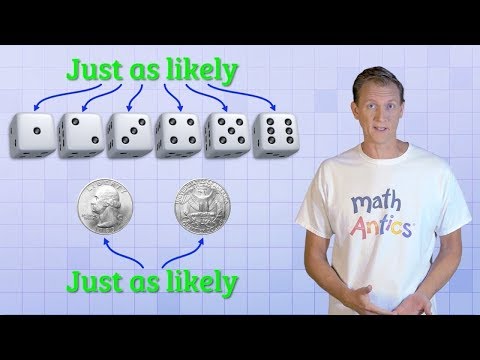
Math Antics: Basic Probability (11 min). Watch how probability is written as the number of favourable outcomes over the total number of outcomes, and how it can also be written as a decimal or a percentage.
Practice
Give each answer as a fraction in its simplest form. Questions 6 and 7 are harder.
Sources and credits
The diagrams, the Rwandan examples, the practice items and the quiz questions were written by Ganzaa.