Temperature Measurement and Physical Properties of Matter
Senior 1 · Physics
Temperature Measurement and Physical Properties of Matter
Lesson 4 of 5
25 min
Brochettes are grilling at a roadside stall in Remera. Nobody carries the smell to you, and there may be no wind, yet within seconds you can smell them from across the street. A spoon of sugar stirred into tea disappears, but every sip is sweet. A drop of ink in a glass of still water slowly colours all of it. These everyday events are clues to one of the biggest ideas in science: all matter is made of tiny particles that are always moving.
Definition
Matter is anything that has mass and takes up space (has volume). Air, water, stone and your body are all matter; light and sound are not.
All matter is made of extremely small particles: atoms, or groups of atoms joined together called molecules. Example: a water molecule, , is two hydrogen atoms joined to one oxygen atom; it is about across.
Definition
The kinetic theory of matter states that:
You need: a beaker of water left to stand until it is completely still, forceps, and one small crystal of potassium permanganate.
Figure 4.1: The purple colour spreads upwards and outwards on its own, until it is spread evenly through the water.
Explanation: particles of water are always moving and bumping into the particles of the dissolving crystal, knocking them in all directions. Over time the purple particles spread from where there are many of them to where there are few. This spreading is called diffusion. It is faster in gases than in liquids, because gas particles are further apart and move faster, and faster in hot water than in cold.
Important
Safety. Potassium permanganate stains skin and clothes brown and is harmful if swallowed. Handle the crystal only with forceps, use just one small crystal, and wash your hands afterwards.
Definition
Diffusion is the spreading of particles of a substance from a region where they are concentrated to a region where they are less concentrated, caused by the random motion of particles. Example: the smell of perfume spreading through a classroom.
Your teacher fills a small glass cell with smoke from a smouldering straw, covers it with a glass slide, shines a bright light from the side and puts it under a microscope. The smoke particles look like bright specks that jiggle about at random, never stopping.
Figure 4.2: The smoke particle moves in a random zigzag. It is being hit, unevenly, by millions of invisible air molecules moving at high speed.
This random movement of small visible particles is called Brownian motion, after the Scottish botanist Robert Brown, who saw pollen grains jiggling in water in 1827. In 1905 Albert Einstein explained it using moving molecules, and it became strong evidence that atoms and molecules are real.
Figure 4.3: The same particles arranged as a solid, a liquid and a gas. What changes is how close together they are, how strongly they attract each other, and how they move.
| Solid | Liquid | Gas | |
|---|---|---|---|
| Arrangement | regular pattern (lattice) | irregular, touching | random, far apart |
| Spacing | very close | close | about 10 particle widths apart |
| Movement | vibrate about fixed positions | move around and slide past each other | move fast in straight lines until they collide |
| Forces of attraction | very strong | strong | very weak |
| Energy of particles | lowest | higher | highest |
Figure 4.4: Heating (red arrows) gives particles more energy, so they break free of each other: solid to liquid to gas. Cooling (blue arrows) does the reverse. A few substances, such as solid carbon dioxide and iodine, change straight from solid to gas.
While a pure substance is melting or boiling, its temperature stays constant: the heat taken in is used to pull the particles apart, not to make them move faster. Pure ice melts at 0 °C and pure water boils at 100 °C at sea level.
Worked example 1: how big is a molecule?
A tiny drop of oil of volume is placed on clean water dusted with fine powder. It spreads into a circular film of area , assumed to be one molecule thick. Estimate the size of an oil molecule.
Convert to SI units: and .
An oil molecule is about 2.5 nanometres long: 400 000 of them in a row would make just 1 mm.
Worked example 2: diffusion in a liquid and in a gas
In the beaker, the purple colour spreads 3.0 cm in 10 minutes. In a classroom, the smell of perfume reaches pupils 5.0 m away in about 1 minute. Compare the average rates of spreading.
The smell spreads roughly 1700 times faster, because gas particles are far apart and move fast (air currents in the room help too).
Worked example 3: from water to steam
At 100 °C, 1 of liquid water becomes about 1700 of steam. What volume of steam could come from a kettle holding 1.5 L of water?
The number of particles is the same; they are simply much further apart in the gas.
Warning
The particles themselves do not melt or expand. When ice melts, its molecules are still water molecules; only their arrangement and motion change. When a gas is heated, it takes up more space because its particles move faster and spread further apart, not because each particle gets bigger.
Tip
Explain any change of state in three steps: heat in or out; particles move faster or slower; attractions broken or formed. Try it: in PhET: States of Matter: Basics (version 1.2.21), heat and cool water or neon and watch the particles change from solid to liquid to gas.
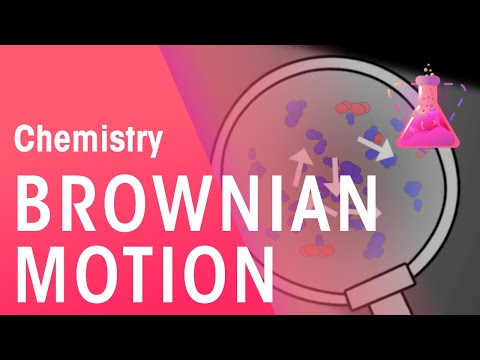
What is Brownian motion? (FuseSchool). Watch for how the random jiggling of visible particles shows that the invisible particles of a liquid or gas are moving.
Practice
Key points
Sources and credits
Written by Ganzaa: the lesson text, experiments, diagrams, tables, worked examples, Rwandan applications and practice exercises.