Temperature Measurement and Physical Properties of Matter
Senior 1 · Physics
Temperature Measurement and Physical Properties of Matter
Lesson 3 of 5
25 min
A chemistry pupil measures the temperature of boiling salty water. A nurse checks whether a child has a fever. A farmer near Nyagatare wants to know how cold it got last night and how hot it got today, without staying awake to watch. One thermometer cannot do all three jobs well. In this lesson you will see how each type is designed for its job, and why every thermometer needs a little time before it gives a true reading.
Definition
A thermometric property is a property of a substance that changes steadily and measurably with temperature, and can therefore be used to make a thermometer. Examples: the expansion of a liquid in a thin tube; the electrical resistance of a wire; the voltage of a thermocouple.
A thermometric liquid is the liquid used in a liquid-in-glass thermometer. The two common ones are mercury and alcohol (ethanol, dyed red or blue).
| Property | Mercury | Alcohol (ethanol) |
|---|---|---|
| Freezing point | −39 °C: cannot measure very cold places | −115 °C: good for very low temperatures |
| Boiling point | 357 °C: good for high temperatures | 78 °C: cannot measure boiling water |
| Seeing the thread | shiny and opaque, easy to see | colourless, must be dyed |
| Wetting the glass | does not wet the glass, so the thread is clean | wets the glass, so some can stick to the bore |
| Expansion | small but very regular | about six times larger, so more sensitive |
| Conducting heat | good conductor: responds quickly | poor conductor: responds more slowly |
| Safety and cost | poisonous and expensive | safe and cheap |
Why not water? Water freezes at 0 °C and boils at 100 °C, which is too narrow a range; it wets the glass, it is colourless, and it expands unevenly between 0 °C and 4 °C.
A long glass tube with a narrow bore, a bulb of mercury or alcohol, and a scale usually from −10 °C to 110 °C. It has no constriction, so the reading falls as soon as it is taken out. To use it: hold it by the top, put the whole bulb in the liquid without touching the container, stir gently, wait until the thread stops moving, and read with your eye level with the top of the thread.
Figure 3.1: A clinical thermometer has a short range and a constriction. Mercury is pushed through the constriction as it expands, but when the thermometer is taken out of the mouth the thread breaks at the constriction and stays at the highest reading.


Warning
Never sterilise a clinical thermometer in boiling water. Water at 100 °C is far above its top reading of 42 °C: the mercury would expand beyond the end of the bore and burst the glass. Wipe it with cold water and an antiseptic instead. If a mercury thermometer breaks, do not touch the mercury; tell an adult, open the windows and collect the beads with a piece of card.
Figure 3.2: Six's thermometer. When it gets warmer, the alcohol in the big bulb expands and pushes the mercury round the U, so the right-hand mercury rises and pushes the red index up. When it gets colder, the left-hand mercury rises and pushes the blue index up its upside-down scale. Each index stays where it was pushed.
The steel indices are held in place by small springs, so they stay at the highest and lowest points the mercury reached. The bottom end of each index gives the reading. To reset the thermometer, a small magnet drags each index back down onto its mercury surface. Six's thermometers are used at weather stations and in greenhouses, where the day's highest and lowest temperatures matter.

Definition
Two bodies are in thermal equilibrium when they are at the same temperature, so no net heat flows between them.
A thermometer shows its OWN temperature. It gives the temperature of a body only after it has reached thermal equilibrium with that body. That is why you must wait until the reading stops changing (about a minute under the tongue for a mercury clinical thermometer).
Worked example 1: reading an unmarked thermometer
An unmarked mercury thermometer has a thread 2.0 cm long at the ice point and 22.0 cm long at the steam point. In a cup of water the thread is 11.0 cm long. What is the temperature of the water?
Worked example 2: a school weather station
A Six's thermometer at a school in Nyagatare shows a minimum of 14 °C and a maximum of 31 °C for one day. Find the day's range of temperature and the mean of the maximum and minimum.
Worked example 3: mixing hot and cold water
(a) 200 g of water at 80 °C is mixed with 200 g of water at 20 °C. (b) 100 g at 80 °C is mixed with 300 g at 20 °C. Find the final temperature each time, assuming no heat is lost to the surroundings.
At thermal equilibrium, the heat lost by the hot water equals the heat gained by the cold water. For water alone this gives the mass-weighted mean:
The mixture ends nearer to the temperature of the larger mass.
Important
Safety. Use a plastic beaker for hot water or hold glass beakers with a cloth. Never use a clinical thermometer for hot liquids in the lab.
Most health centres in Rwanda now use digital thermometers. Their sensor is a thermistor, a tiny device whose electrical resistance changes with temperature; a chip turns the resistance into a number on a screen. Infrared thermometers, pointed at the forehead, measure the heat radiation from the skin without touching it; they were used at the entrances of offices, schools and markets during the COVID-19 pandemic. They contain no mercury and are quick, but their batteries must be kept charged.
Tip
Match the thermometer to the job: laboratory: wide range, no constriction. Clinical: 35–42 °C, constriction, shake down. Six's: two indices, reset with a magnet. And whatever you use, wait for thermal equilibrium.
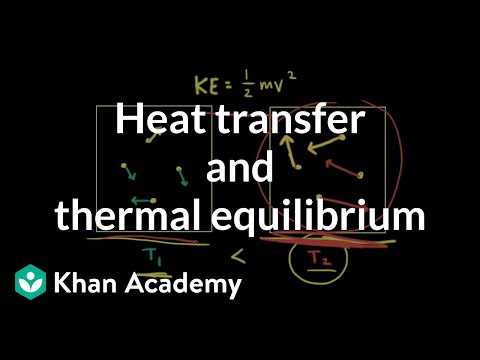
Heat transfer and thermal equilibrium (Khan Academy). Watch for how heat flows from the hotter object to the colder one until both reach the same final temperature.
Practice
Key points
Sources and credits
Written by Ganzaa: the lesson text, the diagrams, the comparison table, worked examples and practice exercises.