Algebraic Fractions
Senior 3 · Mathematics
Algebraic Fractions
Lesson 5 of 5
25 min
Suppose a school tank can be filled from the mains by one tap in 6 hours, or by a bigger tap in 3 hours (illustrative figures). With both taps open, is the answer 9 hours? 4.5 hours? Neither. In one hour the first tap fills of the tank and the second fills . If together they take hours, together they fill of the tank per hour, so
The unknown sits in a denominator. This lesson shows how to solve such equations, and why every answer must be checked against the excluded values.

Definition
Rational equation: an equation that contains at least one algebraic fraction with the unknown in its denominator.
Notation: its conditions of existence are the excluded values of all its fractions.
Example: is a rational equation with the conditions .
Definition
Extraneous solution: a solution of the equation obtained after clearing the fractions that is an excluded value of the original equation. It is not a solution and must be rejected.
Notation: write "rejected: excluded value" next to it.
Example: clearing the fractions in gives , which is excluded; that equation has no solution (see Worked example 3).
Important
Rule. Multiply every term on both sides by the LCD of the fractions. The new equation has no fractions. Every solution of the original equation is a solution of the new one, but the new one may have extra solutions: the values that make the LCD zero. So solve the new equation, then reject any solution that is an excluded value.
Why the extra solutions appear: multiplying both sides by an expression is reversible only when that expression is not zero. For a value that makes the LCD zero, both sides become , so the new equation is true there even though the original has no meaning.
Worked example 1: a linear result
Solve .
Solution Condition: . Multiply every term by the LCD :
12 is not excluded. Check: . ✓
Worked example 2: a quadratic result
Solve .
Solution Conditions: . Multiply every term by :
So or ; neither is excluded. Check: gives ✓; gives ✓.
Worked example 3: extraneous solutions
Solve (a) (b) .
Solution
(a) Condition: . Multiply by :
is rejected (excluded value), so the only solution is . Check: and . ✓
(b) Condition: . Multiply by : , so and . But 2 is excluded, so the equation has no solution.
Many problems about work and motion lead to rational equations, because a rate is a quantity divided by a time.
| Type | Rate | Key fact |
|---|---|---|
| work (filling, weeding, building) | a job done in hours has rate of the job per hour | rates of people or machines working together add |
| motion | time | on a river, speed upstream , downstream |
Worked example 4: two taps
Solve the tank problem from the start of the lesson.
Solution , with . Multiply by : , so . With both taps open the tank fills in 2 hours, less than either tap alone, as it should.
Worked example 5: weeding a field
Working together, Uwase and Mugisha weed a field in 4 days. Working alone, Mugisha would take 6 days longer than Uwase. How long would each take alone? (Illustrative figures.)
Solution Let Uwase take days alone, so Mugisha takes days, with . Their daily rates add up to the joint rate:
Multiply by :
Reject . Uwase takes 6 days and Mugisha 12 days. Check: . ✓
Worked example 6: a boat against the current
A motorboat goes 24 km upstream on a river and 24 km back downstream in a total of 5 hours. Its speed in still water is . Find the speed of the current. (Illustrative figures.)
Solution Let the current be , with . Upstream speed , downstream :
Multiply by :
(reject ). The current flows at . Check: hours. ✓
Warning
Multiply every term, then check every answer. In , the term must be multiplied by too; forgetting a term (especially a whole number such as the 1 in Worked example 2) is the most common mistake. And an answer that is an excluded value is not a solution, however carefully it was found.
Tip
In rate problems, write the rates, not the times. Times of people working together do not add; rates do. Write each rate as , add them, and set the sum equal to the joint rate.
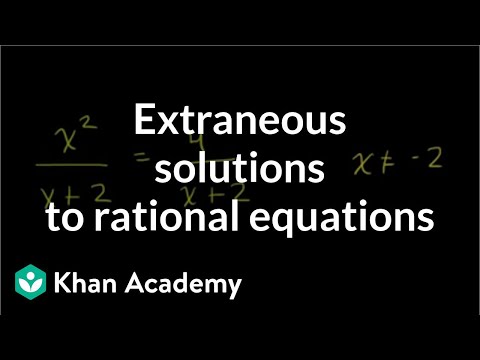
Khan Academy: Extraneous solutions to rational equations (3 min). Watch how the fractions are cleared, the resulting equation is solved, and one of the answers is rejected because it makes a denominator zero.
Practice
State the conditions first, and check your answers. The last three are harder.
Further reading for this unit
Sources and credits
The worked examples, the practice items and the quiz questions were written by Ganzaa.