Effects of Human Activities on Ecosystems and Environmental Conservation
Senior 3 · Biology
Effects of Human Activities on Ecosystems and Environmental Conservation
Lesson 4 of 5
25 min
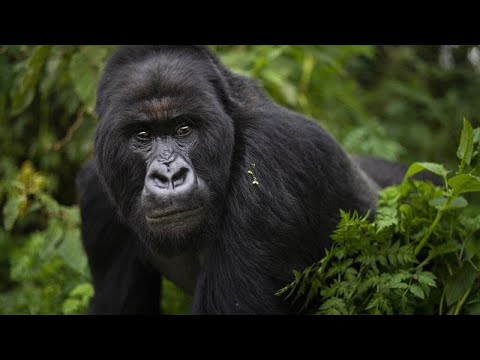
In 2008 there were estimated to be about 680 mountain gorillas in the world, all of them in the forests of the Virunga volcanoes (shared by Rwanda, Uganda and the Democratic Republic of the Congo) and Bwindi in Uganda. The subspecies was listed as Critically Endangered. By 2018 the estimate had risen to over 1,000, and the IUCN moved the mountain gorilla to the less severe category Endangered, crediting anti-poaching patrols, veterinary care such as removing snares, cooperation across borders and the support of communities living around the forests. In 2026 the Rwanda Development Board reported over 1,060 mountain gorillas in the wild. Few species recover like this. Most endangered species are still declining, and many have already gone for ever.
Definition
Extinction: the permanent disappearance of a species: no living individual remains anywhere. Local extinction: the disappearance of a species from one area while it survives elsewhere.
Endangered species: a species at high risk of becoming extinct in the wild.
IUCN Red List: the list, kept by the International Union for Conservation of Nature, that places species in categories according to their risk of extinction.
Conservation: the protection and careful management of species and habitats so that they survive.
In-situ conservation: protecting a species in its natural habitat (a national park). Ex-situ conservation: protecting it outside its habitat (a zoo, a botanical garden or a seed bank).
Figure 1: The IUCN Red List categories, from least to greatest risk.
| Cause | How it works | Example |
|---|---|---|
| Habitat destruction | the species loses food, shelter and breeding sites; the main cause worldwide | forest cleared in Gishwati (Lesson 2) |
| Over-hunting and poaching | animals are killed faster than they breed; snares also catch other species | rhinos killed for their horn across Africa |
| Introduced (invasive) species | a new species competes with, eats or infects native species | water hyacinth, a South American plant, choking lakes and rivers in East Africa |
| Pollution | poisons, low oxygen and plastic kill wildlife | DDT and birds of prey (Lesson 1) |
| Disease | new pathogens spread, especially in small, crowded populations | diseases caught from people threaten gorillas |
| Climate change | habitats become too hot, dry or wet for the species | mountain species with nowhere higher to go |
Species most at risk are large, slow-breeding animals, species found in only one place, and species whose populations are already small, because a small population can be wiped out by one disease outbreak or bad year and loses genetic variety through inbreeding.

Worked example 1: how fast did the gorillas recover?
Take the IUCN estimates of 680 mountain gorillas in 2008 and 1,000 in 2018. (a) Calculate the percentage increase. (b) Calculate the mean yearly growth rate, assuming steady compound growth.
Interpretation: a steady 3.9% a year is fast for a large ape that has one baby every few years; it shows that deaths from poaching and snares had been cut sharply.
Worked example 2: sharing the benefits
The Rwanda Development Board reported in 2026 that tourism revenue sharing had supported nearly 1,300 community projects with more than Rwf 23 billion. (a) Estimate the mean amount per project. (b) Suppose a park earns Rwf 4.5 billion from tourism in one year (illustrative figure). How much goes to its communities at 10%? (c) Explain how this helps conservation.
Warning
Common mistakes. (1) "Endangered" and "extinct" are not the same: an endangered species can still be saved. (2) Zoos alone cannot save a species; without protected habitat there is nowhere to return it. (3) Moving from Critically Endangered to Endangered does not mean a species is safe: the mountain gorilla is still at high risk.
Rwanda's mountain gorillas: A conservation success story (africanews). Watch for the conservation methods mentioned and the challenges that remain.
Tip
Memory hook: "HIPPO" for the causes of extinction. Habitat loss, Invasive species, Pollution, Population growth (more people using more land) and Over-hunting. Add disease and climate change for full marks.
Practice: extinction and conservation
Key points
Sources and credits
Written by Ganzaa: Figure 1, the tables, the worked examples and the practice questions.