Atomic Nuclei and Radioactive Decay
Senior 6 · Physics
Atomic Nuclei and Radioactive Decay
Lesson 3 of 5
25 min
In 1896 Henri Becquerel left uranium salts on a photographic plate wrapped in black paper, in a drawer. When he developed it, the plate showed the outline of the salts: the uranium was giving out something that passed through paper, without any light falling on it. Marie and Pierre Curie soon found two new elements, polonium and radium, that did the same far more strongly. Marie Curie named the effect radioactivity. Within a few years Ernest Rutherford and others showed that the radiation was of three kinds, which they named alpha, beta and gamma. In Lesson 2 you saw WHY some nuclei are unstable. This lesson is about WHAT they emit, how to write the change as an equation, and how the radiation is detected.
Pass the radiation from a source through a magnetic field and it splits into three beams (Figure 3.1). The direction of the force on a moving charge (Fleming's left-hand rule, or ) shows that alpha radiation is positive and beta radiation is negative, while gamma radiation carries no charge at all.
Figure 3.1: Radiation in a magnetic field (not to scale). In a 0.10 T field a 4.8 MeV alpha particle moves on a circle of radius about 3 m, while a 1 MeV beta particle's radius is under 5 cm.
Figure 3.2: The three radiations differ greatly in how far they penetrate matter.
| Property | alpha (α) | beta-minus (β⁻) | gamma (γ) |
|---|---|---|---|
| nature | helium-4 nucleus, | fast electron, | high-energy photon (electromagnetic wave) |
| charge | 0 | ||
| typical speed | about 5% of | up to about 99% of | |
| energies | a few MeV, at one or a few sharp values for each nuclide | a continuous spread up to a maximum | sharp values, keV to MeV |
| ionising power | very strong | moderate | weak |
| range in air | a few cm | up to a few metres | very long; intensity falls with distance |
| stopped by | a sheet of paper, or the dead outer layer of skin | a few mm of aluminium | never fully stopped; reduced by cm of lead or m of concrete |
| deflection in E and B fields | small | large, opposite way | none |
The penetration and the ionisation are two sides of one fact. An alpha particle, slow and doubly charged, knocks electrons off almost every atom it passes, so it loses its energy in a few centimetres of air. A gamma photon rarely interacts at all, so it travels far and ionises little.
Definition
Radioactive decay is the spontaneous change of an unstable nucleus into a more stable one, with the emission of radiation. The original nucleus is the parent; the one formed is the daughter. Ionising radiation is radiation with enough energy to remove electrons from atoms, forming ions. Example: radium-226 (parent) decays by alpha emission to radon-222 (daughter).
In every nuclear change the total nucleon number and the total charge (the sum of the values) are conserved. So the top numbers balance, and the bottom numbers balance.
Alpha decay removes 2 protons and 2 neutrons:
Beta-minus decay: a neutron in the nucleus turns into a proton, an electron and an electron antineutrino, . The electron and antineutrino leave:
Beta-plus decay: a proton turns into a neutron, a positron (the electron's antiparticle) and a neutrino, :
Electron capture has the same effect on : the nucleus captures one of its own inner electrons, .
Gamma emission: after an alpha or beta decay the daughter is often left in an excited state, marked *. It drops to its ground state by emitting a gamma photon, and and do not change. Cobalt-60 decays by beta-minus emission to an excited nickel-60 nucleus, which emits two gamma photons of 1.17 MeV and 1.33 MeV:
Why a neutrino? Alpha particles from one nuclide come out with one or a few sharply defined energies, but beta particles come out with a continuous spread of energies. In 1930 Wolfgang Pauli proposed that a third, almost undetectable particle shares the energy: the neutrino, detected in 1956. You will meet it again in Unit 6.
Worked example 1: completing nuclear equations
Identify X in each decay: (a) ; (b) ; (c) ; (d) .
Solution (balance on top, below)
(a) , : X is (thorium).
(b) , : X is , a beta-minus particle.
(c) , : X is (neon).
(d) , : X is (xenon). Neutrinos have and , so they do not affect the balance.
Worked example 2: the energy of an alpha decay
Radium-226 decays to radon-222 by alpha emission. The atomic masses are , and . Find (a) the energy released, , and (b) the kinetic energy of the alpha particle, if the radium nucleus was at rest.
Solution
(a) (the electrons balance: 88 on each side). .
(b) Momentum is conserved, so the alpha particle and the radon nucleus fly apart with equal and opposite momenta . Since , the kinetic energy divides in inverse proportion to the masses:
The measured alpha energy is 4.78 MeV. The radon nucleus recoils with the other 0.09 MeV. Because the split is fixed, every alpha particle from this decay has the same energy.
Worked example 3: a decay series
Uranium-238 decays through a series of radioactive daughters to stable lead-206. How many alpha and how many beta-minus decays occur?
Solution
Only alpha decay changes , by 4 each time: alpha decays.
Eight alpha decays lower by 16, from 92 to 76. Lead has , so six beta-minus decays must raise by 6. Answer: 8 α and 6 β⁻. Check: . Radium-226 and radon-222 are two of the members of this series.
Every detector uses the fact that the radiation ionises matter.
Figure 3.3: A Geiger–Müller tube and its circuit.

A GM tube clicks even with no source present. This background radiation comes from radon gas seeping out of rocks and soil, from rocks and building materials, from cosmic rays, from radioactive potassium-40 and carbon-14 in food and in our own bodies, and from medical uses. Always measure the background count rate first and subtract it from every reading.
Apparatus: a GM tube and counter, sealed school sources, tongs, absorbers: paper, aluminium sheets of 1 to 5 mm, lead sheets.
Method: Record the background count over 5 minutes. Place the source a fixed distance (about 2 cm) from the window and record the count rate with no absorber, then with paper, then with 3 mm of aluminium, then with 2 cm of lead between them. Subtract the background from each reading.
Warning
Safety. In Rwanda, radioactive sources are regulated by the Rwanda Utilities Regulatory Authority (RURA) under Law N° 59 of 2017 governing radiation protection. School sources are sealed and must be handled only by the teacher, with tongs, held at arm's length and pointed away from people. Return each source to its lead-lined box as soon as the reading is taken. Never touch, open or take a source home; wash your hands after the lesson. The three rules, time, distance and shielding, are explained in Lesson 5.
Worked example 4: analysing absorption readings
In Experiment 3.1 the background was 24 counts per minute. With a mixed source the readings were:
| Absorber | none | paper | 3 mm aluminium | 2 cm lead |
|---|---|---|---|---|
| count rate / min⁻¹ | 1850 | 1210 | 460 | 150 |
Which radiations does the source emit?
Solution
Corrected rates: 1826, 1186, 436, 126 per minute.
The source emits all three. (The lead reduces the γ count without stopping it.)
Warning
Common mistakes. (1) Forgetting the neutrino or antineutrino in beta decay. (2) Writing the beta particle as in β⁻ decay: the electron is . (3) Thinking gamma emission changes the element: and stay the same. (4) Saying beta particles come from the atom's electron shells: they are created in the nucleus when a neutron changes into a proton. (5) Not subtracting the background count.
Tip
For decay series: alpha changes A, beta does not. Count the alphas from the change in (divide by 4), then use the change in to count the betas.
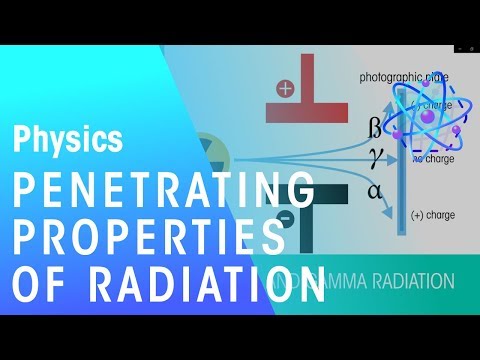
Penetrating Properties of Radiation (FuseSchool). Watch how paper, aluminium and lead absorb alpha, beta and gamma radiation, and how this links to their ionising power.
Practice
Key points
Sources and credits
The three diagrams, the experiment, the worked examples and the practice exercises are written by Ganzaa. This lesson adapts CC BY-SA material and is shared under CC BY-SA 4.0.