Atomic Nuclei and Radioactive Decay
Senior 6 · Physics
Atomic Nuclei and Radioactive Decay
Lesson 2 of 5
25 min
A helium-4 nucleus is two protons and two neutrons. Add up their masses from the table in Lesson 1: . Now measure a helium-4 nucleus in a mass spectrometer: . About 0.030 u, roughly 0.75% of the total, has gone missing. It has not been destroyed. When the four nucleons came together they released energy, and by that energy carried mass away with it. To pull the nucleus apart again you must put the same energy back. This "missing mass" explains why some nuclei are stable and others decay, and why both splitting and fusing nuclei can release energy.
For a nucleus with protons and neutrons, the mass defect is
and the binding energy is the energy equivalent of the mass defect, , or .
Using atomic masses. Data tables list the masses of neutral ATOMS, which include electrons. If you use the mass of a hydrogen-1 atom, (one proton plus one electron), in place of , the electron masses cancel:
(The electrons' own small binding energies, a few eV to keV, are negligible here.)
To compare nuclei of different sizes, divide by the number of nucleons: the binding energy per nucleon is the average energy needed to remove one nucleon. The larger it is, the more tightly bound, and so the more stable, the nucleus.
Definition
The mass defect of a nucleus is the difference between the total mass of its separate nucleons and the mass of the nucleus. The binding energy is the energy needed to separate a nucleus completely into its individual protons and neutrons (equal to the energy released when it forms). Example: helium-4 has and , or 7.07 MeV per nucleon.
Worked example 1: helium-4 from atomic masses
Given , and , find the binding energy and the binding energy per nucleon of .
Solution
, and per nucleon.
The same answer as the opening, where nuclear masses were used: the electrons cancel.
Worked example 2: iron-56 and uranium-238
The atomic masses are and . Compare their binding energies per nucleon.
Solution
Fe-56 (, ): ; ; .
U-238 (, ): ; ; .
Uranium has almost four times the TOTAL binding energy, but each of its nucleons is held about 1.2 MeV less tightly than in iron. Iron is the more stable nucleus.
Figure 2.1: Binding energy per nucleon for a selection of stable and long-lived nuclides (data from the Atomic Mass Evaluation 2020).
Read the graph carefully:
Any change that moves nucleons TOWARDS the peak releases energy. Joining two light nuclei into one (fusion) climbs the left side; splitting a heavy nucleus into two middle-sized ones (fission) climbs the right side. Lesson 5 returns to both.
Nucleons are held together by the strong nuclear force. It is attractive between any two nucleons, much stronger than the electric force at about 1 fm, but it acts only over about 2 to 3 fm. So each nucleon attracts only its near neighbours. In a small nucleus many nucleons sit on the surface with fewer neighbours, so is low. The electric repulsion between protons, however, acts across the whole nucleus: every proton repels every other one. In a heavy nucleus this repulsion grows roughly as and steadily reduces the binding per nucleon. Heavy nuclei therefore need extra neutrons, which add strong-force attraction without adding repulsion.
Worked example 3: estimating the energy of fission from the graph
A uranium-235 nucleus absorbs a neutron and splits into two nuclei of mass number about 117 each. Use Figure 2.1 to estimate the energy released.
Solution
Before: 236 nucleons bound at about 7.6 MeV each. After: 236 nucleons bound at about 8.5 MeV each (read at ). The binding energy increases by about , and this energy is released. So one fission releases roughly 200 MeV, an estimate that agrees with measured values. By comparison, burning one molecule of methane releases about 9 eV: more than twenty million times less.
Figure 2.2: Stable nuclei lie in a narrow band. Unstable nuclei decay in a way that brings them towards it.
For light nuclei the stable ones have (carbon-12, oxygen-16). Heavier stable nuclei need more neutrons: for lead-208, the heaviest stable nuclide. No nucleus with is stable. A nucleus away from the band is radioactive: it decays spontaneously, and the type of decay moves it towards the band, as Lesson 3 shows.
Warning
Common mistakes. (1) Thinking binding energy is energy stored IN the nucleus that it can give out. It is energy that was released when the nucleus formed, and that must be SUPPLIED to take it apart. (2) Mixing atomic masses with the proton mass: use with atomic masses, or with nuclear masses, never a mixture. (3) Judging stability from the total binding energy: compare the binding energy PER NUCLEON. (4) Rounding too early: the mass defect is a small difference of large numbers, so keep all six decimal places until the end.
Tip
On the binding energy curve, uphill is downhill: every nuclear change that moves nucleons UP the curve, towards iron, releases energy. Fusion climbs from the left, fission from the right.
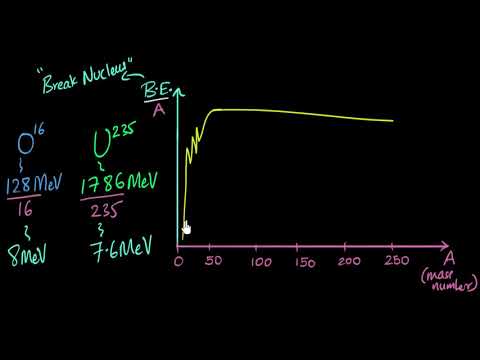
Binding energy graph (Khan Academy India). Watch how the shape of the binding-energy-per-nucleon curve shows why both fusion of light nuclei and fission of heavy nuclei release energy.
Practice
Use , and .
Key points
Sources and credits
The two graphs, the worked examples and the practice exercises are written by Ganzaa.