X-Rays and Laser Radiations
Senior 6 · Physics
X-Rays and Laser Radiations
Lesson 4 of 4
25 min
At an airport, your bag rolls through an X-ray scanner, while at the checkout a red laser reads the barcode on a bottle of water. Both are electromagnetic radiation made by electrons in atoms, but they do completely different jobs, and they are dangerous in completely different ways. X-rays are used because they pass THROUGH things; laser light because it can be aimed and focused with great precision. This lesson surveys the uses of each, explains the dangers and the safety rules that follow from the physics of Lessons 1 to 3, and ends by comparing the two.

Every use depends on one property from Lesson 1: X-rays penetrate matter, and are absorbed more strongly by materials of higher atomic number and density.
Figure 4.1: Forming a shadow image (radiograph).
| Field | Use | Physics |
|---|---|---|
| medicine | radiographs of bones, teeth and chests; CT scans (Unit 8) | bone (calcium) absorbs more than soft tissue; contrast agents containing iodine or barium make blood vessels or the gut visible |
| medicine | radiotherapy for cancer | high-energy X-rays from a linear accelerator damage tumour cells, aimed from several directions to spare healthy tissue |
| security | baggage and cargo scanners | metals and dense materials show as dark shadows |
| industry | checking welds, pipes and castings for cracks | a crack absorbs less, so it shows up on the image |
| science | X-ray crystallography | diffraction () reveals the arrangement of atoms in crystals, proteins and medicines |
| astronomy | X-ray telescopes in space | the atmosphere absorbs X-rays, so the telescopes must orbit above it |
X-rays are ionising: each photon carries enough energy to break chemical bonds, including those in DNA. The World Health Organization (fact sheet "Ionizing radiation and health effects", 2023) describes two kinds of harm:
A single medical radiograph gives a very small dose, and its benefit usually far outweighs the risk. The international Basic Safety Standards, which the WHO co-sponsors, set the rules: every exposure must be justified (it must do more good than harm) and optimised (the dose kept as low as reasonably achievable while still giving the information needed). In practice:
Worked example 1: distance protects the radiographer
The X-rays scattered from a patient spread out from a small region, roughly like a point source. A radiographer who stood 0.50 m from the patient moves to 2.0 m away during the exposure. By what factor is her exposure reduced, and what assumption is made?
Solution
For a point source, intensity (Unit 5). The factor is : her exposure falls to one sixteenth.
Assumption: the scattered radiation behaves like a point source and is not absorbed or reflected on the way. In practice she also stands behind a lead screen, which reduces it much further.
Lasers are used because their light is monochromatic, coherent, directional and intense (Lesson 3).
| Field | Use | Property used |
|---|---|---|
| medicine | reshaping the cornea to correct eyesight (with ultraviolet lasers, 193 nm); sealing the retina; removing tumours, tattoos and birthmarks; dentistry | intensity focused precisely; the wavelength is chosen to be absorbed by the target tissue |
| communications | sending internet and telephone signals along optical fibres as pulses of infrared light (about 1310 nm and 1550 nm) | a narrow, monochromatic beam that enters a thin fibre and spreads little in time |
| industry | cutting, welding and engraving metal, cloth and wood | high intensity at a tiny focal spot |
| everyday technology | barcode scanners, laser printers, optical discs (CD 780 nm, DVD 650 nm, Blu-ray 405 nm) | a beam focused to a spot about the size of its wavelength: a shorter wavelength reads smaller pits, so more data fits on a disc |
| measurement | surveying and range-finding, LIDAR, measuring the distance to the Moon | directional beam; timing a pulse's round trip |
| science | holography, spectroscopy, detecting gravitational waves (LIGO, 2015) | coherence and a precisely known wavelength |

Worked example 2: timing a laser pulse to the Moon
Laser pulses fired from Earth bounce off reflectors left on the Moon by the Apollo astronauts. A pulse returns 2.56 s after it was sent. (a) Find the distance to the Moon. (b) The return is timed to s. What uncertainty in distance does this give?
Solution
(a) The light travels there and back: , about 384 000 km.
(b) , about 1.5 mm. Only a laser's narrow beam can deliver enough photons to the reflectors, and back, for such a measurement.

Worked example 3: why a laser can cut steel
A 2.0 kW carbon dioxide laser is focused to a spot 0.20 mm in diameter. Find the intensity at the spot and compare it with sunlight (about ).
Solution
, about 60 million times the intensity of sunlight. Delivered onto a tiny area, this heats the metal past its melting point in milliseconds, while the material a millimetre away stays fairly cool.
Ordinary laser light is non-ionising: a visible photon carries only about 2 to 3 eV. Its danger is the concentration of energy. The greatest risk is to the eye.
Figure 4.2: The eye's own lens makes a laser beam dangerous.
Lasers are sold in safety classes (international standard IEC 60825-1). The main classes are shown, simplified, for a continuous visible beam; the standard also has classes 1M and 2M for beams that are hazardous only through magnifying optics:
| Class | Typical power (visible beam) | Hazard |
|---|---|---|
| 1 | very low, or fully enclosed (as in a laser printer) | safe in normal use |
| 2 | under 1 mW | safe for a brief accidental glance, because the eye's natural aversion response (blinking, turning away) limits it; never stare into the beam |
| 3R | up to 5 mW | low risk, but do not look into the beam |
| 3B | up to 500 mW | the direct beam or a mirror reflection can injure the eye |
| 4 | above 500 mW | eye and skin injury, even from scattered light; fire risk |
Safety rules: never look into a beam or point it at anyone; keep beams below eye level; wear goggles made for the laser's specific wavelength when using Class 3B and 4 lasers; and never aim any laser at an aircraft or a vehicle, because even a small pointer can dazzle a pilot or driver at a critical moment.
| Feature | X-rays (from a tube) | Laser light |
|---|---|---|
| nature | electromagnetic waves | electromagnetic waves |
| typical wavelength | 0.01 nm to 10 nm | about 200 nm (ultraviolet) to 10 μm (infrared) |
| photon energy | about 100 eV to 100 keV: ionising | about 0.1 eV to 6 eV: non-ionising |
| how produced | fast electrons decelerated by nuclei, or falling into inner-shell vacancies | stimulated emission between outer energy levels, with a population inversion |
| spectrum | continuous, plus characteristic lines | one very narrow line |
| coherence | incoherent | coherent |
| beam | spreads out; shaped by lead collimators | narrow, parallel, easily focused |
| main hazard | ionisation of cells: cancer risk, burns at high doses | heating: eye and skin burns |
| protection | justification, short time, distance, lead shielding | never look into the beam, safety class, goggles for the wavelength |
The two worlds meet in the X-ray free-electron laser, in which electrons from a linear accelerator are made to emit coherent X-ray pulses so short and bright that they can photograph molecules in motion.
Warning
Common mistakes. (1) Saying laser light is dangerous because it is "radiation" like X-rays: visible laser light is non-ionising; its danger is concentrated heating. (2) Thinking X-rays make a person or object radioactive: they do not; the exposure stops when the beam is switched off. (3) Thinking a reflection of a powerful laser is safe: reflected, and for Class 4 even scattered, light can injure. (4) Saying a lead apron makes an X-ray examination risk-free: it shields other organs, but the examination must still be justified.
Tip
To decide which tool a job needs, ask: "Through, or onto?" To see THROUGH something, use X-rays (they penetrate). To act ONTO a precise point, or to carry a signal far, use a laser (it is directional and focusable).
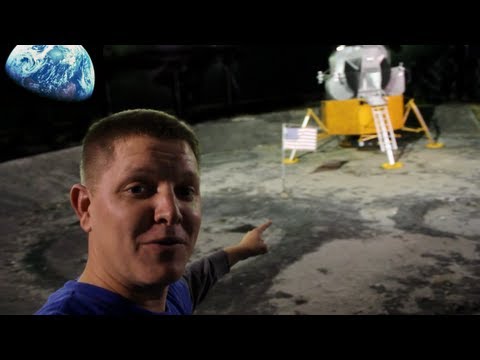
Why Astronauts left a reflector on the Moon! (Smarter Every Day, with MinutePhysics). Watch how laser pulses are fired at the Apollo reflectors and timed on their return to measure the distance to the Moon.
Practice
Key points
Further reading
Sources and credits
The two diagrams, the worked examples and the practice exercises are written by Ganzaa. This lesson adapts CC BY-SA material and is shared under CC BY-SA 4.0.